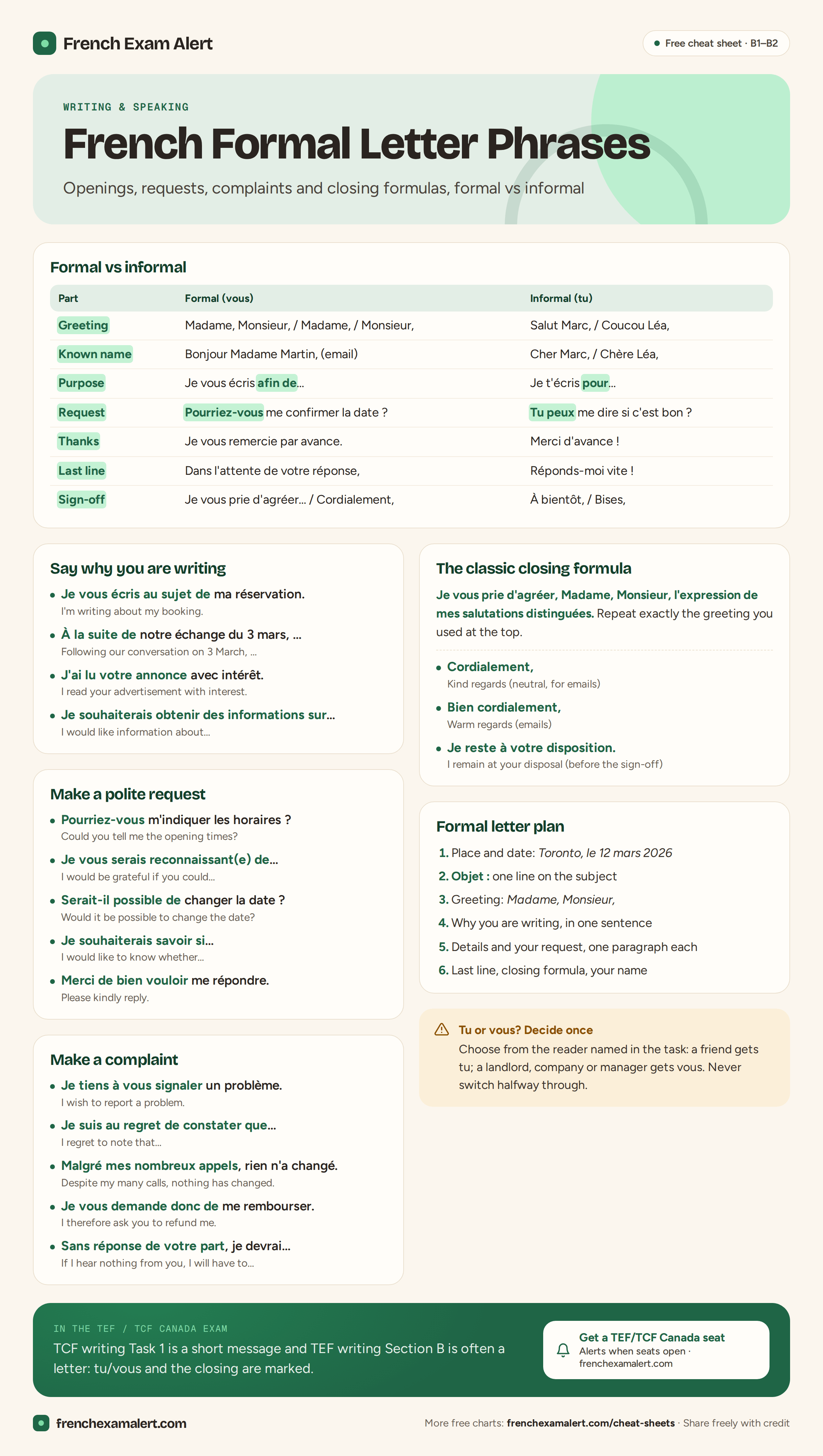
French Formal Letter Phrases
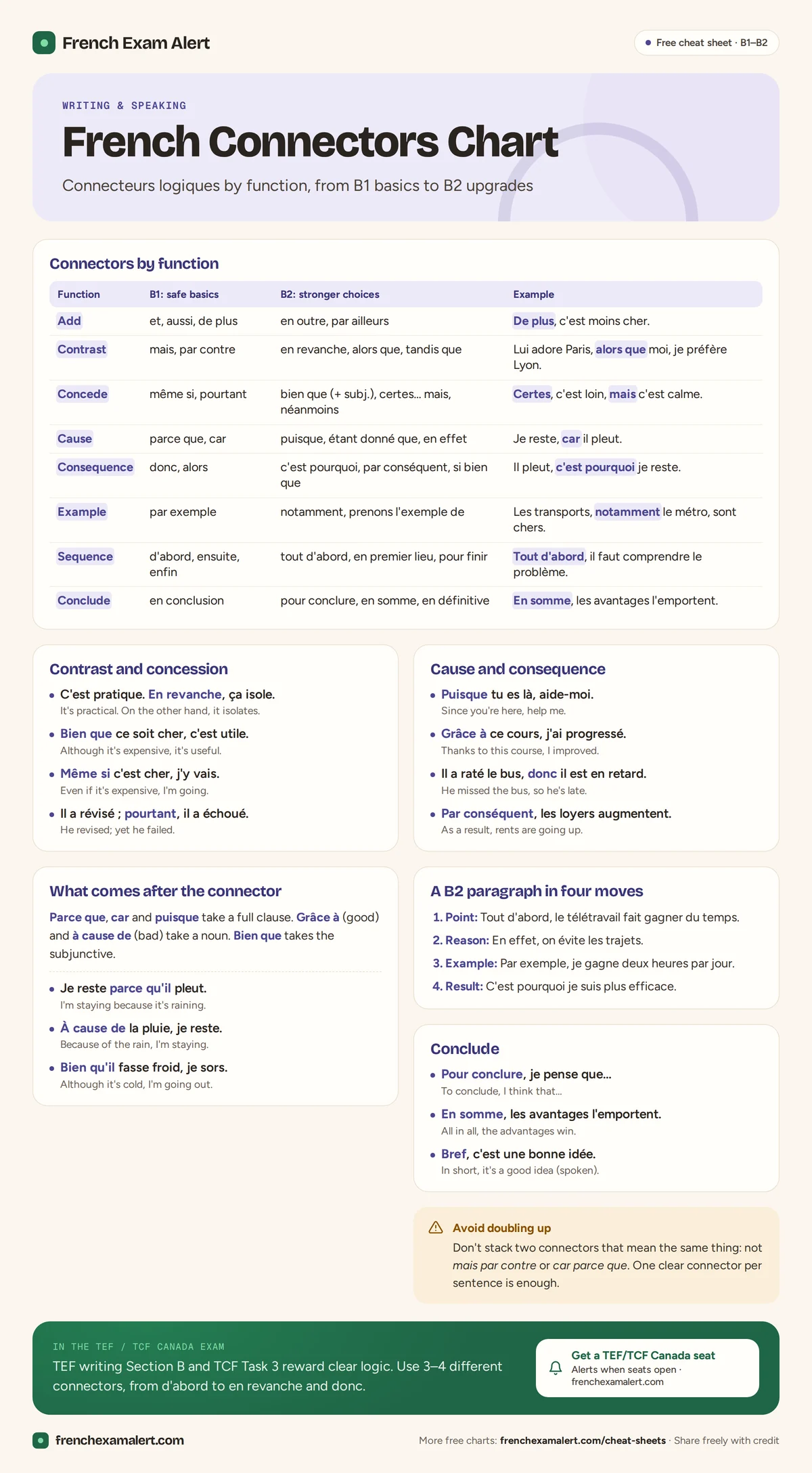
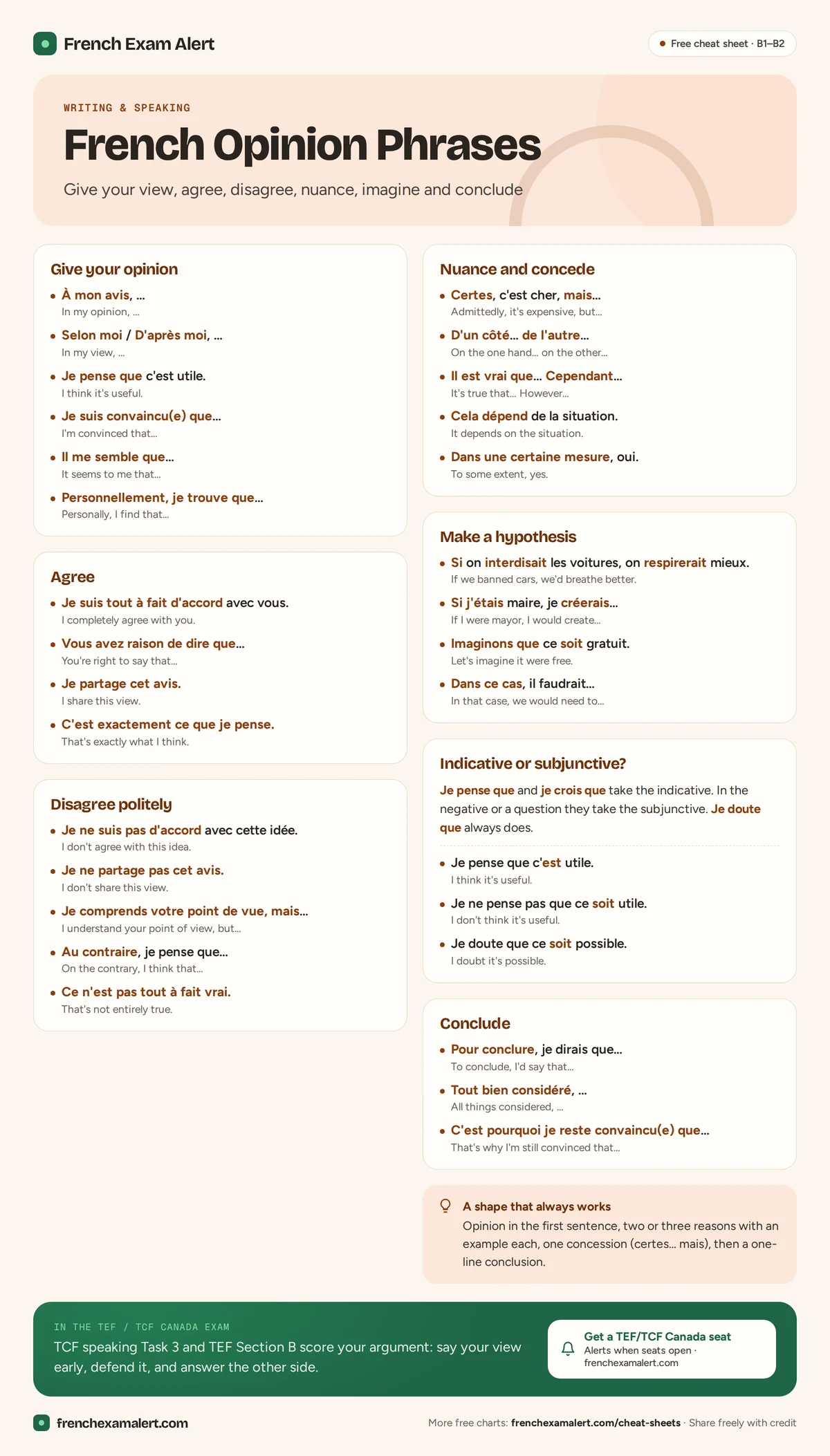
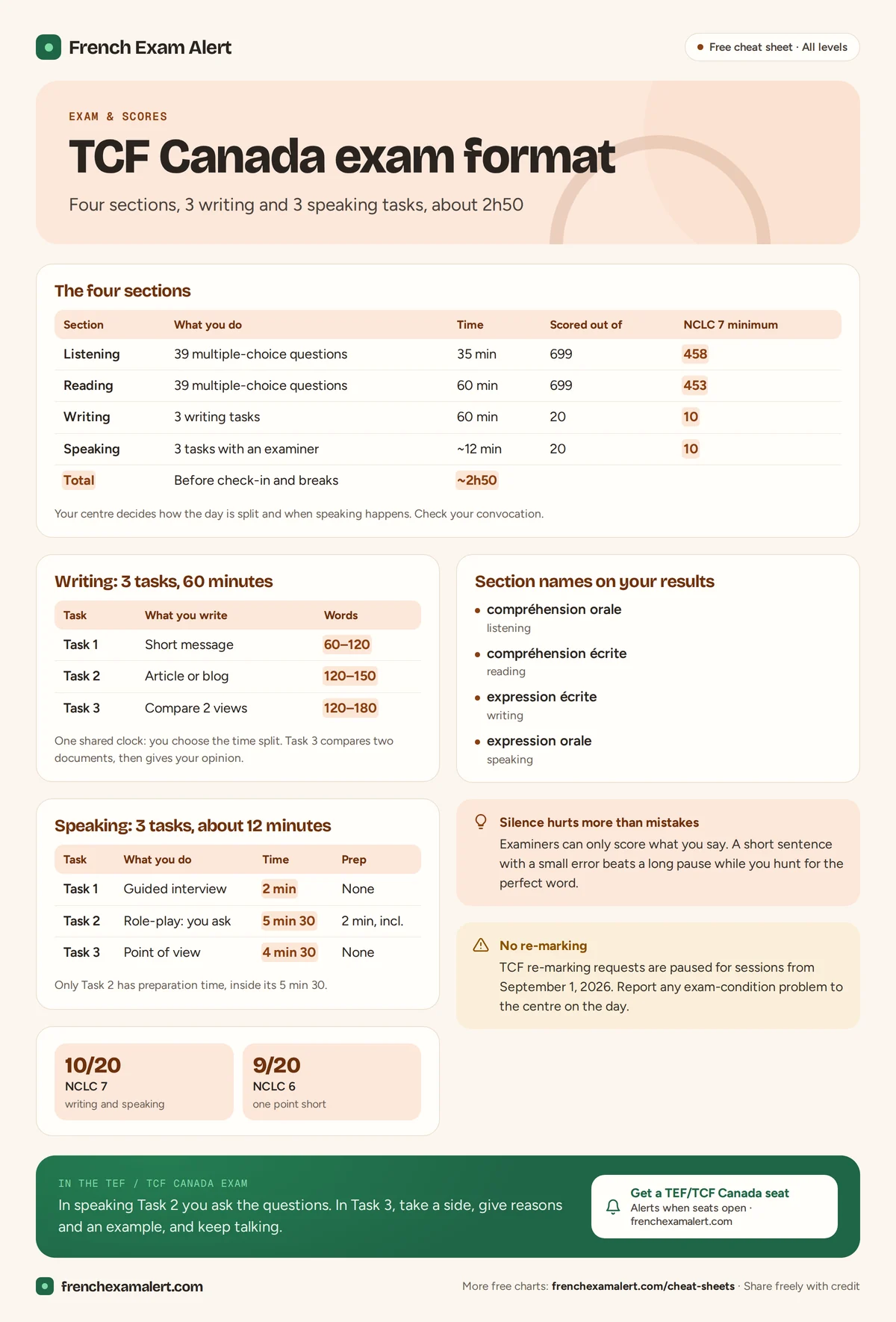
A formal French letter or email opens with Madame, Monsieur, says why you are writing in the first sentence (je vous écris au sujet de…), makes the request politely with the conditional, and ends with a closing formula such as Je vous prie d'agréer, Madame, Monsieur, l'expression de mes salutations distinguées. In an email, Cordialement is enough. Use vous from start to finish.
Free to print and share with credit to French Exam Alert (licence). 2400×4244px.
In the TEF / TCF Canada exam
TCF writing Task 1 is a short message and TEF writing Section B is often a letter: tu/vous and the closing are marked.
French Formal Letter Phrases: the full chart as text
Formal vs informal
| Part | Formal (vous) | Informal (tu) |
|---|---|---|
| Greeting | Madame, Monsieur, / Madame, / Monsieur, | Salut Marc, / Coucou Léa, |
| Known name | Bonjour Madame Martin, (email) | Cher Marc, / Chère Léa, |
| Purpose | Je vous écris afin de… | Je t'écris pour… |
| Request | Pourriez-vous me confirmer la date ? | Tu peux me dire si c'est bon ? |
| Thanks | Je vous remercie par avance. | Merci d'avance ! |
| Last line | Dans l'attente de votre réponse, | Réponds-moi vite ! |
| Sign-off | Je vous prie d'agréer… / Cordialement, | À bientôt, / Bises, |
Say why you are writing
- Je vous écris au sujet de ma réservation.I'm writing about my booking.
- À la suite de notre échange du 3 mars, …Following our conversation on 3 March, …
- J'ai lu votre annonce avec intérêt.I read your advertisement with interest.
- Je souhaiterais obtenir des informations sur…I would like information about…
Make a polite request
- Pourriez-vous m'indiquer les horaires ?Could you tell me the opening times?
- Je vous serais reconnaissant(e) de…I would be grateful if you could…
- Serait-il possible de changer la date ?Would it be possible to change the date?
- Je souhaiterais savoir si…I would like to know whether…
- Merci de bien vouloir me répondre.Please kindly reply.
Make a complaint
- Je tiens à vous signaler un problème.I wish to report a problem.
- Je suis au regret de constater que…I regret to note that…
- Malgré mes nombreux appels, rien n'a changé.Despite my many calls, nothing has changed.
- Je vous demande donc de me rembourser.I therefore ask you to refund me.
- Sans réponse de votre part, je devrai…If I hear nothing from you, I will have to…
The classic closing formula
Je vous prie d'agréer, Madame, Monsieur, l'expression de mes salutations distinguées. Repeat exactly the greeting you used at the top.
- Cordialement,Kind regards (neutral, for emails)
- Bien cordialement,Warm regards (emails)
- Je reste à votre disposition.I remain at your disposal (before the sign-off)
Formal letter plan
- Place and date: Toronto, le 12 mars 2026
- Objet : one line on the subject
- Greeting: Madame, Monsieur,
- Why you are writing, in one sentence
- Details and your request, one paragraph each
- Last line, closing formula, your name
Go deeper
 Free PDF · 28 pagesTEF & TCF Canada Writing Templates (Expression écrite)Fill-in templates, phrase banks and counted model answers for all five writing tasks Guide · 9 min readTCF Canada writing: the 3 tasks, word counts and model answersThree tasks, one clock, and a 10/20 that decides your CRS bonus
Preparing for TEF or TCF Canada?
Seats at many centres sell out within minutes. Pick your cities and we alert you by email or WhatsApp the moment one opens.
Questions
The classic formula is Je vous prie d'agréer, Madame, Monsieur, l'expression de mes salutations distinguées, repeating the greeting you used at the top. In a formal email, Cordialement or Bien cordialement is standard and perfectly polite.
Write Madame, Monsieur, on its own line, followed by a comma. If you know the person is a woman or a man, use Madame, or Monsieur, alone. Don't add the surname after Madame or Monsieur in a traditional letter.
Follow the reader named in the task. A friend, family member or close colleague gets tu; a neighbour you don't know well, a company or an official gets vous. Whatever you choose, stay consistent to the end.