TEF & TCF Canada Writing Templates (Expression écrite)
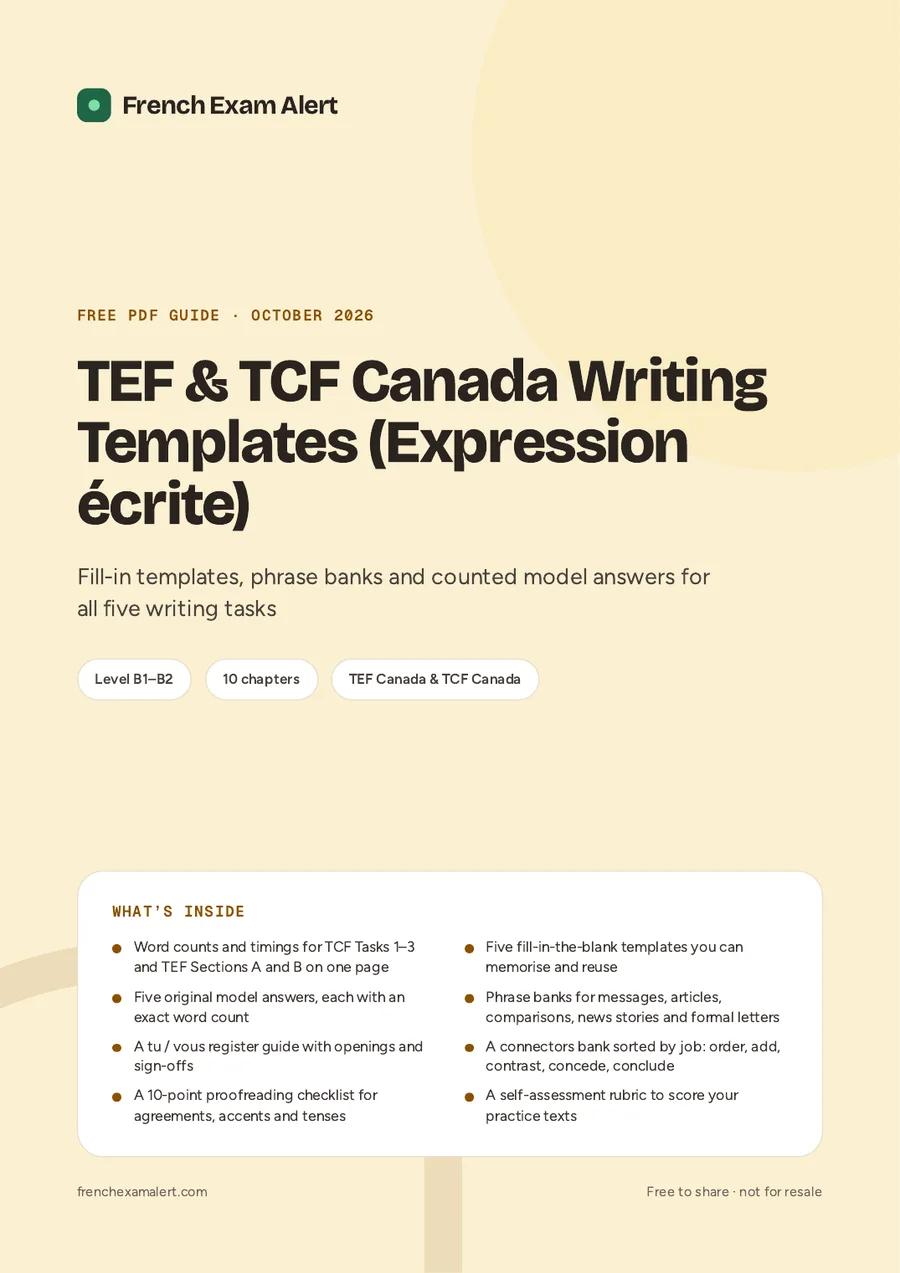
Fill-in templates, phrase banks and counted model answers for all five writing tasks
This PDF gives you a fill-in template for every TEF Canada and TCF Canada writing task, with the real word counts and timings. Each task comes with a phrase bank, an original model answer with an exact word count, and the mistakes that cost the most marks. It ends with a connectors bank, a 10-point proofreading checklist and a self-assessment rubric.
What’s inside
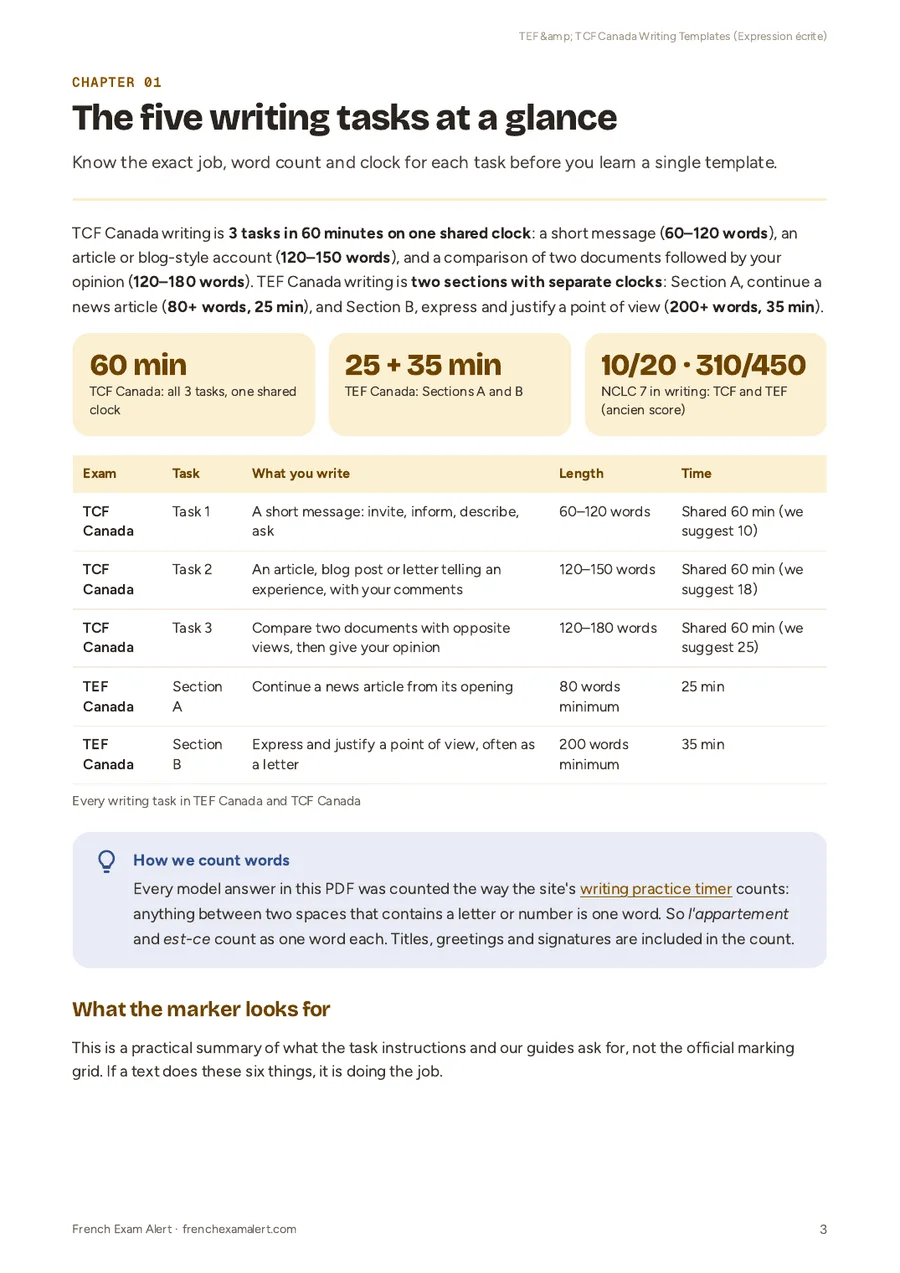
- Word counts and timings for TCF Tasks 1–3 and TEF Sections A and B on one page
- Five fill-in-the-blank templates you can memorise and reuse
- Five original model answers, each with an exact word count
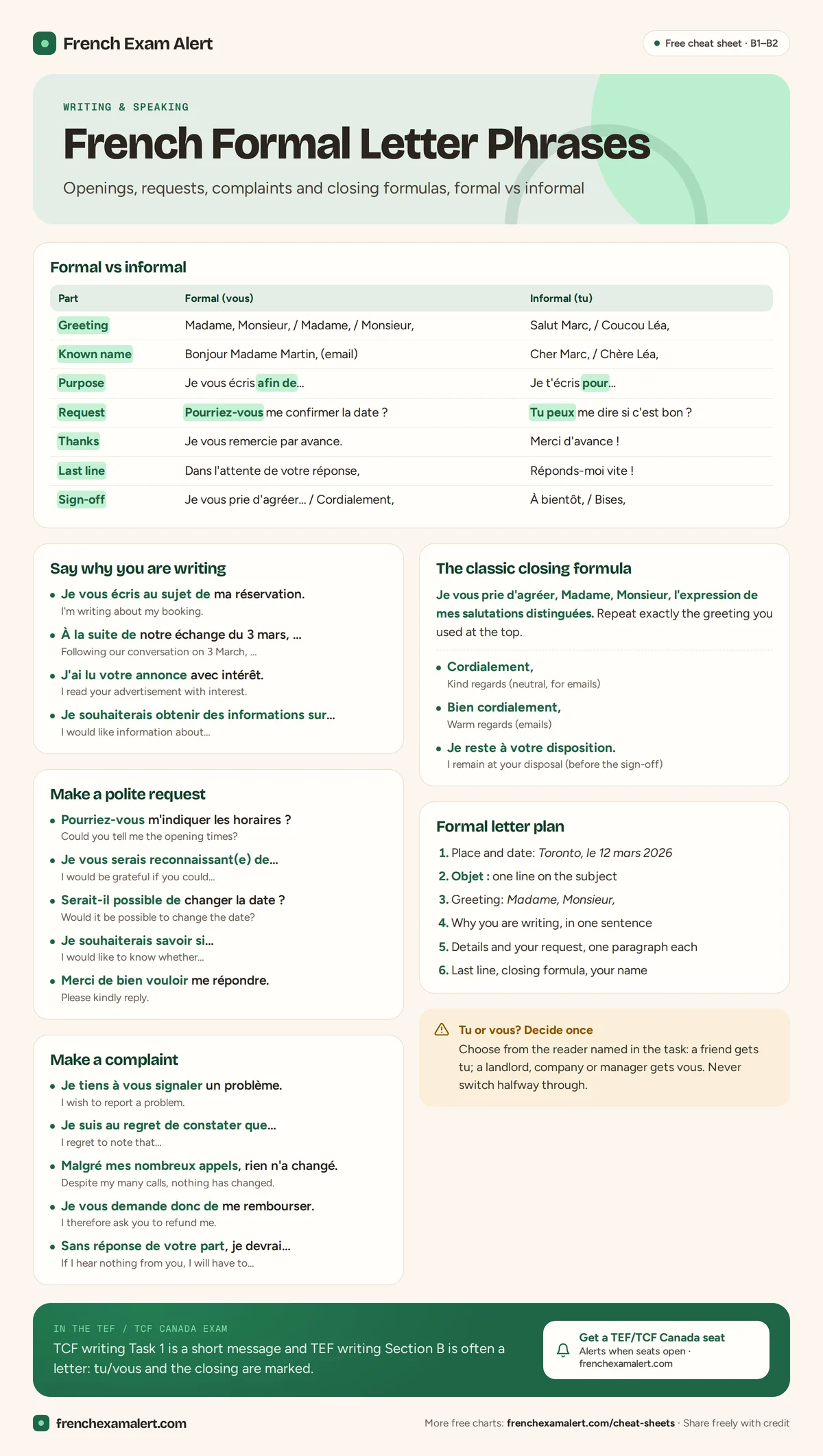
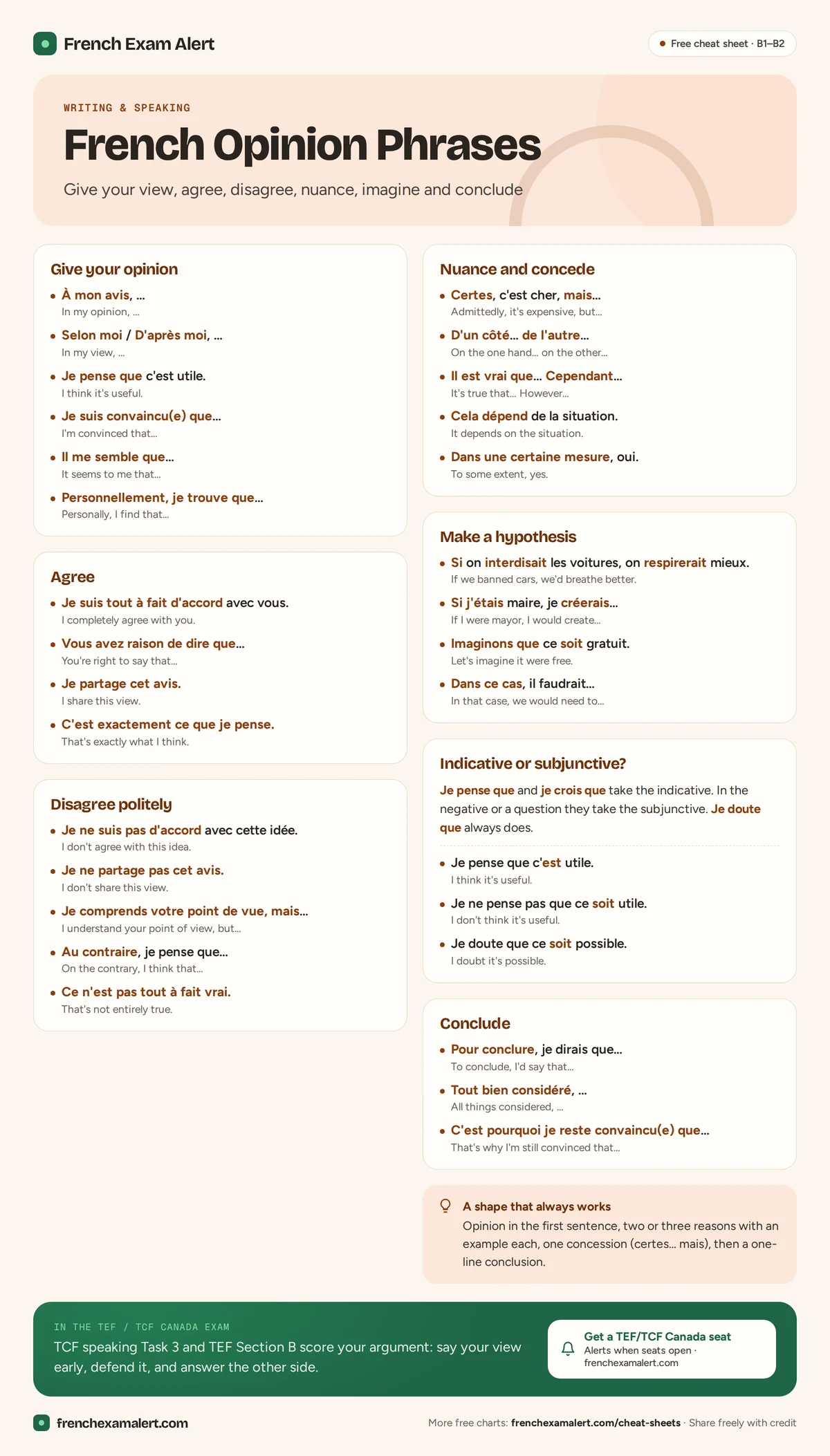
- Phrase banks for messages, articles, comparisons, news stories and formal letters
- A tu / vous register guide with openings and sign-offs
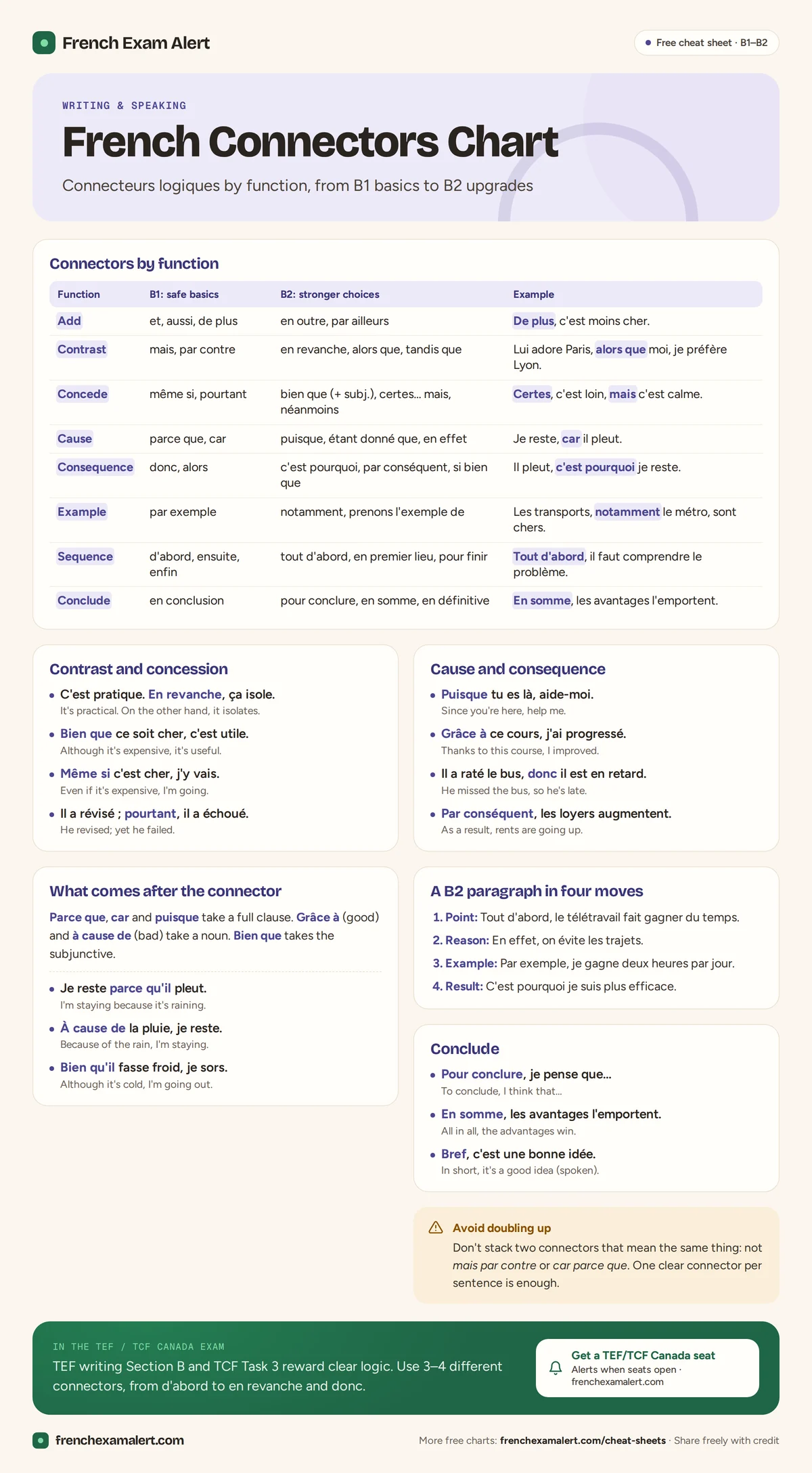
- A connectors bank sorted by job: order, add, contrast, concede, conclude
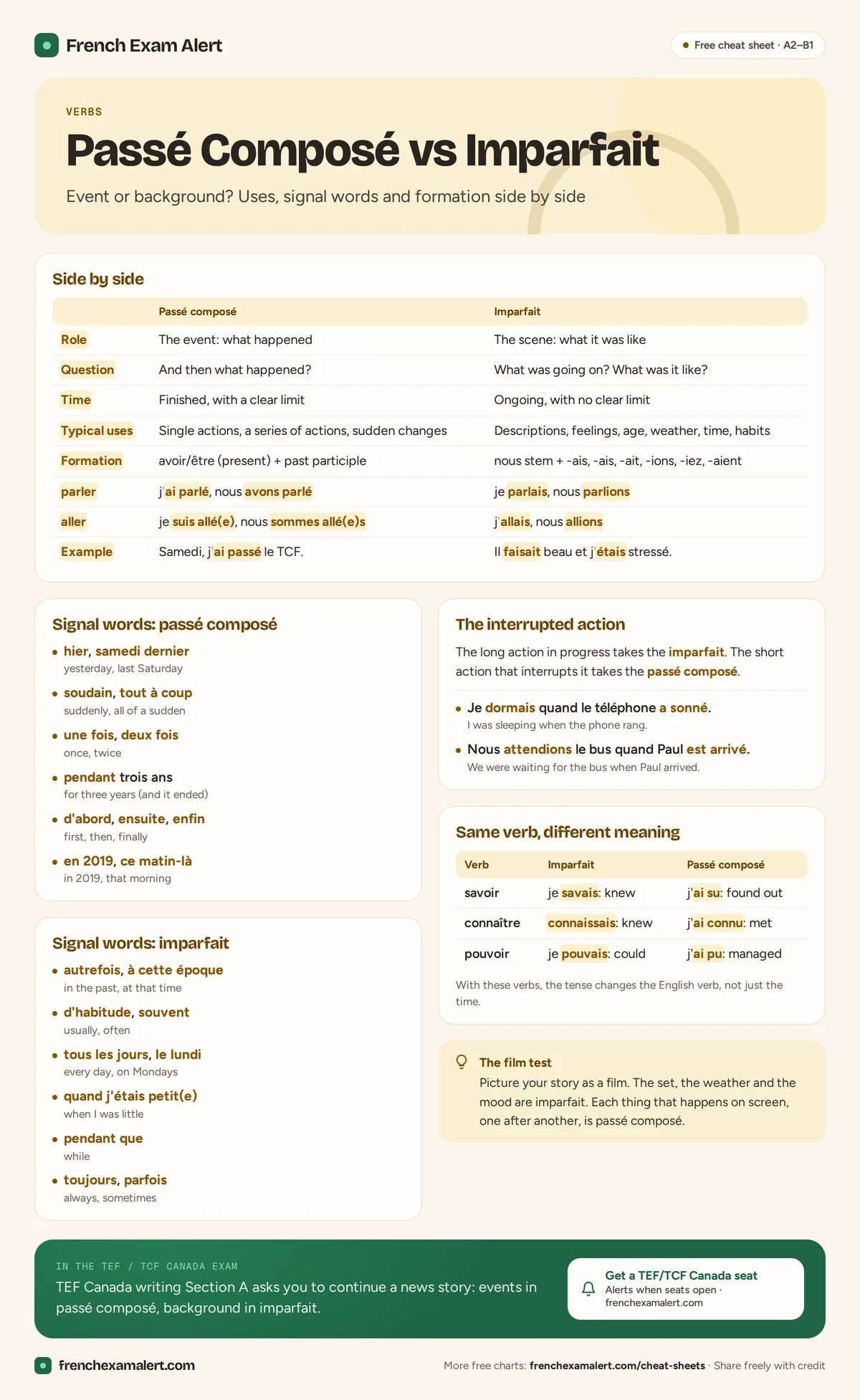
- A 10-point proofreading checklist for agreements, accents and tenses
- A self-assessment rubric to score your practice texts
Who it’s for: Anyone sitting TEF Canada or TCF Canada writing who wants a ready structure for every task and is aiming for NCLC 7.
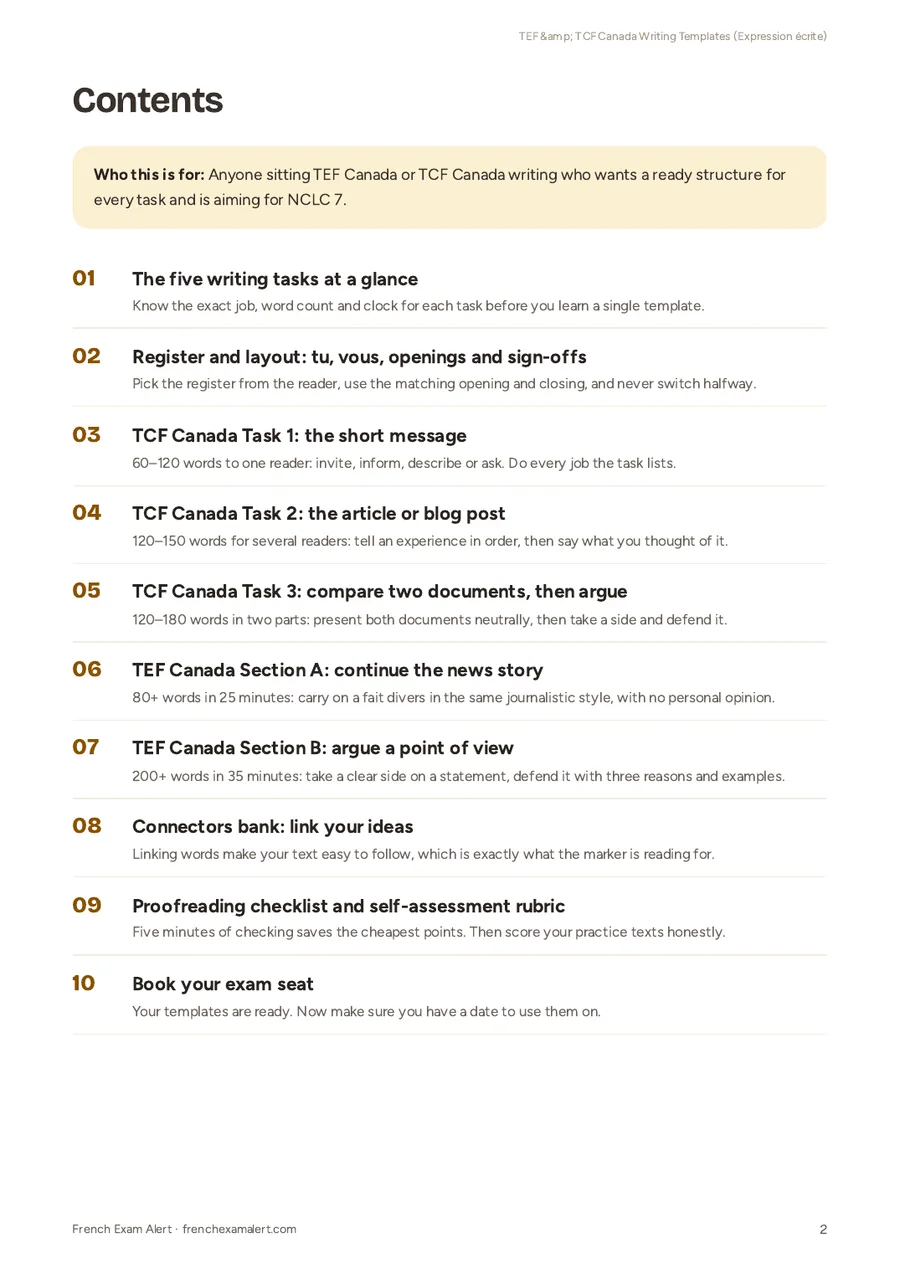
Contents
- 01The five writing tasks at a glanceKnow the exact job, word count and clock for each task before you learn a single template.
- 02Register and layout: tu, vous, openings and sign-offsPick the register from the reader, use the matching opening and closing, and never switch halfway.
- 03TCF Canada Task 1: the short message60–120 words to one reader: invite, inform, describe or ask. Do every job the task lists.
- 04TCF Canada Task 2: the article or blog post120–150 words for several readers: tell an experience in order, then say what you thought of it.
- 05TCF Canada Task 3: compare two documents, then argue120–180 words in two parts: present both documents neutrally, then take a side and defend it.
- 06TEF Canada Section A: continue the news story80+ words in 25 minutes: carry on a fait divers in the same journalistic style, with no personal opinion.
- 07TEF Canada Section B: argue a point of view200+ words in 35 minutes: take a clear side on a statement, defend it with three reasons and examples.
- 08Connectors bank: link your ideasLinking words make your text easy to follow, which is exactly what the marker is reading for.
- 09Proofreading checklist and self-assessment rubricFive minutes of checking saves the cheapest points. Then score your practice texts honestly.
- 10Book your exam seatYour templates are ready. Now make sure you have a date to use them on.
Look inside
Got your exam date yet?
TEF and TCF Canada seats at many centres sell out within minutes. Pick your cities and we alert you by email or WhatsApp the moment one opens.
Questions
Yes, as a skeleton. Memorise the structure, the openings, the connectors and the closing formulas, then fill them with content that answers the exact task. A text that ignores the task because it was prepared in advance loses marks.
Task 3 asks for 120–180 words. Aim for about 150–170: around 40–60 words comparing the two documents, then 80–120 words for your own opinion.
At least 200 words in 35 minutes. Aiming for 220–260 words gives you a safe margin without eating into your proofreading time.
Choose from the reader in the task: tu for a friend or family member, vous for a stranger, an organisation or several readers. Then keep it the same all the way through, including the sign-off.
One-page cheat sheets to go with it
Related guides
TCF Canada writing: the 3 tasks, word counts and model answers
Three tasks, one clock, and a 10/20 that decides your CRS bonus
Read the guide →TEF Canada writing and speaking: Sections A and B explained
200 words in 35 minutes, then 10 minutes to change a mind
Read the guide →TCF Canada exam format: every section, timing and score explained
Why one point out of 20 can cost you 50 CRS points
Read the guide →More free PDFs
All PDF guides →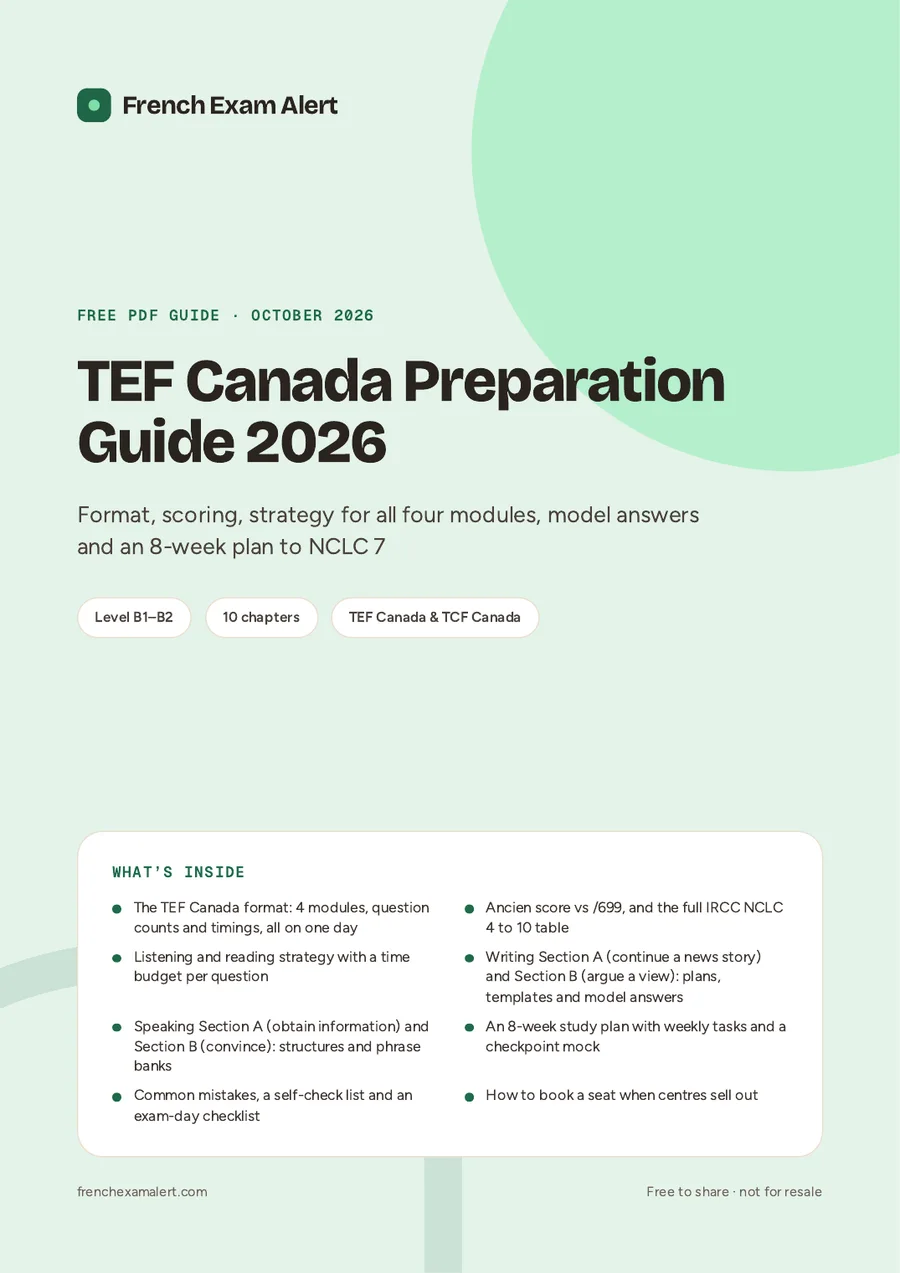 Free PDF · 26 pagesTEF Canada Preparation Guide 2026Format, scoring, strategy for all four modules, model answers and an 8-week plan to NCLC 7
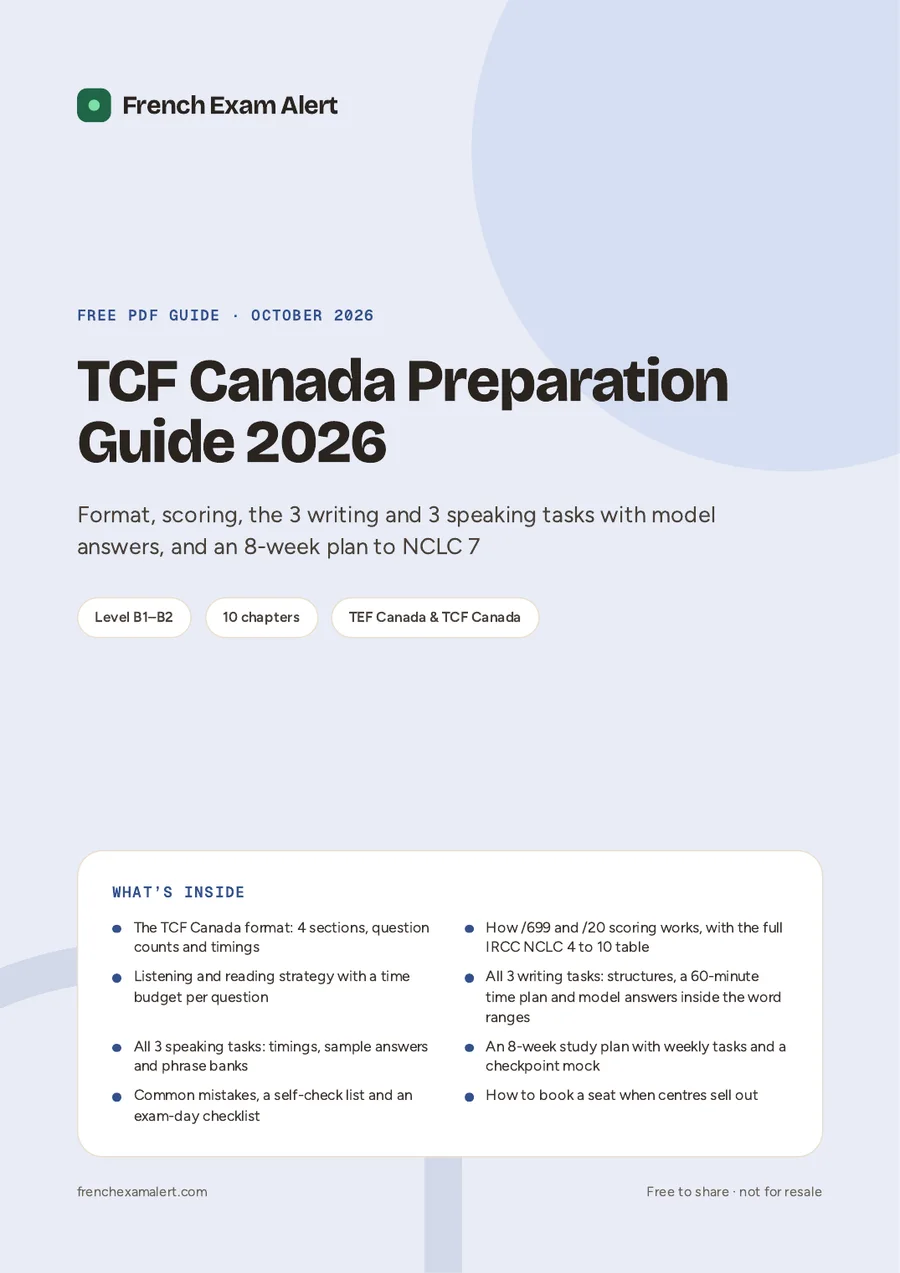 Free PDF · 24 pagesTCF Canada Preparation Guide 2026Format, scoring, the 3 writing and 3 speaking tasks with model answers, and an 8-week plan to NCLC 7
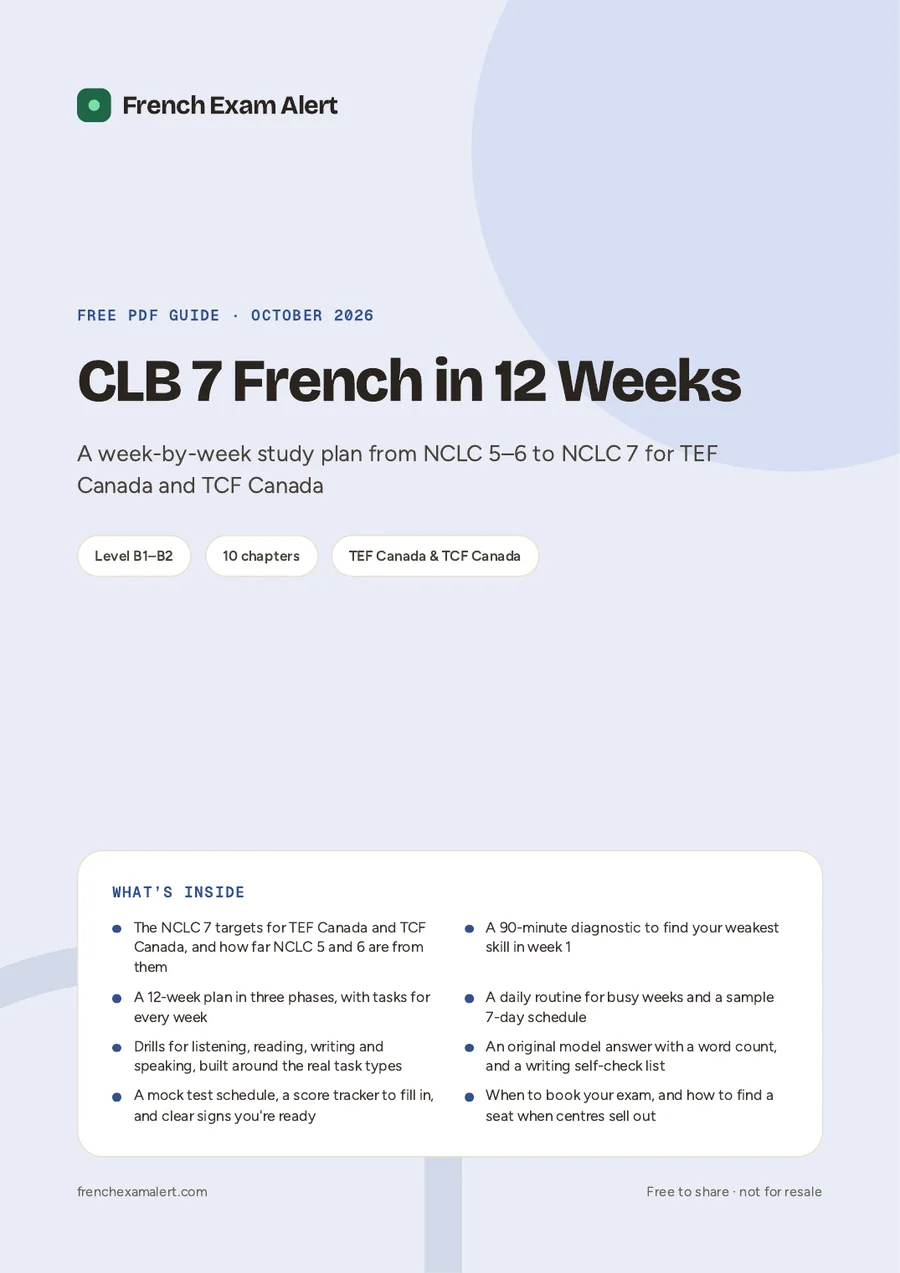 Free PDF · 26 pagesCLB 7 French in 12 WeeksA week-by-week study plan from NCLC 5–6 to NCLC 7 for TEF Canada and TCF Canada
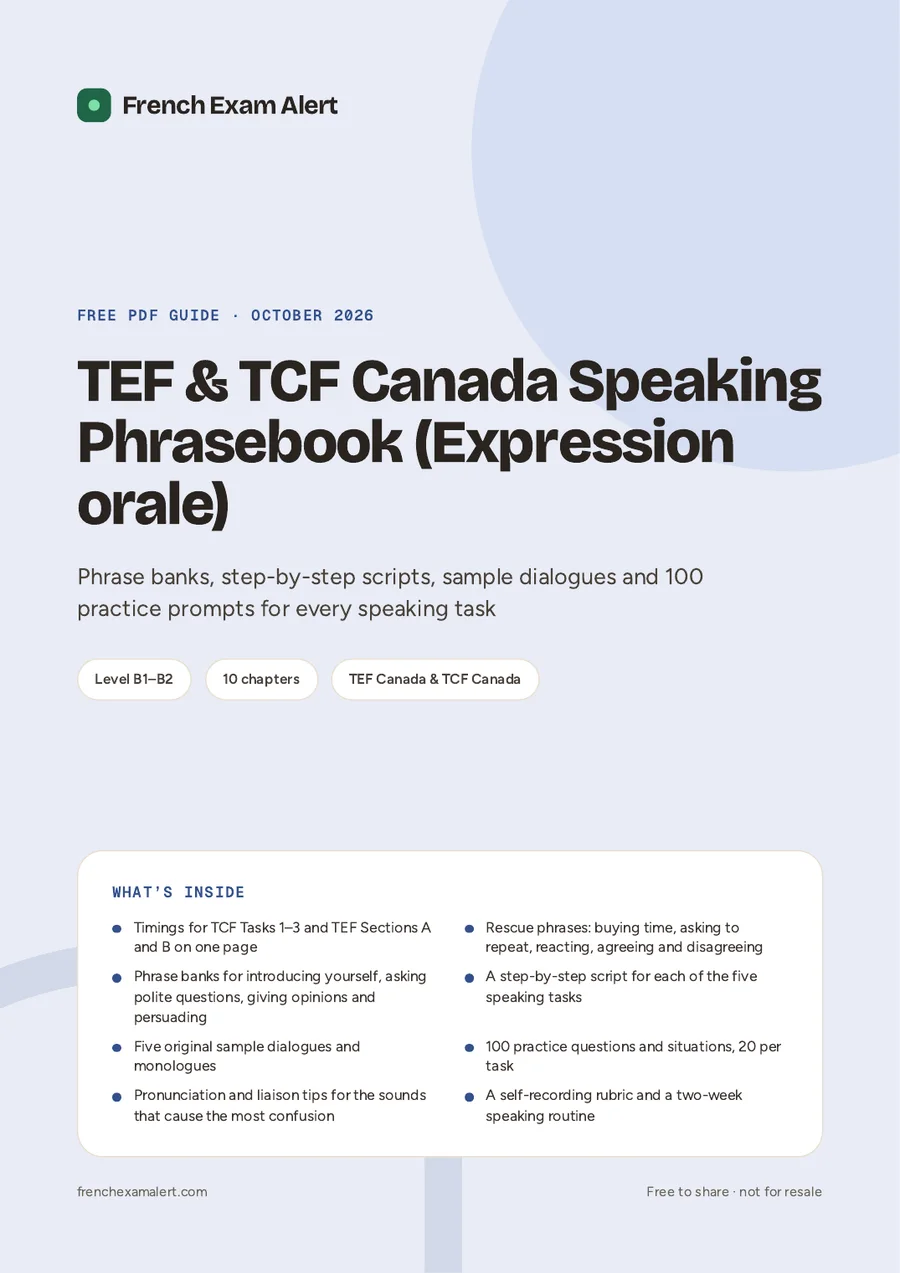 Free PDF · 29 pagesTEF & TCF Canada Speaking Phrasebook (Expression orale)Phrase banks, step-by-step scripts, sample dialogues and 100 practice prompts for every speaking task