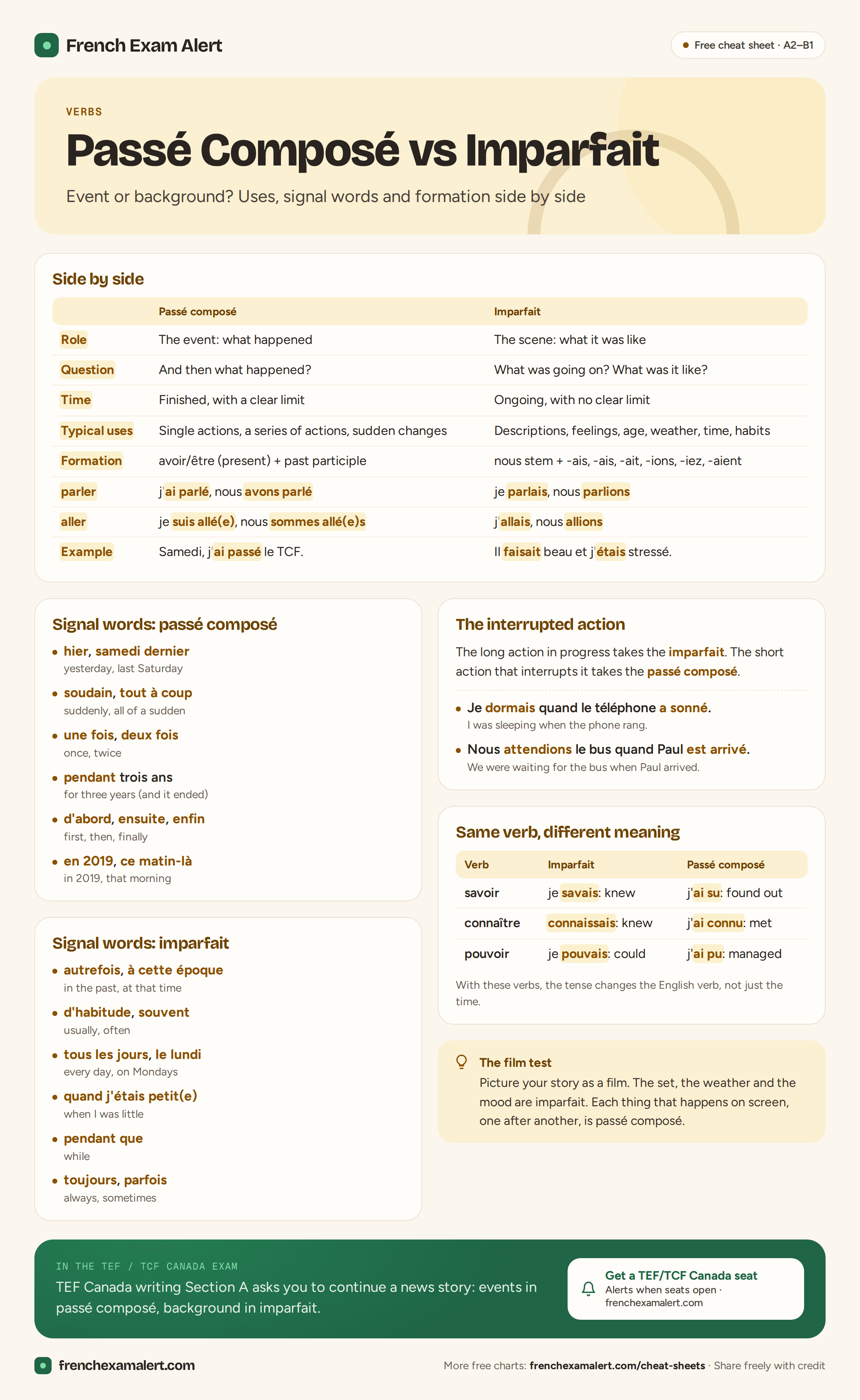
Passé Composé vs Imparfait
Use the passé composé for finished events that move a story forward, and the imparfait for background, descriptions and past habits. Ask yourself: what happened? (passé composé) or what was it like, what was going on? (imparfait). Most past stories need both, often in the same sentence.
Free to print and share with credit to French Exam Alert (licence). 2400×3908px.
In the TEF / TCF Canada exam
TEF Canada writing Section A asks you to continue a news story: events in passé composé, background in imparfait.
Passé Composé vs Imparfait: the full chart as text
Side by side
| Passé composé | Imparfait | |
|---|---|---|
| Role | The event: what happened | The scene: what it was like |
| Question | And then what happened? | What was going on? What was it like? |
| Time | Finished, with a clear limit | Ongoing, with no clear limit |
| Typical uses | Single actions, a series of actions, sudden changes | Descriptions, feelings, age, weather, time, habits |
| Formation | avoir/être (present) + past participle | nous stem + -ais, -ais, -ait, -ions, -iez, -aient |
| parler | j'ai parlé, nous avons parlé | je parlais, nous parlions |
| aller | je suis allé(e), nous sommes allé(e)s | j'allais, nous allions |
| Example | Samedi, j'ai passé le TCF. | Il faisait beau et j'étais stressé. |
Signal words: passé composé
- hier, samedi dernieryesterday, last Saturday
- soudain, tout à coupsuddenly, all of a sudden
- une fois, deux foisonce, twice
- pendant trois ansfor three years (and it ended)
- d'abord, ensuite, enfinfirst, then, finally
- en 2019, ce matin-làin 2019, that morning
Signal words: imparfait
- autrefois, à cette époquein the past, at that time
- d'habitude, souventusually, often
- tous les jours, le lundievery day, on Mondays
- quand j'étais petit(e)when I was little
- pendant quewhile
- toujours, parfoisalways, sometimes
The interrupted action
The long action in progress takes the imparfait. The short action that interrupts it takes the passé composé.
- Je dormais quand le téléphone a sonné.I was sleeping when the phone rang.
- Nous attendions le bus quand Paul est arrivé.We were waiting for the bus when Paul arrived.
Same verb, different meaning
| Verb | Imparfait | Passé composé |
|---|---|---|
| savoir | je savais: knew | j'ai su: found out |
| connaître | connaissais: knew | j'ai connu: met |
| pouvoir | je pouvais: could | j'ai pu: managed |
With these verbs, the tense changes the English verb, not just the time.
Go deeper
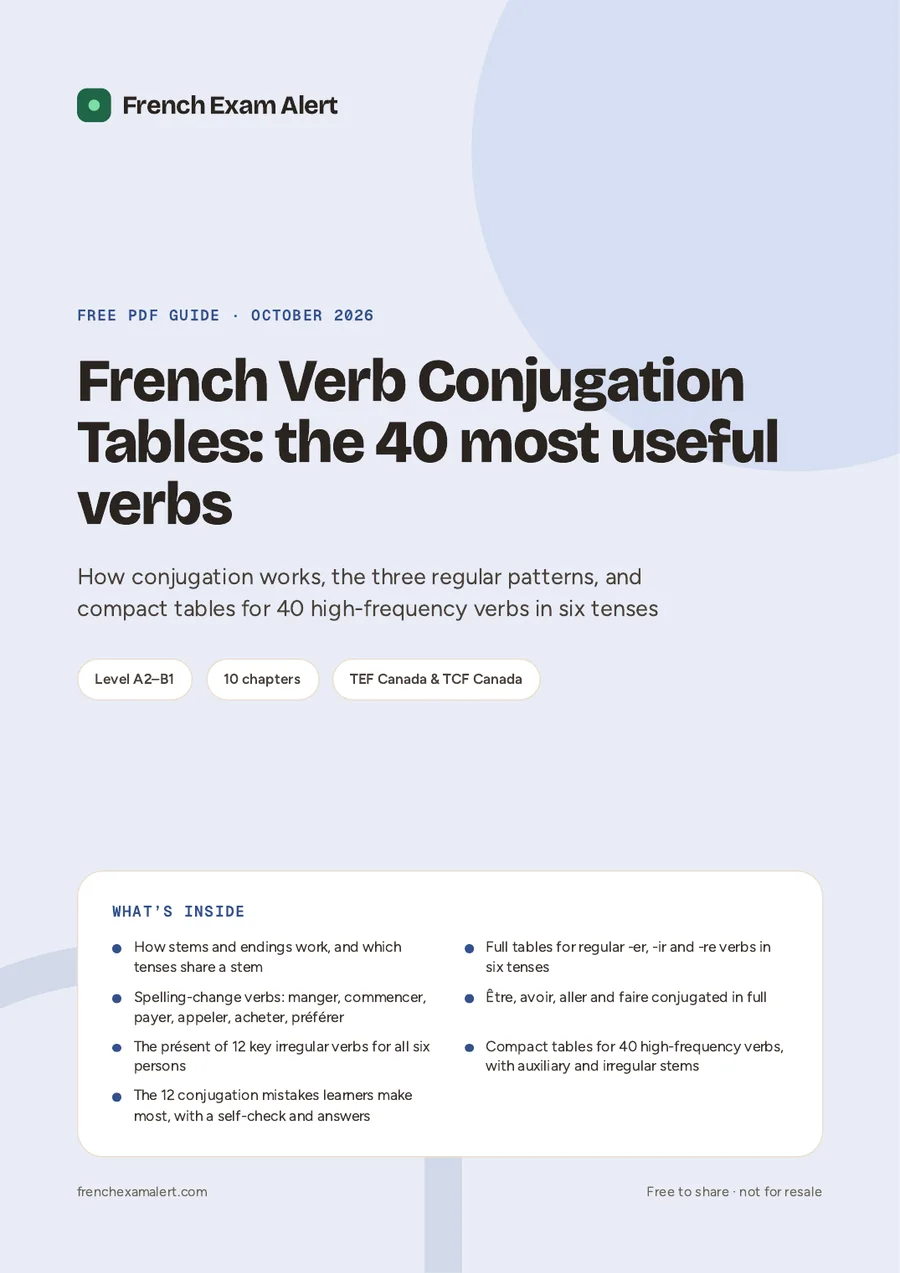 Free PDF · 23 pagesFrench Verb Conjugation Tables: the 40 most useful verbsHow conjugation works, the three regular patterns, and compact tables for 40 high-frequency verbs in six tenses Guide · 9 min readTEF Canada writing and speaking: Sections A and B explained200 words in 35 minutes, then 10 minutes to change a mind
Preparing for TEF or TCF Canada?
Seats at many centres sell out within minutes. Pick your cities and we alert you by email or WhatsApp the moment one opens.
Questions
Ask what the verb does in the story. If it reports an event that happened and finished, use the passé composé: il a appelé. If it describes the situation, a feeling, the weather or a habit, use the imparfait: il était tard, il pleuvait.
Pendant + a duration usually takes the passé composé, because the period is closed: j'ai habité à Montréal pendant cinq ans. Pendant que (while) is different: it introduces a background action and takes the imparfait: pendant que je cuisinais.
Yes. Repeated past habits take the imparfait, often with d'habitude, souvent or tous les jours: le samedi, nous allions au marché. It translates as used to or would in English.