French Connectors Chart
French connectors (connecteurs logiques) link your ideas and show the reader how they fit together: adding a point, contrasting, giving a cause or a result, or concluding. At B1, et, mais, parce que and donc are enough. For NCLC 7 writing and speaking, add a few B2 connectors such as en revanche, par conséquent and bien que, and use them correctly.
Free to print and share with credit to French Exam Alert (licence). 2400×4352px.
In the TEF / TCF Canada exam
TEF writing Section B and TCF Task 3 reward clear logic. Use 3–4 different connectors, from d'abord to en revanche and donc.
French Connectors Chart: the full chart as text
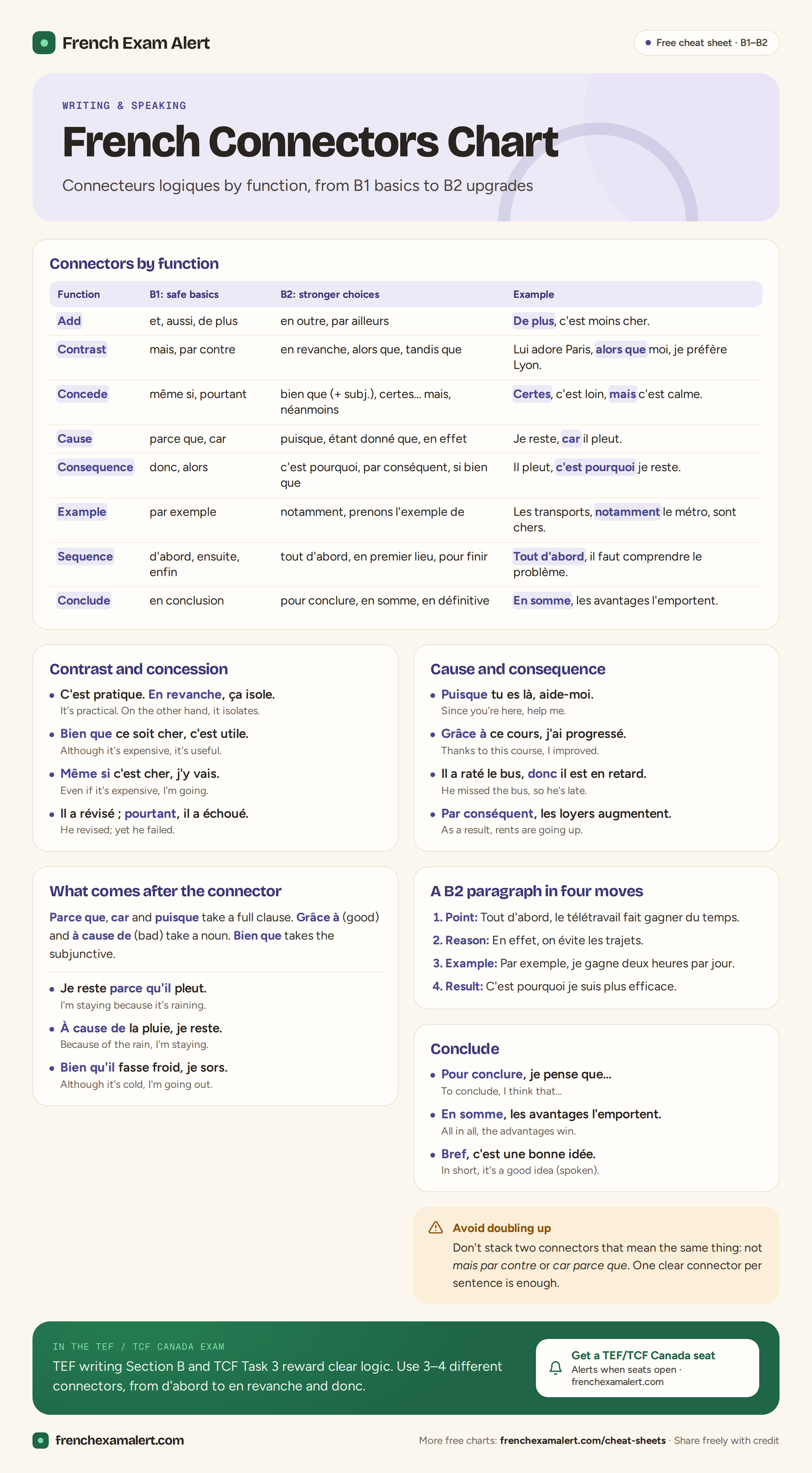
Connectors by function
| Function | B1: safe basics | B2: stronger choices | Example |
|---|---|---|---|
| Add | et, aussi, de plus | en outre, par ailleurs | De plus, c'est moins cher. |
| Contrast | mais, par contre | en revanche, alors que, tandis que | Lui adore Paris, alors que moi, je préfère Lyon. |
| Concede | même si, pourtant | bien que (+ subj.), certes… mais, néanmoins | Certes, c'est loin, mais c'est calme. |
| Cause | parce que, car | puisque, étant donné que, en effet | Je reste, car il pleut. |
| Consequence | donc, alors | c'est pourquoi, par conséquent, si bien que | Il pleut, c'est pourquoi je reste. |
| Example | par exemple | notamment, prenons l'exemple de | Les transports, notamment le métro, sont chers. |
| Sequence | d'abord, ensuite, enfin | tout d'abord, en premier lieu, pour finir | Tout d'abord, il faut comprendre le problème. |
| Conclude | en conclusion | pour conclure, en somme, en définitive | En somme, les avantages l'emportent. |
Contrast and concession
- C'est pratique. En revanche, ça isole.It's practical. On the other hand, it isolates.
- Bien que ce soit cher, c'est utile.Although it's expensive, it's useful.
- Même si c'est cher, j'y vais.Even if it's expensive, I'm going.
- Il a révisé ; pourtant, il a échoué.He revised; yet he failed.
What comes after the connector
Parce que, car and puisque take a full clause. Grâce à (good) and à cause de (bad) take a noun. Bien que takes the subjunctive.
- Je reste parce qu'il pleut.I'm staying because it's raining.
- À cause de la pluie, je reste.Because of the rain, I'm staying.
- Bien qu'il fasse froid, je sors.Although it's cold, I'm going out.
Cause and consequence
- Puisque tu es là, aide-moi.Since you're here, help me.
- Grâce à ce cours, j'ai progressé.Thanks to this course, I improved.
- Il a raté le bus, donc il est en retard.He missed the bus, so he's late.
- Par conséquent, les loyers augmentent.As a result, rents are going up.
A B2 paragraph in four moves
- Point: Tout d'abord, le télétravail fait gagner du temps.
- Reason: En effet, on évite les trajets.
- Example: Par exemple, je gagne deux heures par jour.
- Result: C'est pourquoi je suis plus efficace.
Conclude
- Pour conclure, je pense que…To conclude, I think that…
- En somme, les avantages l'emportent.All in all, the advantages win.
- Bref, c'est une bonne idée.In short, it's a good idea (spoken).
Go deeper
Preparing for TEF or TCF Canada?
Seats at many centres sell out within minutes. Pick your cities and we alert you by email or WhatsApp the moment one opens.
Questions
En revanche (on the other hand), par conséquent (as a result), bien que (although, + subjunctive), en effet (indeed, to justify a point), notamment (in particular) and en somme (all in all). Use a few of them correctly rather than many of them loosely.
Both mean because. Parce que is the everyday choice and can start an answer to pourquoi. Car is a little more formal, is common in writing, and never starts a sentence.
Yes. Bien que is always followed by the subjunctive: bien qu'il fasse froid. Même si, which also means even if or although, takes the indicative: même s'il fait froid.