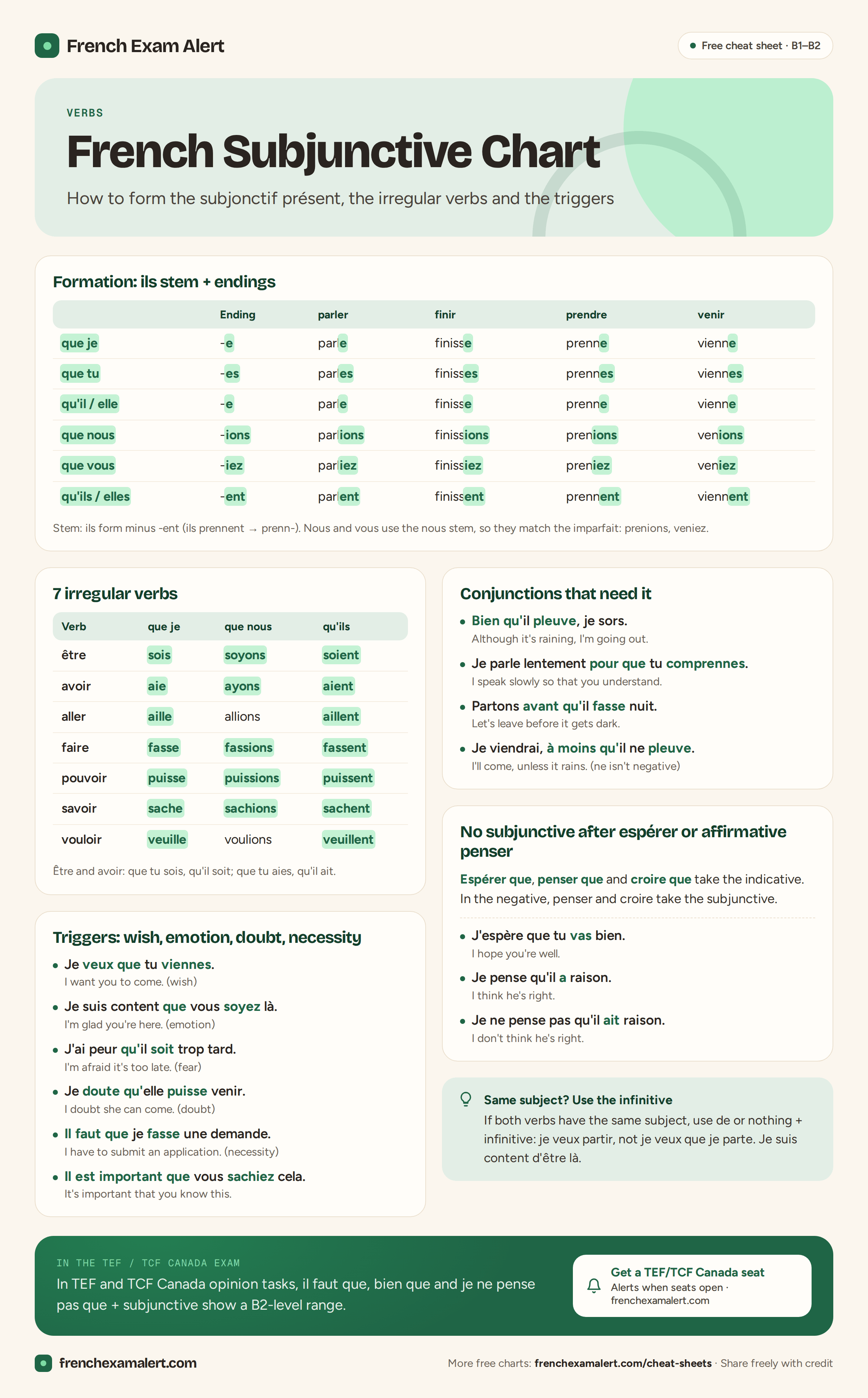
French Subjunctive Chart
Use the subjunctive after que when the main clause expresses a wish, a feeling, a doubt or a necessity: il faut que tu viennes. To form it, take the ils form of the present, drop -ent and add -e, -es, -e, -ions, -iez, -ent. Seven common verbs are irregular: être, avoir, aller, faire, pouvoir, savoir and vouloir.
Free to print and share with credit to French Exam Alert (licence). 2400×3864px.
In the TEF / TCF Canada exam
In TEF and TCF Canada opinion tasks, il faut que, bien que and je ne pense pas que + subjunctive show a B2-level range.
French Subjunctive Chart: the full chart as text
Formation: ils stem + endings
| Ending | parler | finir | prendre | venir | |
|---|---|---|---|---|---|
| que je | -e | parle | finisse | prenne | vienne |
| que tu | -es | parles | finisses | prennes | viennes |
| qu'il / elle | -e | parle | finisse | prenne | vienne |
| que nous | -ions | parlions | finissions | prenions | venions |
| que vous | -iez | parliez | finissiez | preniez | veniez |
| qu'ils / elles | -ent | parlent | finissent | prennent | viennent |
Stem: ils form minus -ent (ils prennent → prenn-). Nous and vous use the nous stem, so they match the imparfait: prenions, veniez.
7 irregular verbs
| Verb | que je | que nous | qu'ils |
|---|---|---|---|
| être | sois | soyons | soient |
| avoir | aie | ayons | aient |
| aller | aille | allions | aillent |
| faire | fasse | fassions | fassent |
| pouvoir | puisse | puissions | puissent |
| savoir | sache | sachions | sachent |
| vouloir | veuille | voulions | veuillent |
Être and avoir: que tu sois, qu'il soit; que tu aies, qu'il ait.
Triggers: wish, emotion, doubt, necessity
- Je veux que tu viennes.I want you to come. (wish)
- Je suis content que vous soyez là.I'm glad you're here. (emotion)
- J'ai peur qu'il soit trop tard.I'm afraid it's too late. (fear)
- Je doute qu'elle puisse venir.I doubt she can come. (doubt)
- Il faut que je fasse une demande.I have to submit an application. (necessity)
- Il est important que vous sachiez cela.It's important that you know this.
Conjunctions that need it
- Bien qu'il pleuve, je sors.Although it's raining, I'm going out.
- Je parle lentement pour que tu comprennes.I speak slowly so that you understand.
- Partons avant qu'il fasse nuit.Let's leave before it gets dark.
- Je viendrai, à moins qu'il ne pleuve.I'll come, unless it rains. (ne isn't negative)
No subjunctive after espérer or affirmative penser
Espérer que, penser que and croire que take the indicative. In the negative, penser and croire take the subjunctive.
- J'espère que tu vas bien.I hope you're well.
- Je pense qu'il a raison.I think he's right.
- Je ne pense pas qu'il ait raison.I don't think he's right.
Go deeper
 Free PDF · 23 pagesFrench Verb Conjugation Tables: the 40 most useful verbsHow conjugation works, the three regular patterns, and compact tables for 40 high-frequency verbs in six tenses Guide · 9 min readTEF Canada writing and speaking: Sections A and B explained200 words in 35 minutes, then 10 minutes to change a mind
Preparing for TEF or TCF Canada?
Seats at many centres sell out within minutes. Pick your cities and we alert you by email or WhatsApp the moment one opens.
Questions
Use it in a que clause after a verb or phrase of wish (vouloir que), emotion (être content que, avoir peur que), doubt (douter que, ne pas penser que) or necessity (il faut que, il est important que). It also follows some conjunctions: bien que, pour que, avant que, à moins que, sans que.
No. Espérer que takes the indicative, usually the present or the future: j'espère que tu viendras. The same goes for penser que and croire que in the affirmative: je pense qu'il est prêt. Only the negative, je ne pense pas qu'il soit prêt, takes the subjunctive.
In standard grammar, no: après que takes the indicative (après qu'il est parti), while avant que takes the subjunctive (avant qu'il parte). Many speakers use the subjunctive after après que, but in an exam, the indicative is the safe choice.