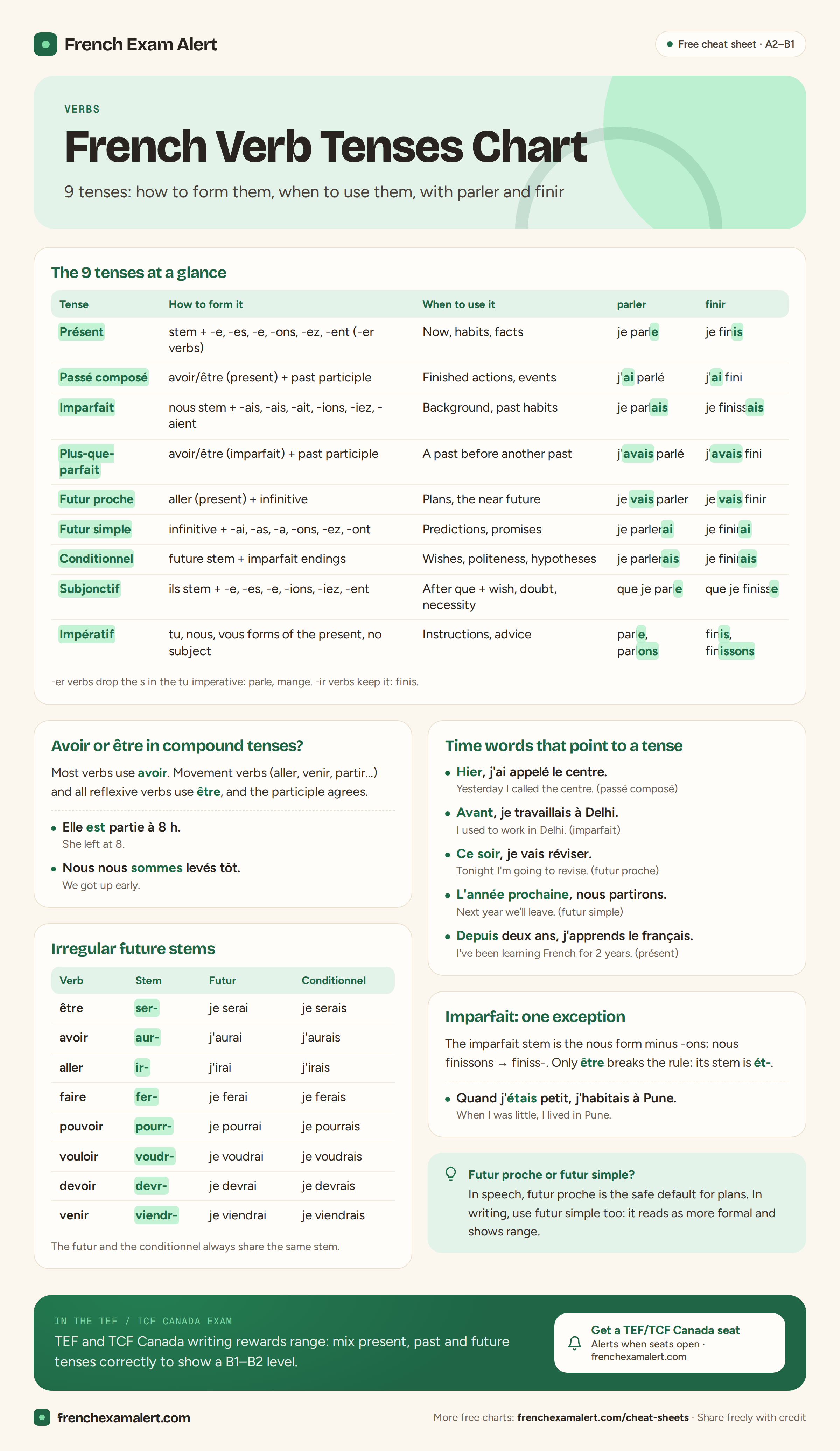
French Verb Tenses Chart
French has nine tenses that cover almost everything you'll say or write at B1–B2: présent, passé composé, imparfait, plus-que-parfait, futur proche, futur simple, conditionnel présent, subjonctif présent and impératif. Each one has a simple formula: a stem plus a set of endings, or an auxiliary plus a past participle. Learn the formula once and it works for every regular verb.
Free to print and share with credit to French Exam Alert (licence). 2400×4146px.
In the TEF / TCF Canada exam
TEF and TCF Canada writing rewards range: mix present, past and future tenses correctly to show a B1–B2 level.
French Verb Tenses Chart: the full chart as text
The 9 tenses at a glance
| Tense | How to form it | When to use it | parler | finir |
|---|---|---|---|---|
| Présent | stem + -e, -es, -e, -ons, -ez, -ent (-er verbs) | Now, habits, facts | je parle | je finis |
| Passé composé | avoir/être (present) + past participle | Finished actions, events | j'ai parlé | j'ai fini |
| Imparfait | nous stem + -ais, -ais, -ait, -ions, -iez, -aient | Background, past habits | je parlais | je finissais |
| Plus-que-parfait | avoir/être (imparfait) + past participle | A past before another past | j'avais parlé | j'avais fini |
| Futur proche | aller (present) + infinitive | Plans, the near future | je vais parler | je vais finir |
| Futur simple | infinitive + -ai, -as, -a, -ons, -ez, -ont | Predictions, promises | je parlerai | je finirai |
| Conditionnel | future stem + imparfait endings | Wishes, politeness, hypotheses | je parlerais | je finirais |
| Subjonctif | ils stem + -e, -es, -e, -ions, -iez, -ent | After que + wish, doubt, necessity | que je parle | que je finisse |
| Impératif | tu, nous, vous forms of the present, no subject | Instructions, advice | parle, parlons | finis, finissons |
-er verbs drop the s in the tu imperative: parle, mange. -ir verbs keep it: finis.
Avoir or être in compound tenses?
Most verbs use avoir. Movement verbs (aller, venir, partir…) and all reflexive verbs use être, and the participle agrees.
- Elle est partie à 8 h.She left at 8.
- Nous nous sommes levés tôt.We got up early.
Irregular future stems
| Verb | Stem | Futur | Conditionnel |
|---|---|---|---|
| être | ser- | je serai | je serais |
| avoir | aur- | j'aurai | j'aurais |
| aller | ir- | j'irai | j'irais |
| faire | fer- | je ferai | je ferais |
| pouvoir | pourr- | je pourrai | je pourrais |
| vouloir | voudr- | je voudrai | je voudrais |
| devoir | devr- | je devrai | je devrais |
| venir | viendr- | je viendrai | je viendrais |
The futur and the conditionnel always share the same stem.
Time words that point to a tense
- Hier, j'ai appelé le centre.Yesterday I called the centre. (passé composé)
- Avant, je travaillais à Delhi.I used to work in Delhi. (imparfait)
- Ce soir, je vais réviser.Tonight I'm going to revise. (futur proche)
- L'année prochaine, nous partirons.Next year we'll leave. (futur simple)
- Depuis deux ans, j'apprends le français.I've been learning French for 2 years. (présent)
Imparfait: one exception
The imparfait stem is the nous form minus -ons: nous finissons → finiss-. Only être breaks the rule: its stem is ét-.
- Quand j'étais petit, j'habitais à Pune.When I was little, I lived in Pune.
Go deeper
Preparing for TEF or TCF Canada?
Seats at many centres sell out within minutes. Pick your cities and we alert you by email or WhatsApp the moment one opens.
Questions
French grammar books list about 20 tense and mood forms, but many are literary. For everyday French and for TEF or TCF Canada, nine cover nearly everything: présent, passé composé, imparfait, plus-que-parfait, futur proche, futur simple, conditionnel présent, subjonctif présent and impératif.
Start with the présent, the passé composé and the futur proche. Together they let you talk about now, the past and the future. Then add the imparfait, the futur simple and the conditionnel, which you need to reach B1.
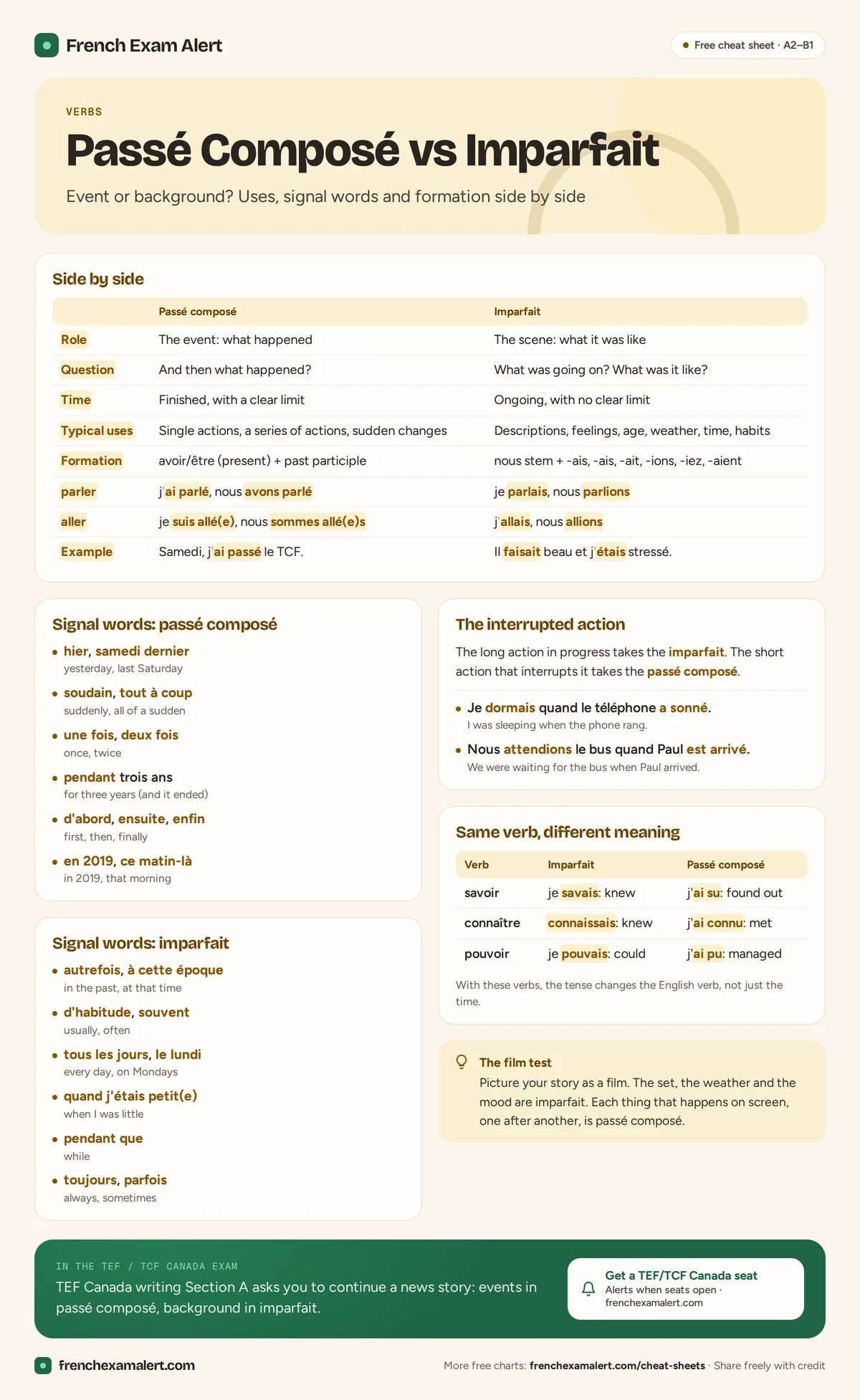
The passé composé tells what happened: finished events. The imparfait sets the scene: background, descriptions and past habits. Hier, j'ai pris le bus (event) parce qu'il pleuvait (background). See the passé composé vs imparfait chart.