French Irregular Verbs Chart
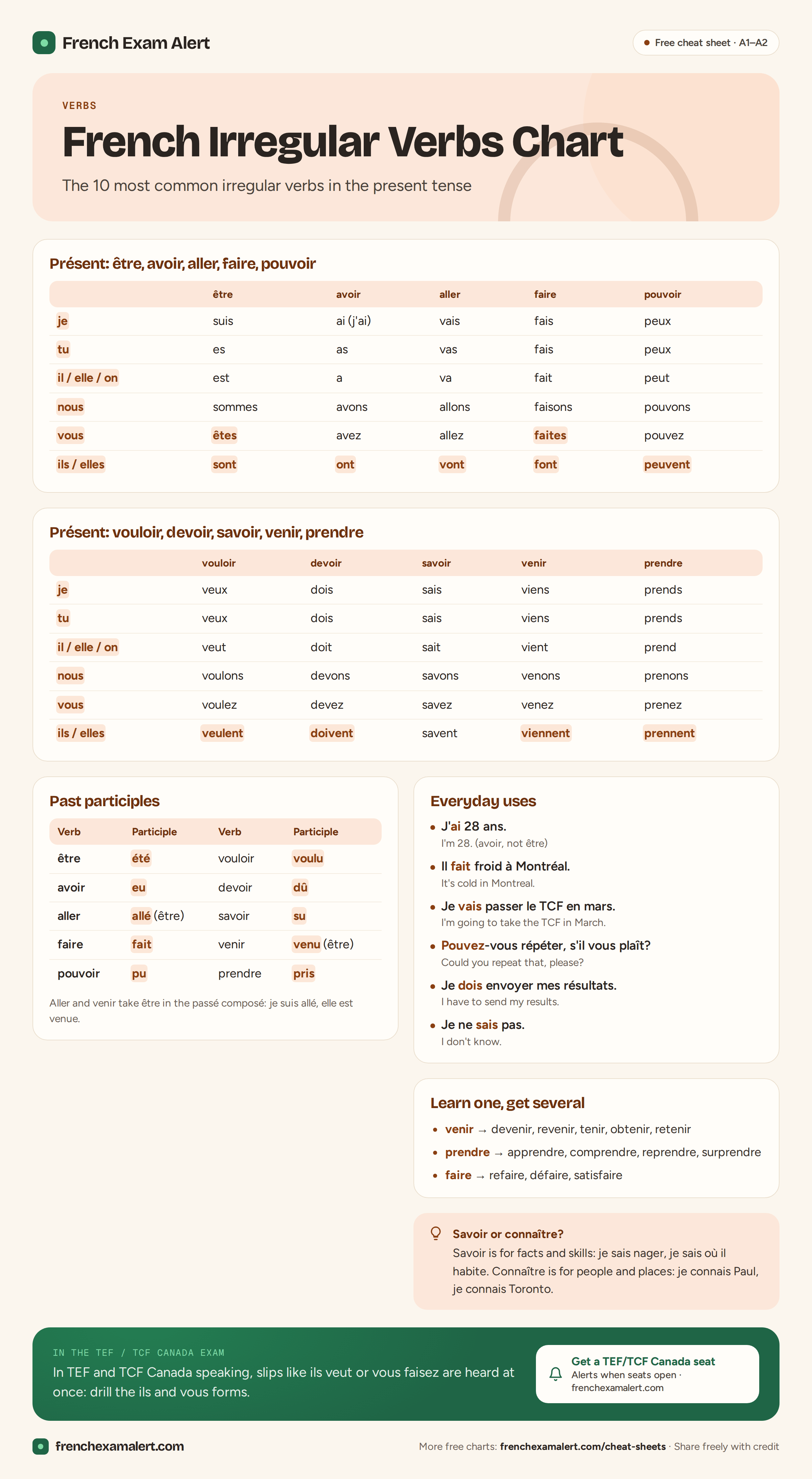
The ten most useful irregular French verbs are être, avoir, aller, faire, pouvoir, vouloir, devoir, savoir, venir and prendre. They don't follow the regular -er, -ir or -re patterns, but they appear in almost every sentence, so they are worth learning by heart. Most of them share a pattern: the nous and vous forms keep the infinitive stem, and the other forms change.
Free to print and share with credit to French Exam Alert (licence). 2400×4370px.
In the TEF / TCF Canada exam
In TEF and TCF Canada speaking, slips like ils veut or vous faisez are heard at once: drill the ils and vous forms.
French Irregular Verbs Chart: the full chart as text
Présent: être, avoir, aller, faire, pouvoir
| être | avoir | aller | faire | pouvoir | |
|---|---|---|---|---|---|
| je | suis | ai (j'ai) | vais | fais | peux |
| tu | es | as | vas | fais | peux |
| il / elle / on | est | a | va | fait | peut |
| nous | sommes | avons | allons | faisons | pouvons |
| vous | êtes | avez | allez | faites | pouvez |
| ils / elles | sont | ont | vont | font | peuvent |
Présent: vouloir, devoir, savoir, venir, prendre
| vouloir | devoir | savoir | venir | prendre | |
|---|---|---|---|---|---|
| je | veux | dois | sais | viens | prends |
| tu | veux | dois | sais | viens | prends |
| il / elle / on | veut | doit | sait | vient | prend |
| nous | voulons | devons | savons | venons | prenons |
| vous | voulez | devez | savez | venez | prenez |
| ils / elles | veulent | doivent | savent | viennent | prennent |
Past participles
| Verb | Participle | Verb | Participle |
|---|---|---|---|
| être | été | vouloir | voulu |
| avoir | eu | devoir | dû |
| aller | allé (être) | savoir | su |
| faire | fait | venir | venu (être) |
| pouvoir | pu | prendre | pris |
Aller and venir take être in the passé composé: je suis allé, elle est venue.
Everyday uses
- J'ai 28 ans.I'm 28. (avoir, not être)
- Il fait froid à Montréal.It's cold in Montreal.
- Je vais passer le TCF en mars.I'm going to take the TCF in March.
- Pouvez-vous répéter, s'il vous plaît?Could you repeat that, please?
- Je dois envoyer mes résultats.I have to send my results.
- Je ne sais pas.I don't know.
Learn one, get several
- venir → devenir, revenir, tenir, obtenir, retenir
- prendre → apprendre, comprendre, reprendre, surprendre
- faire → refaire, défaire, satisfaire
Go deeper
Preparing for TEF or TCF Canada?
Seats at many centres sell out within minutes. Pick your cities and we alert you by email or WhatsApp the moment one opens.
Questions
Être, avoir, aller and faire are the most frequent, followed by pouvoir, vouloir, devoir, savoir, venir and prendre. Together they appear in most everyday sentences, and être and avoir are also the auxiliaries of the passé composé.
Partly. Many irregular verbs change their stem in je, tu, il and ils but keep the infinitive stem in nous and vous: je veux, nous voulons, ils veulent. This is sometimes called a boot verb, because the changed forms make a boot shape in the table.
No. The vous form of faire is vous faites, and the vous form of dire is vous dites. Être also has an irregular vous form: vous êtes. These three (and compounds such as refaire) are the only verbs whose vous form doesn't end in -ez.