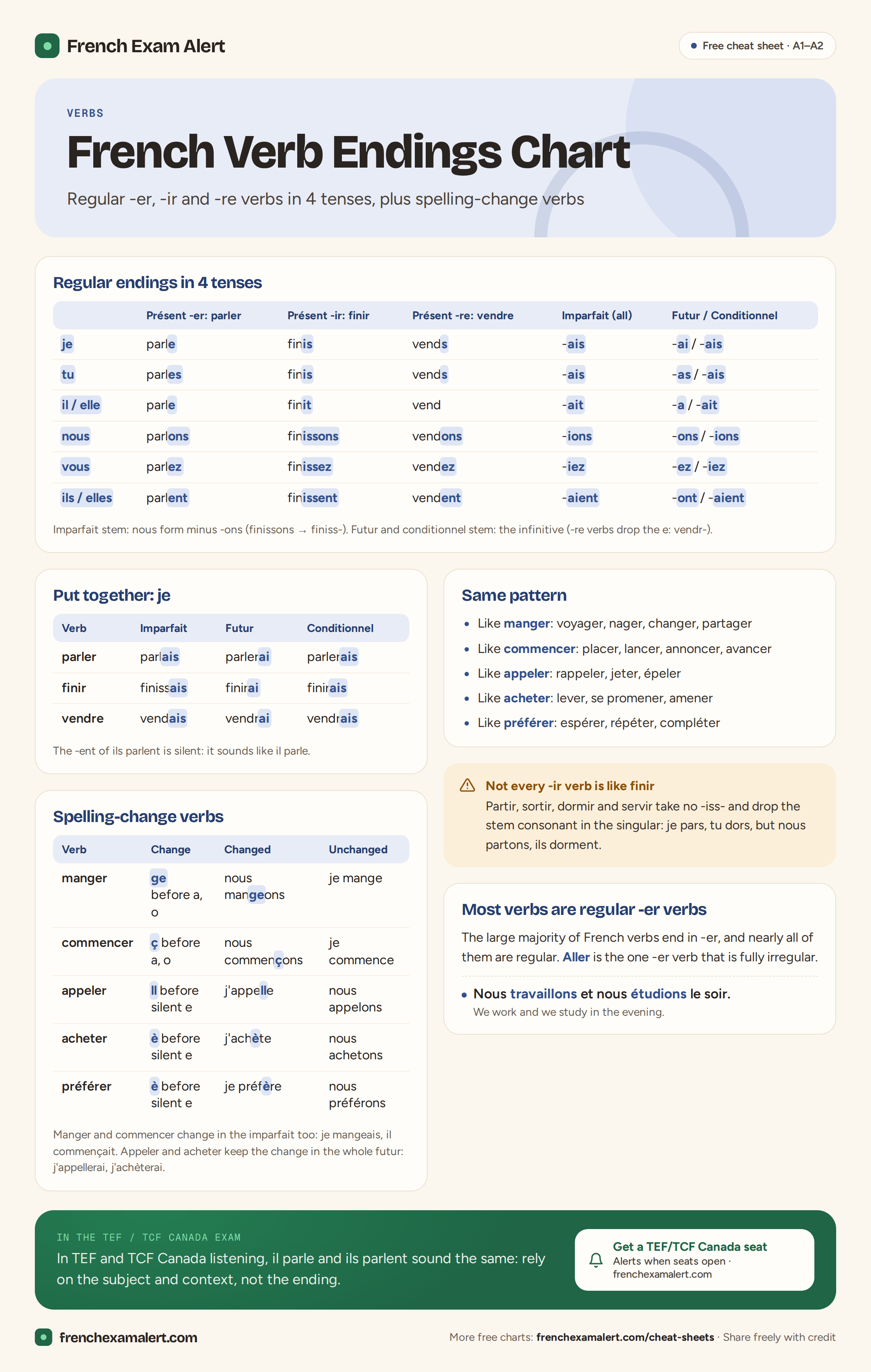
French Verb Endings Chart
Regular French verbs fall into three groups: -er (parler), -ir (finir) and -re (vendre). Each group has its own present-tense endings, but the imparfait, futur and conditionnel use one set of endings for all three. A few -er verbs change their spelling to keep the right sound: nous mangeons, j'appelle, j'achète.
Free to print and share with credit to French Exam Alert (licence). 2400×3782px.
In the TEF / TCF Canada exam
In TEF and TCF Canada listening, il parle and ils parlent sound the same: rely on the subject and context, not the ending.
French Verb Endings Chart: the full chart as text
Regular endings in 4 tenses
| Présent -er: parler | Présent -ir: finir | Présent -re: vendre | Imparfait (all) | Futur / Conditionnel | |
|---|---|---|---|---|---|
| je | parle | finis | vends | -ais | -ai / -ais |
| tu | parles | finis | vends | -ais | -as / -ais |
| il / elle | parle | finit | vend | -ait | -a / -ait |
| nous | parlons | finissons | vendons | -ions | -ons / -ions |
| vous | parlez | finissez | vendez | -iez | -ez / -iez |
| ils / elles | parlent | finissent | vendent | -aient | -ont / -aient |
Imparfait stem: nous form minus -ons (finissons → finiss-). Futur and conditionnel stem: the infinitive (-re verbs drop the e: vendr-).
Put together: je
| Verb | Imparfait | Futur | Conditionnel |
|---|---|---|---|
| parler | parlais | parlerai | parlerais |
| finir | finissais | finirai | finirais |
| vendre | vendais | vendrai | vendrais |
The -ent of ils parlent is silent: it sounds like il parle.
Spelling-change verbs
| Verb | Change | Changed | Unchanged |
|---|---|---|---|
| manger | ge before a, o | nous mangeons | je mange |
| commencer | ç before a, o | nous commençons | je commence |
| appeler | ll before silent e | j'appelle | nous appelons |
| acheter | è before silent e | j'achète | nous achetons |
| préférer | è before silent e | je préfère | nous préférons |
Manger and commencer change in the imparfait too: je mangeais, il commençait. Appeler and acheter keep the change in the whole futur: j'appellerai, j'achèterai.
Same pattern
- Like manger: voyager, nager, changer, partager
- Like commencer: placer, lancer, annoncer, avancer
- Like appeler: rappeler, jeter, épeler
- Like acheter: lever, se promener, amener
- Like préférer: espérer, répéter, compléter
Most verbs are regular -er verbs
The large majority of French verbs end in -er, and nearly all of them are regular. Aller is the one -er verb that is fully irregular.
- Nous travaillons et nous étudions le soir.We work and we study in the evening.
Go deeper
Preparing for TEF or TCF Canada?
Seats at many centres sell out within minutes. Pick your cities and we alert you by email or WhatsApp the moment one opens.
Questions
In the present, regular -er verbs take -e, -es, -e, -ons, -ez, -ent: je parle, tu parles, il parle, nous parlons, vous parlez, ils parlent. The je, tu, il and ils forms all sound the same.
No. Only the present tense differs by group. The imparfait (-ais, -ais, -ait, -ions, -iez, -aient), the futur (-ai, -as, -a, -ons, -ez, -ont) and the conditionnel (-ais, -ais, -ait, -ions, -iez, -aient) use the same endings for every verb.
Before a or o, the letter g sounds hard, as in gare. Adding an e keeps the soft sound of manger. Verbs in -cer do the same with a cedilla: nous commençons.