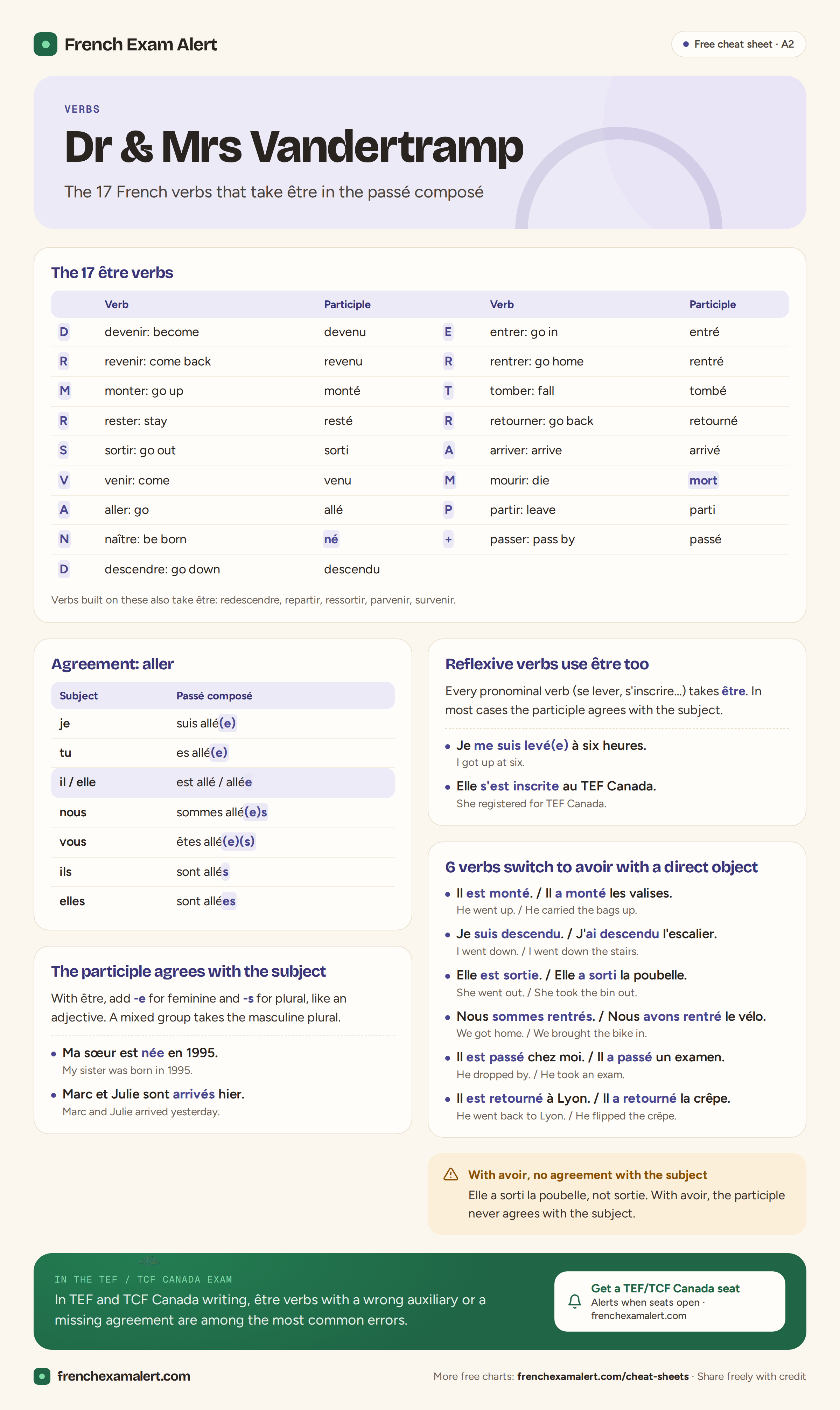
Dr & Mrs Vandertramp
In the passé composé, most French verbs use avoir, but 17 verbs of movement and change of state use être. DR MRS VANDERTRAMP is a memory aid: each letter starts one of them, and passer is the extra one. With être, the past participle agrees with the subject: elle est allée, ils sont partis.
Free to print and share with credit to French Exam Alert (licence). 2400×4028px.
In the TEF / TCF Canada exam
In TEF and TCF Canada writing, être verbs with a wrong auxiliary or a missing agreement are among the most common errors.
Dr & Mrs Vandertramp: the full chart as text
The 17 être verbs
| Verb | Participle | Verb | Participle | ||
|---|---|---|---|---|---|
| D | devenir: become | devenu | E | entrer: go in | entré |
| R | revenir: come back | revenu | R | rentrer: go home | rentré |
| M | monter: go up | monté | T | tomber: fall | tombé |
| R | rester: stay | resté | R | retourner: go back | retourné |
| S | sortir: go out | sorti | A | arriver: arrive | arrivé |
| V | venir: come | venu | M | mourir: die | mort |
| A | aller: go | allé | P | partir: leave | parti |
| N | naître: be born | né | + | passer: pass by | passé |
| D | descendre: go down | descendu |
Verbs built on these also take être: redescendre, repartir, ressortir, parvenir, survenir.
Agreement: aller
| Subject | Passé composé |
|---|---|
| je | suis allé(e) |
| tu | es allé(e) |
| il / elle | est allé / allée |
| nous | sommes allé(e)s |
| vous | êtes allé(e)(s) |
| ils | sont allés |
| elles | sont allées |
The participle agrees with the subject
With être, add -e for feminine and -s for plural, like an adjective. A mixed group takes the masculine plural.
- Ma sœur est née en 1995.My sister was born in 1995.
- Marc et Julie sont arrivés hier.Marc and Julie arrived yesterday.
Reflexive verbs use être too
Every pronominal verb (se lever, s'inscrire…) takes être. In most cases the participle agrees with the subject.
- Je me suis levé(e) à six heures.I got up at six.
- Elle s'est inscrite au TEF Canada.She registered for TEF Canada.
6 verbs switch to avoir with a direct object
- Il est monté. / Il a monté les valises.He went up. / He carried the bags up.
- Je suis descendu. / J'ai descendu l'escalier.I went down. / I went down the stairs.
- Elle est sortie. / Elle a sorti la poubelle.She went out. / She took the bin out.
- Nous sommes rentrés. / Nous avons rentré le vélo.We got home. / We brought the bike in.
- Il est passé chez moi. / Il a passé un examen.He dropped by. / He took an exam.
- Il est retourné à Lyon. / Il a retourné la crêpe.He went back to Lyon. / He flipped the crêpe.
Go deeper
Preparing for TEF or TCF Canada?
Seats at many centres sell out within minutes. Pick your cities and we alert you by email or WhatsApp the moment one opens.
Questions
Each letter starts a French verb that takes être in the passé composé: devenir, revenir, monter, rester, sortir, venir, aller, naître, descendre, entrer, rentrer, tomber, retourner, arriver, mourir, partir. Passer is the 17th verb and is often added as an extra P.
Yes. Every pronominal verb uses être in the passé composé: je me suis réveillé, nous nous sommes inscrits. The participle usually agrees with the subject, except when a direct object follows the verb: elle s'est lavé les mains.
Passer, monter, descendre, sortir, rentrer and retourner take avoir when they have a direct object. Il est passé chez moi (he dropped by) uses être, but il a passé un examen (he took an exam) uses avoir.