French Conditional & Si Clauses
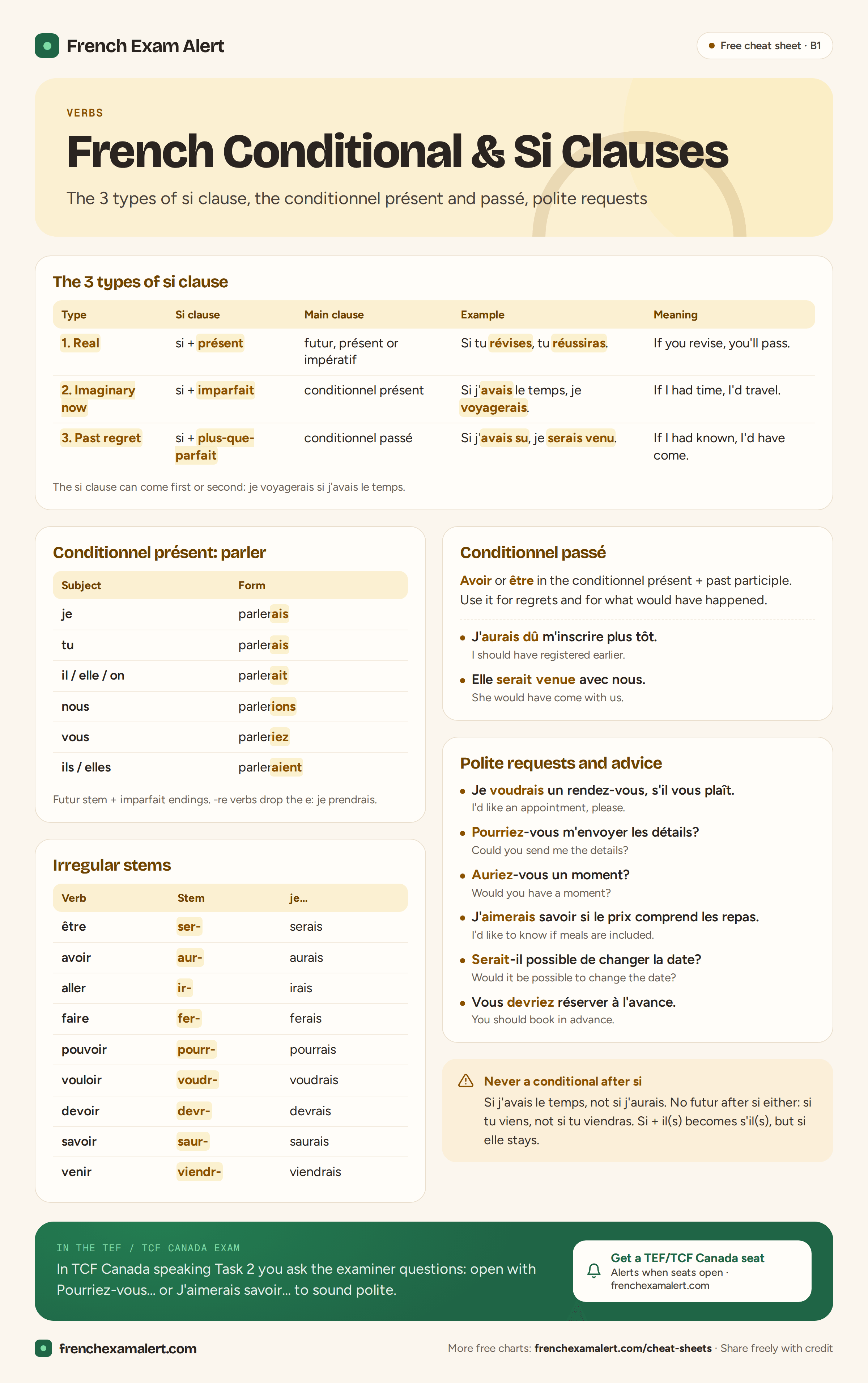
French si clauses come in three types: si + présent with a futur (a real possibility), si + imparfait with a conditionnel présent (an imaginary present), and si + plus-que-parfait with a conditionnel passé (a past that didn't happen). The conditionnel présent is the future stem plus the imparfait endings: je voudrais, nous pourrions. It is also the standard way to make a polite request.
Free to print and share with credit to French Exam Alert (licence). 2400×3822px.
In the TEF / TCF Canada exam
In TCF Canada speaking Task 2 you ask the examiner questions: open with Pourriez-vous… or J'aimerais savoir… to sound polite.
French Conditional & Si Clauses: the full chart as text
The 3 types of si clause
| Type | Si clause | Main clause | Example | Meaning |
|---|---|---|---|---|
| 1. Real | si + présent | futur, présent or impératif | Si tu révises, tu réussiras. | If you revise, you'll pass. |
| 2. Imaginary now | si + imparfait | conditionnel présent | Si j'avais le temps, je voyagerais. | If I had time, I'd travel. |
| 3. Past regret | si + plus-que-parfait | conditionnel passé | Si j'avais su, je serais venu. | If I had known, I'd have come. |
The si clause can come first or second: je voyagerais si j'avais le temps.
Conditionnel présent: parler
| Subject | Form |
|---|---|
| je | parlerais |
| tu | parlerais |
| il / elle / on | parlerait |
| nous | parlerions |
| vous | parleriez |
| ils / elles | parleraient |
Futur stem + imparfait endings. -re verbs drop the e: je prendrais.
Irregular stems
| Verb | Stem | je… |
|---|---|---|
| être | ser- | serais |
| avoir | aur- | aurais |
| aller | ir- | irais |
| faire | fer- | ferais |
| pouvoir | pourr- | pourrais |
| vouloir | voudr- | voudrais |
| devoir | devr- | devrais |
| savoir | saur- | saurais |
| venir | viendr- | viendrais |
Conditionnel passé
Avoir or être in the conditionnel présent + past participle. Use it for regrets and for what would have happened.
- J'aurais dû m'inscrire plus tôt.I should have registered earlier.
- Elle serait venue avec nous.She would have come with us.
Polite requests and advice
- Je voudrais un rendez-vous, s'il vous plaît.I'd like an appointment, please.
- Pourriez-vous m'envoyer les détails?Could you send me the details?
- Auriez-vous un moment?Would you have a moment?
- J'aimerais savoir si le prix comprend les repas.I'd like to know if meals are included.
- Serait-il possible de changer la date?Would it be possible to change the date?
- Vous devriez réserver à l'avance.You should book in advance.
Go deeper
 Free PDF · 23 pagesFrench Verb Conjugation Tables: the 40 most useful verbsHow conjugation works, the three regular patterns, and compact tables for 40 high-frequency verbs in six tenses Guide · 8 min readTCF Canada speaking: the 3 tasks, minute by minute12 minutes, 3 tasks, and only one of them gives you prep time
Preparing for TEF or TCF Canada?
Seats at many centres sell out within minutes. Pick your cities and we alert you by email or WhatsApp the moment one opens.
Questions
After si, use the présent, the imparfait or the plus-que-parfait, never the futur or the conditionnel. The tense after si sets the tense of the main clause: présent → futur, imparfait → conditionnel présent, plus-que-parfait → conditionnel passé.
Take the futur stem, which is usually the infinitive (parler-, finir-, vendr-), and add the imparfait endings: -ais, -ais, -ait, -ions, -iez, -aient. Irregular verbs use their irregular futur stem: je serais, j'aurais, je ferais, je pourrais.
Je veux sounds like a demand. The conditionnel softens it, like I'd like instead of I want in English. Use je voudrais, pourriez-vous and j'aimerais with officials, examiners and anyone you address as vous.