TCF Canada Preparation Guide 2026
Format, scoring, the 3 writing and 3 speaking tasks with model answers, and an 8-week plan to NCLC 7
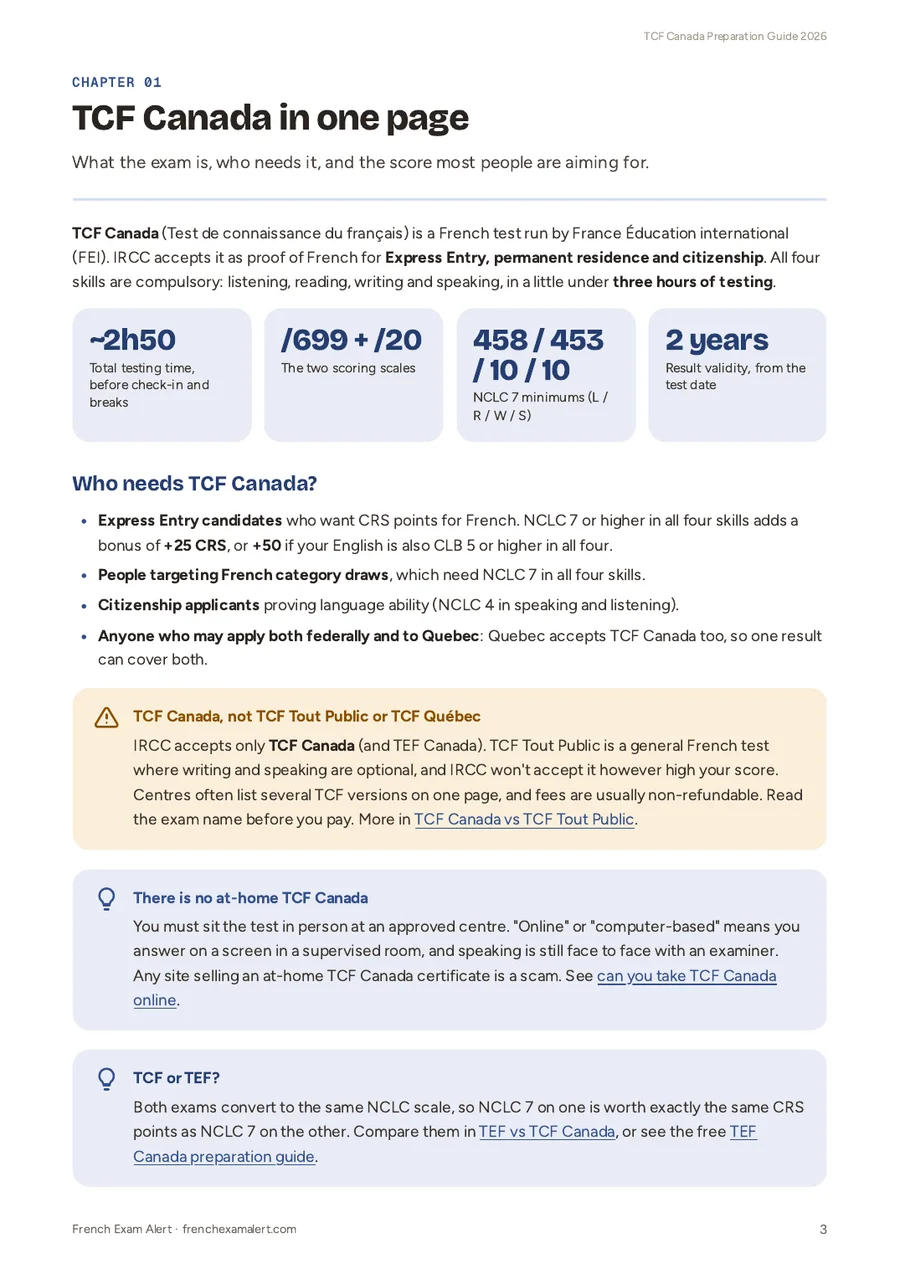
This free PDF covers everything you need to prepare for TCF Canada: the four sections and their timings, how the /699 and /20 scores convert to NCLC, and a method for every task. It includes original model answers for all three writing tasks with word counts, speaking structures and phrase banks, and an 8-week plan. Print it, work through it, and use the checklists before your exam.
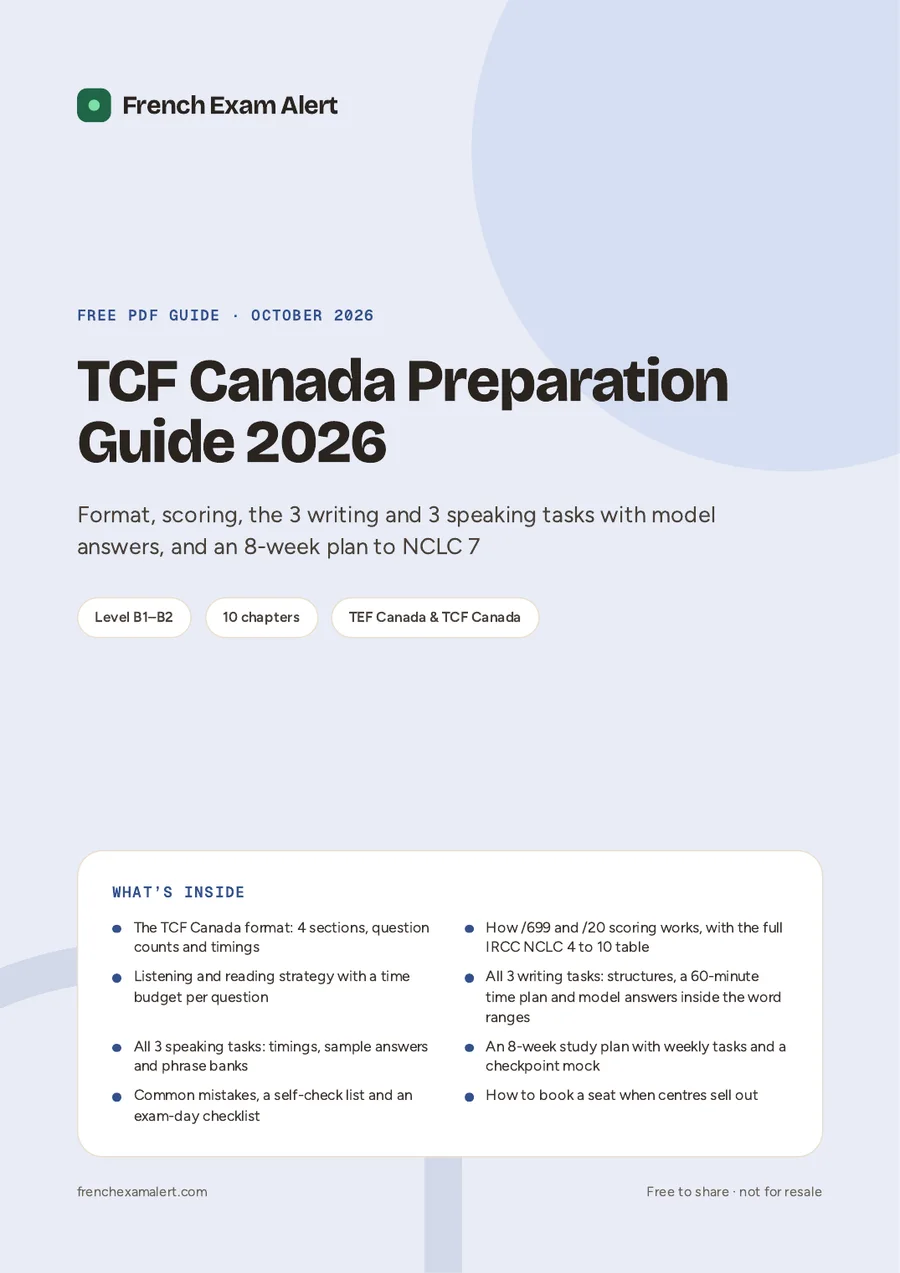
What’s inside
- The TCF Canada format: 4 sections, question counts and timings
- How /699 and /20 scoring works, with the full IRCC NCLC 4 to 10 table
- Listening and reading strategy with a time budget per question
- All 3 writing tasks: structures, a 60-minute time plan and model answers inside the word ranges
- All 3 speaking tasks: timings, sample answers and phrase banks
- An 8-week study plan with weekly tasks and a checkpoint mock
- Common mistakes, a self-check list and an exam-day checklist
- How to book a seat when centres sell out
Who it’s for: Anyone taking TCF Canada for Express Entry, PR or citizenship, especially learners between A2 and B2 aiming for NCLC 7.
Contents
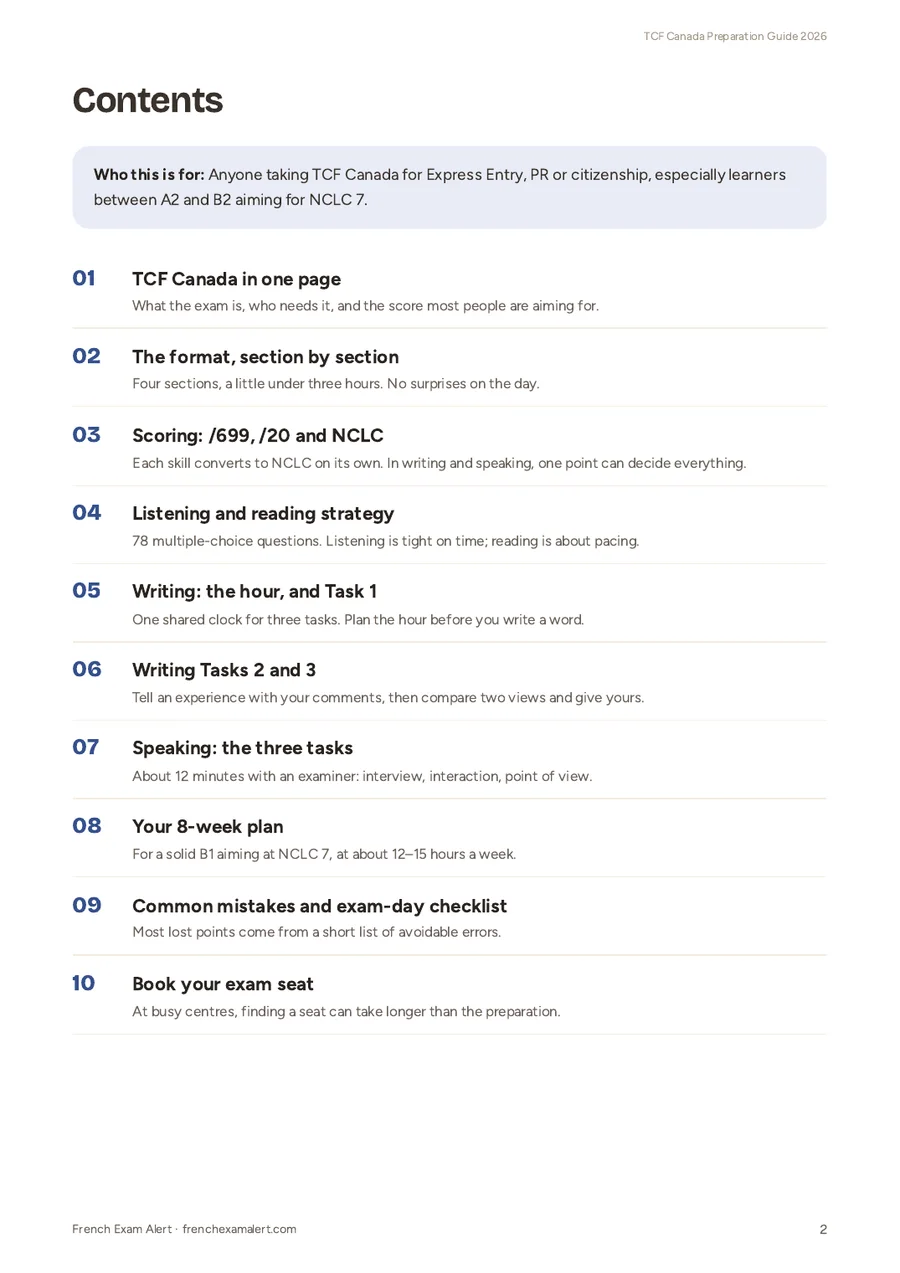
- 01TCF Canada in one pageWhat the exam is, who needs it, and the score most people are aiming for.
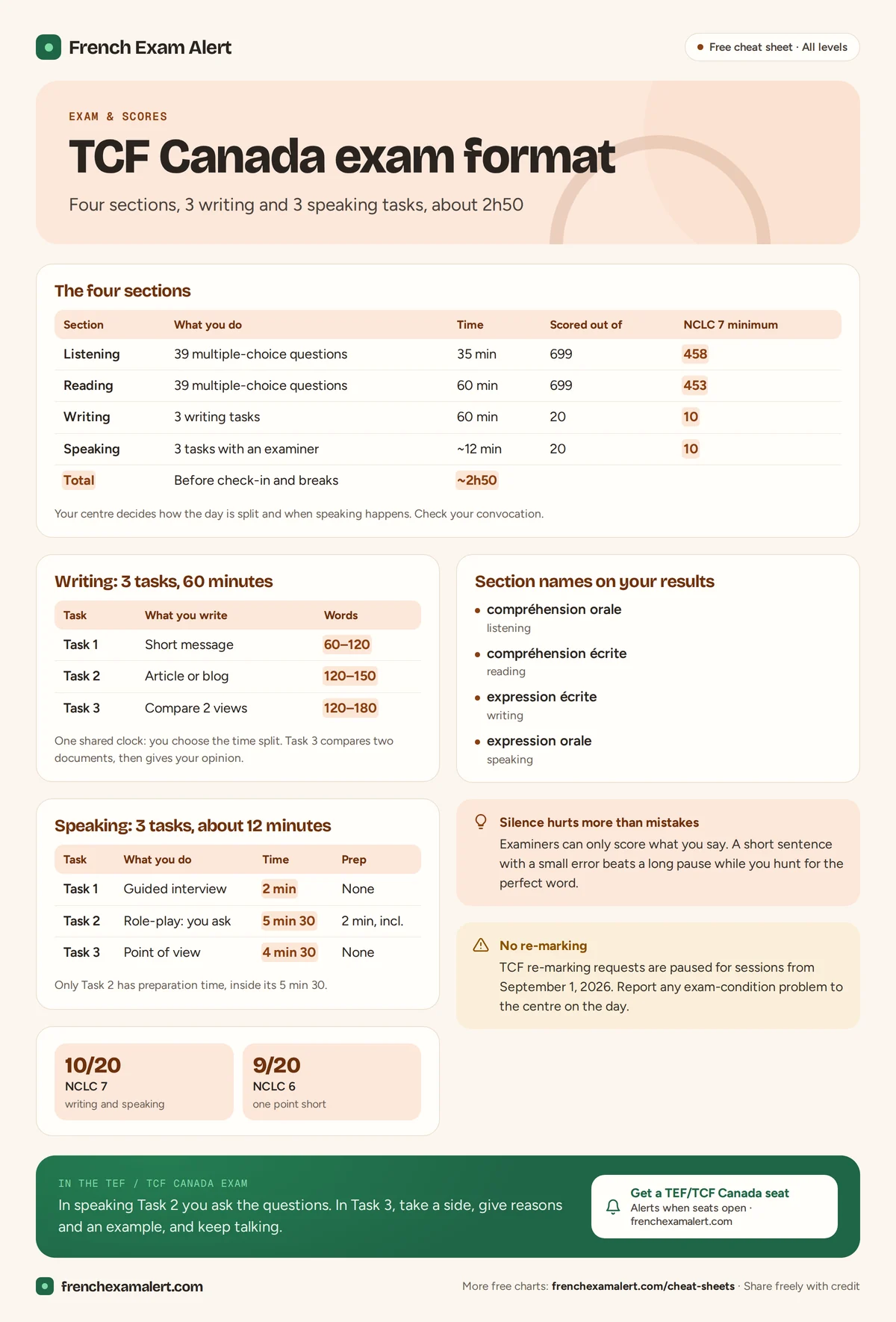
- 02The format, section by sectionFour sections, a little under three hours. No surprises on the day.
- 03Scoring: /699, /20 and NCLCEach skill converts to NCLC on its own. In writing and speaking, one point can decide everything.
- 04Listening and reading strategy78 multiple-choice questions. Listening is tight on time; reading is about pacing.
- 05Writing: the hour, and Task 1One shared clock for three tasks. Plan the hour before you write a word.
- 06Writing Tasks 2 and 3Tell an experience with your comments, then compare two views and give yours.
- 07Speaking: the three tasksAbout 12 minutes with an examiner: interview, interaction, point of view.
- 08Your 8-week planFor a solid B1 aiming at NCLC 7, at about 12–15 hours a week.
- 09Common mistakes and exam-day checklistMost lost points come from a short list of avoidable errors.
- 10Book your exam seatAt busy centres, finding a seat can take longer than the preparation.
Look inside
Got your exam date yet?
TEF and TCF Canada seats at many centres sell out within minutes. Pick your cities and we alert you by email or WhatsApp the moment one opens.
Questions
Yes. Download it, print it and share it. It covers the format, scoring, all three writing and speaking tasks with model answers, and an 8-week plan.
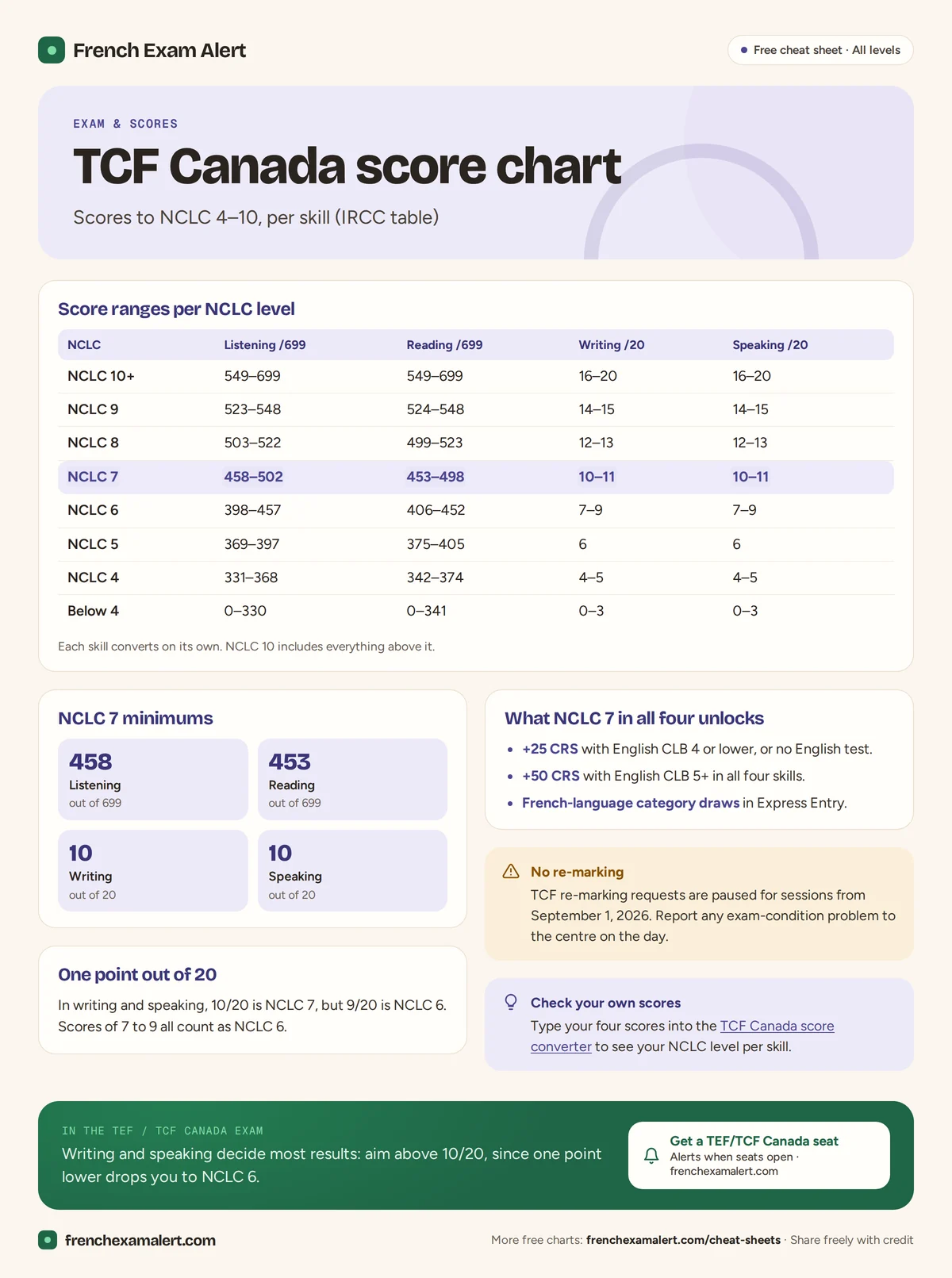
At least 458 in listening, 453 in reading, 10/20 in writing and 10/20 in speaking. Each skill must reach its own minimum.
Task 1 is 60–120 words, Task 2 is 120–150 words and Task 3 is 120–180 words, all in one 60-minute block.
Yes, if you're already around B1 and can study 12–15 hours a week. From A2, plan on six months or more to reach NCLC 7 in all four skills.
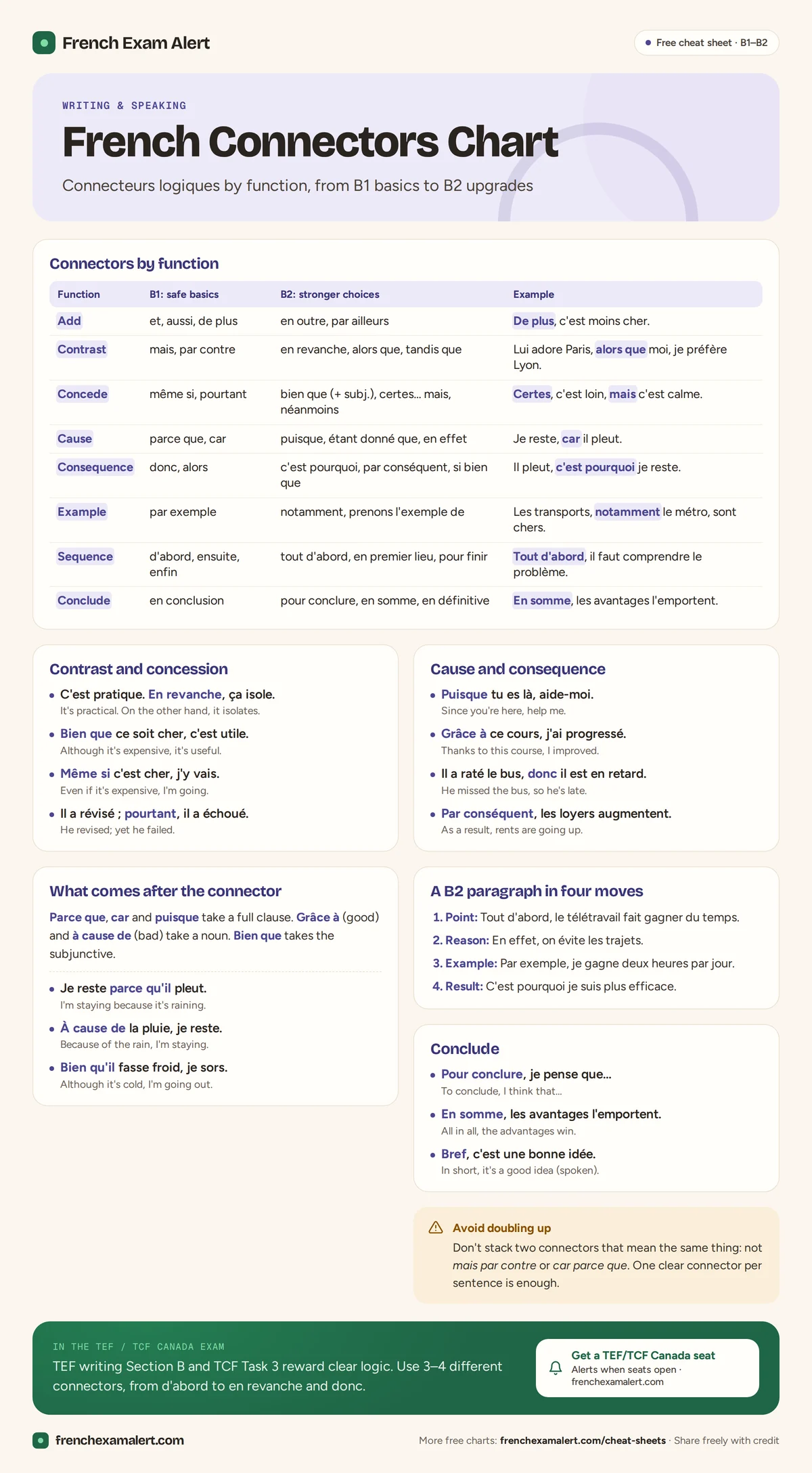
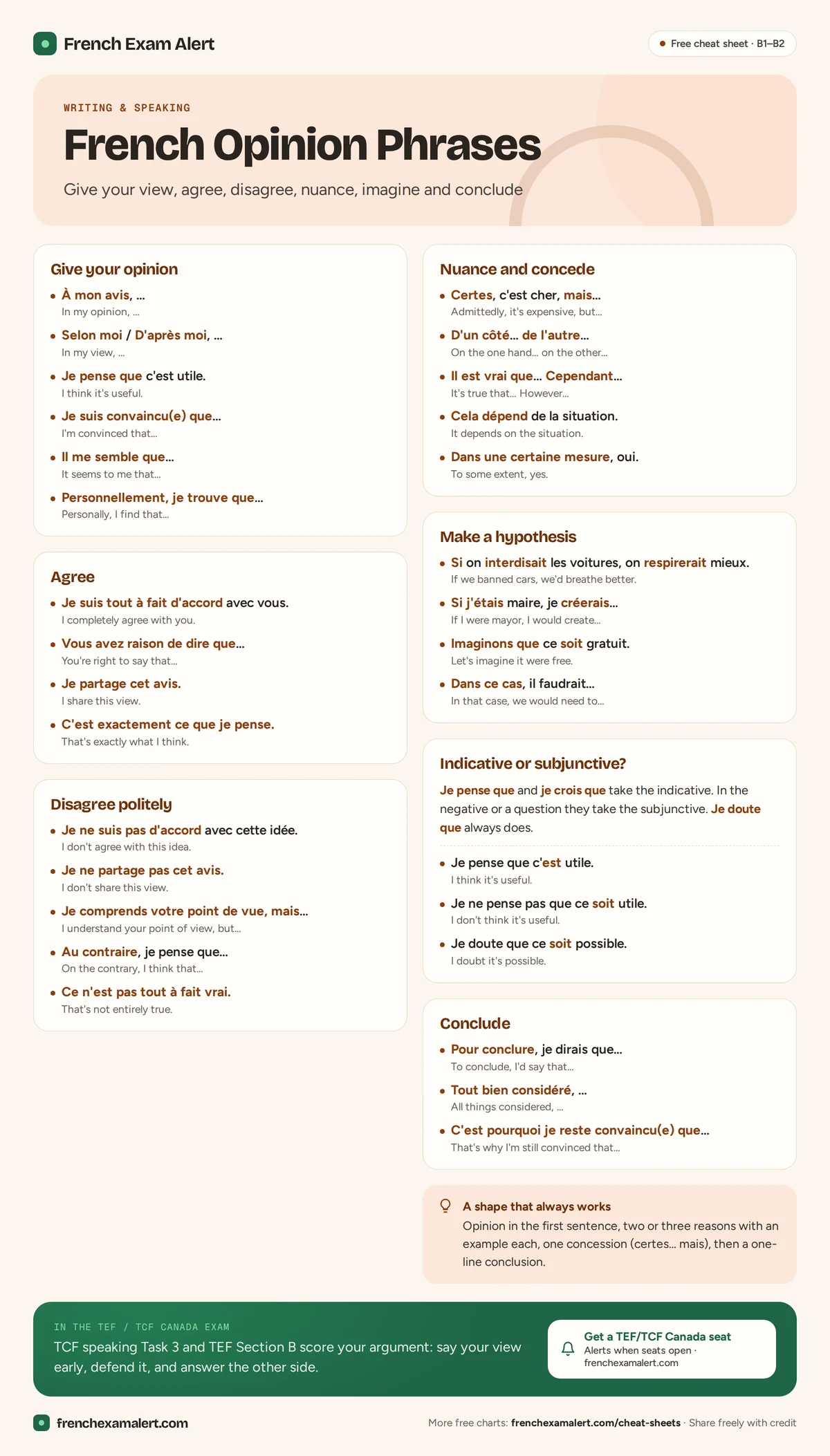
One-page cheat sheets to go with it
Related guides
TCF Canada exam format: every section, timing and score explained
Why one point out of 20 can cost you 50 CRS points
Read the guide →TCF Canada writing: the 3 tasks, word counts and model answers
Three tasks, one clock, and a 10/20 that decides your CRS bonus
Read the guide →TCF Canada speaking: the 3 tasks, minute by minute
12 minutes, 3 tasks, and only one of them gives you prep time
Read the guide →More free PDFs
All PDF guides →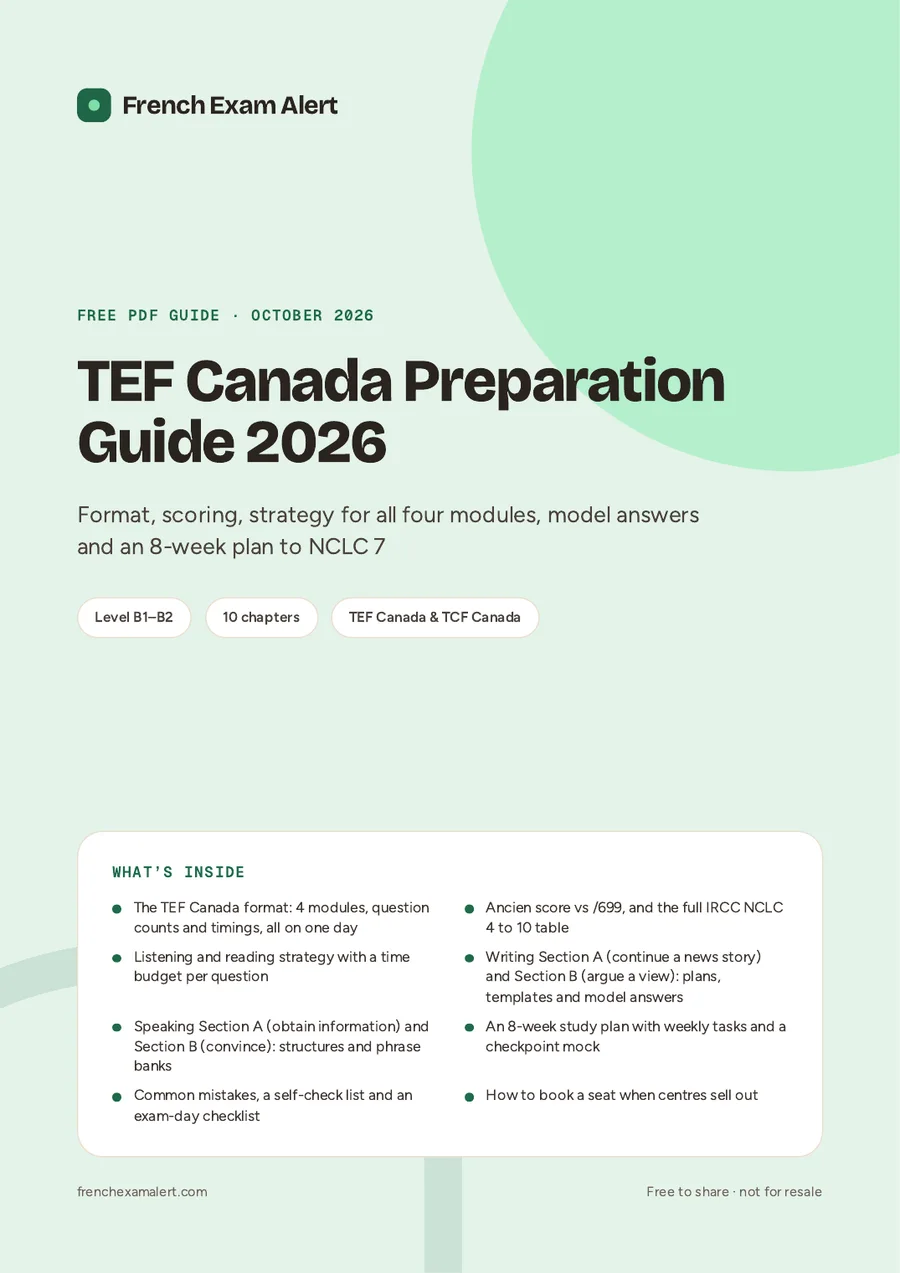 Free PDF · 26 pagesTEF Canada Preparation Guide 2026Format, scoring, strategy for all four modules, model answers and an 8-week plan to NCLC 7
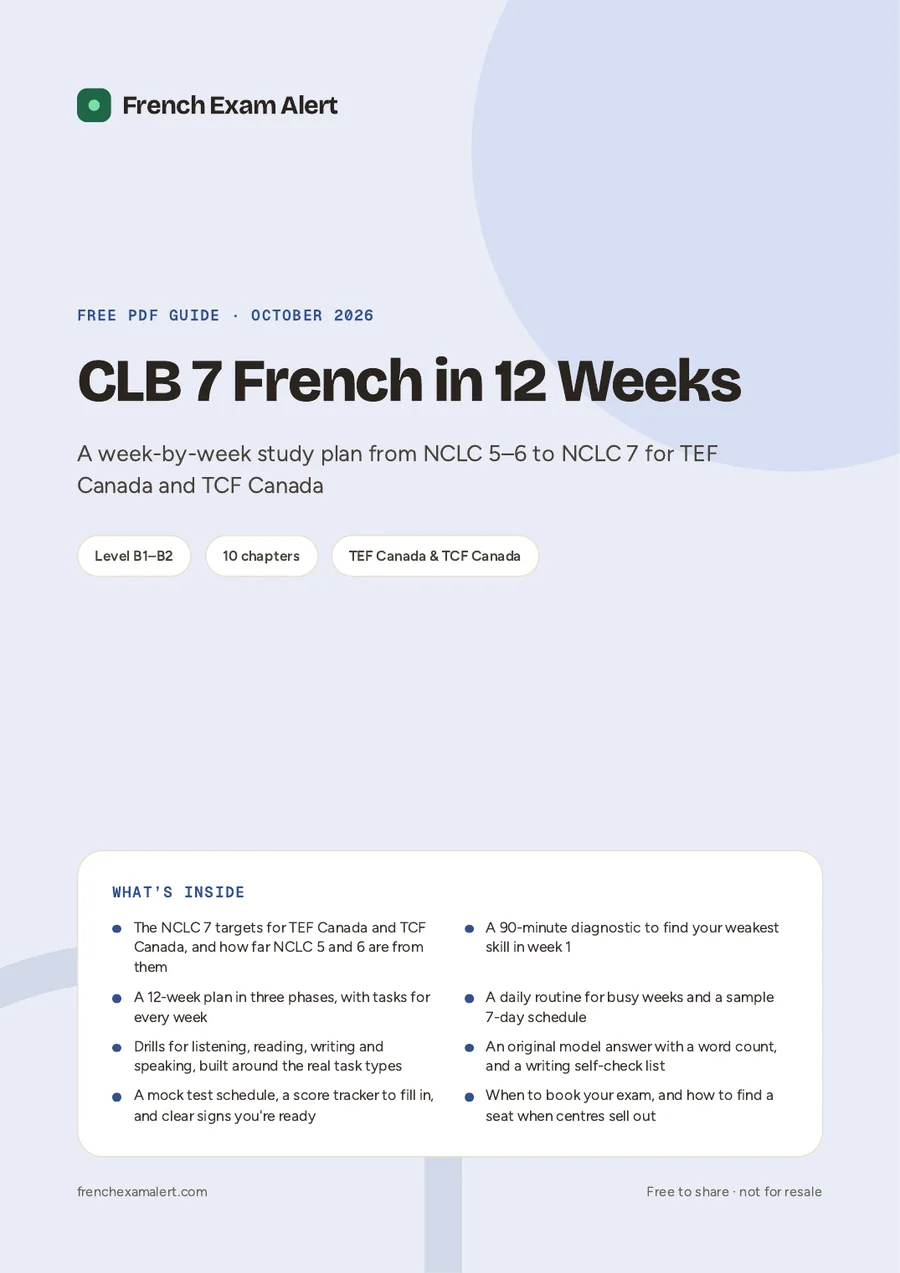 Free PDF · 26 pagesCLB 7 French in 12 WeeksA week-by-week study plan from NCLC 5–6 to NCLC 7 for TEF Canada and TCF Canada
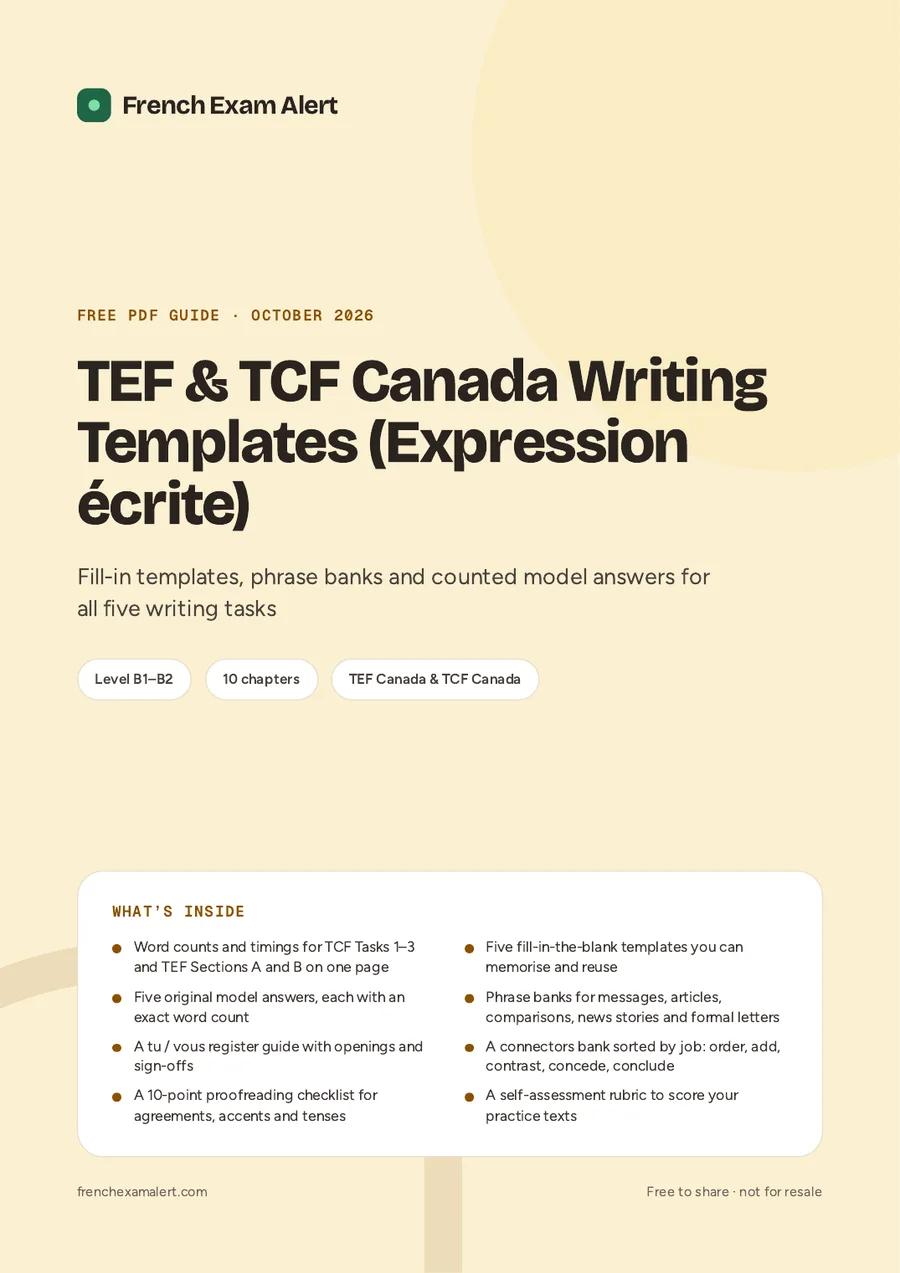 Free PDF · 28 pagesTEF & TCF Canada Writing Templates (Expression écrite)Fill-in templates, phrase banks and counted model answers for all five writing tasks
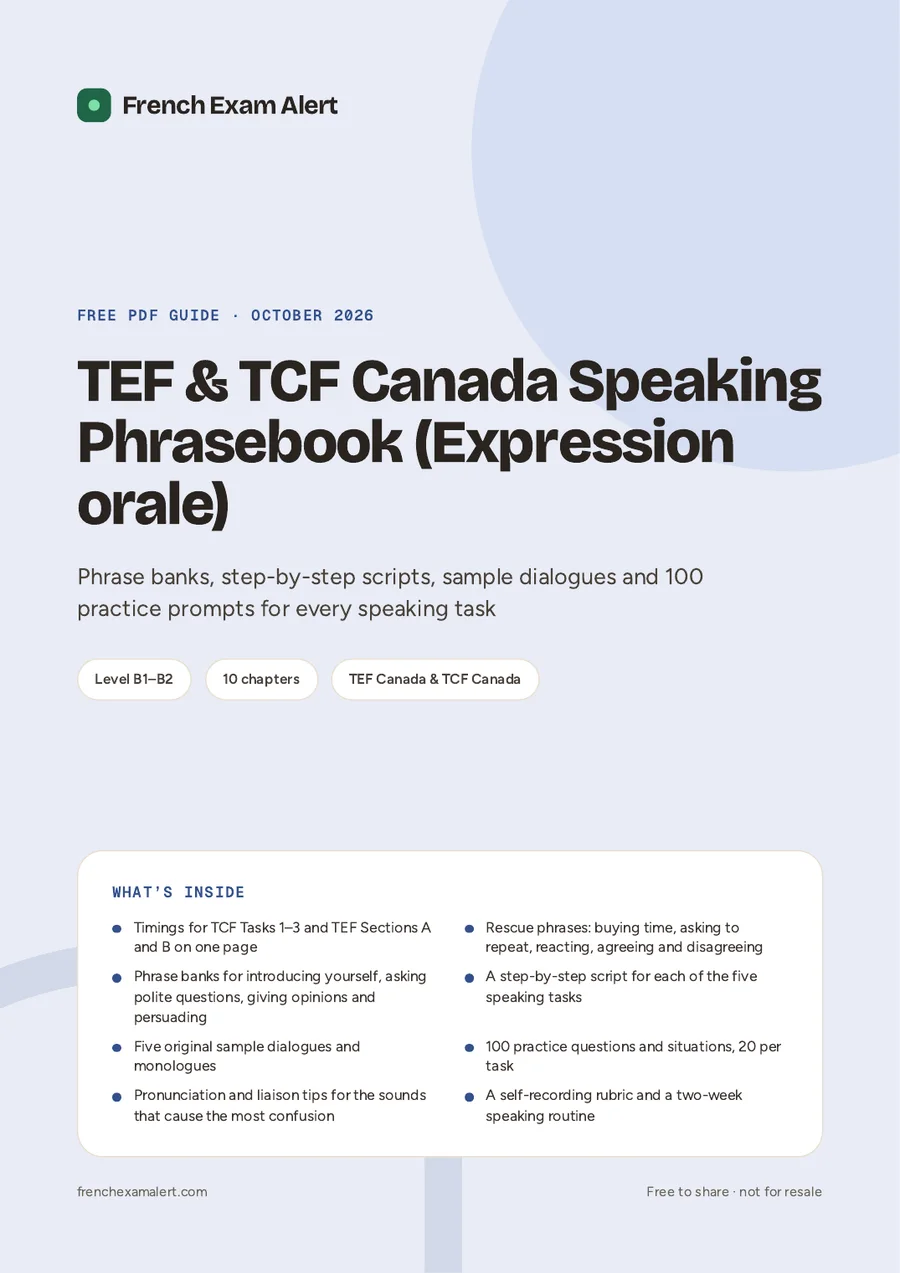 Free PDF · 29 pagesTEF & TCF Canada Speaking Phrasebook (Expression orale)Phrase banks, step-by-step scripts, sample dialogues and 100 practice prompts for every speaking task