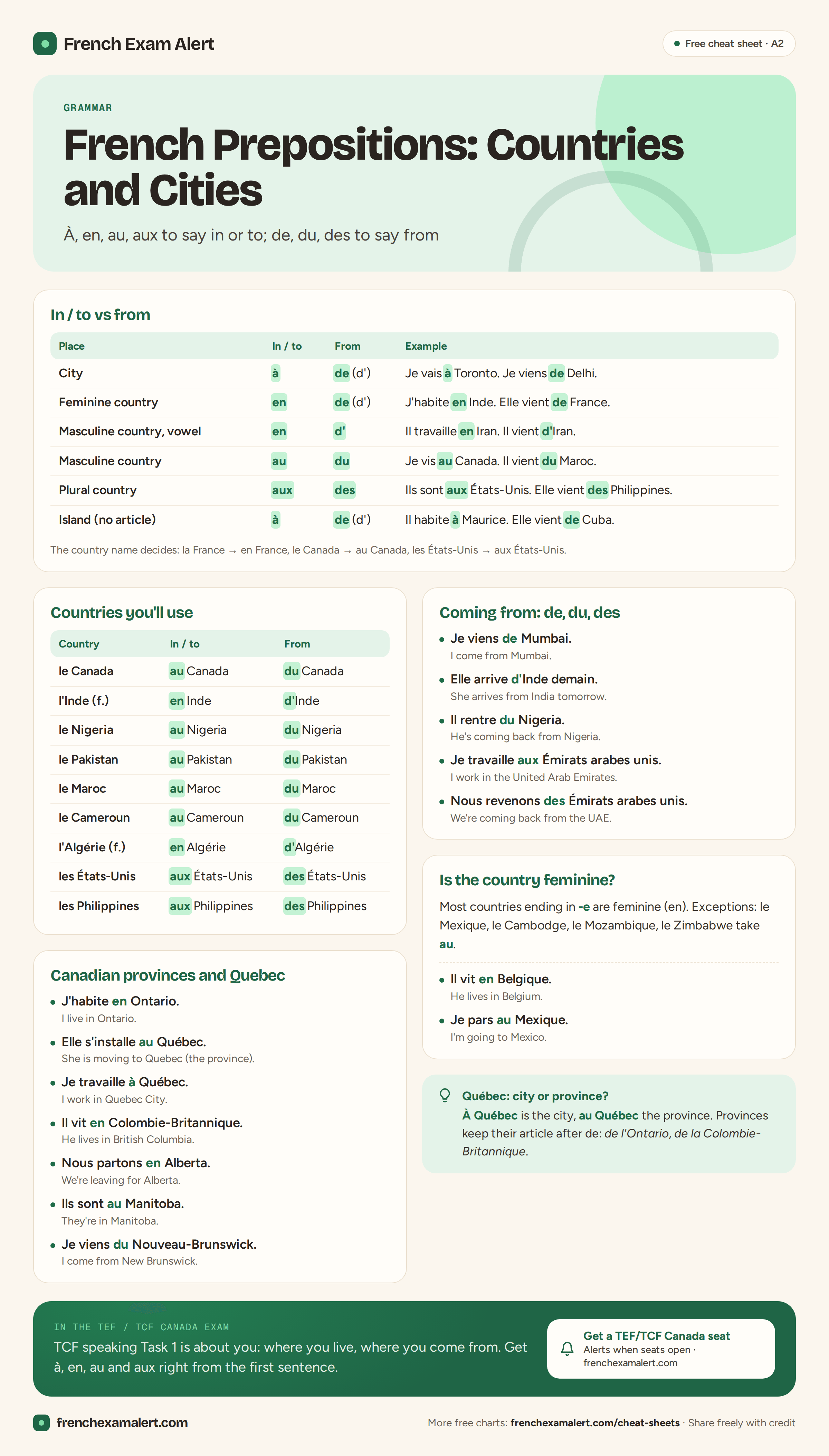
French Prepositions: Countries and Cities
Use à before a city, en before a feminine country or one that starts with a vowel, au before a masculine country and aux before a plural one. To say where you come from, use de (d') for cities and feminine countries, du for masculine countries and des for plural ones. Most countries ending in -e are feminine.
Free to print and share with credit to French Exam Alert (licence). 2400×4214px.
In the TEF / TCF Canada exam
TCF speaking Task 1 is about you: where you live, where you come from. Get à, en, au and aux right from the first sentence.
French Prepositions: Countries and Cities: the full chart as text
In / to vs from
| Place | In / to | From | Example |
|---|---|---|---|
| City | à | de (d') | Je vais à Toronto. Je viens de Delhi. |
| Feminine country | en | de (d') | J'habite en Inde. Elle vient de France. |
| Masculine country, vowel | en | d' | Il travaille en Iran. Il vient d'Iran. |
| Masculine country | au | du | Je vis au Canada. Il vient du Maroc. |
| Plural country | aux | des | Ils sont aux États-Unis. Elle vient des Philippines. |
| Island (no article) | à | de (d') | Il habite à Maurice. Elle vient de Cuba. |
The country name decides: la France → en France, le Canada → au Canada, les États-Unis → aux États-Unis.
Countries you'll use
| Country | In / to | From |
|---|---|---|
| le Canada | au Canada | du Canada |
| l'Inde (f.) | en Inde | d'Inde |
| le Nigeria | au Nigeria | du Nigeria |
| le Pakistan | au Pakistan | du Pakistan |
| le Maroc | au Maroc | du Maroc |
| le Cameroun | au Cameroun | du Cameroun |
| l'Algérie (f.) | en Algérie | d'Algérie |
| les États-Unis | aux États-Unis | des États-Unis |
| les Philippines | aux Philippines | des Philippines |
Canadian provinces and Quebec
- J'habite en Ontario.I live in Ontario.
- Elle s'installe au Québec.She is moving to Quebec (the province).
- Je travaille à Québec.I work in Quebec City.
- Il vit en Colombie-Britannique.He lives in British Columbia.
- Nous partons en Alberta.We're leaving for Alberta.
- Ils sont au Manitoba.They're in Manitoba.
- Je viens du Nouveau-Brunswick.I come from New Brunswick.
Coming from: de, du, des
- Je viens de Mumbai.I come from Mumbai.
- Elle arrive d'Inde demain.She arrives from India tomorrow.
- Il rentre du Nigeria.He's coming back from Nigeria.
- Je travaille aux Émirats arabes unis.I work in the United Arab Emirates.
- Nous revenons des Émirats arabes unis.We're coming back from the UAE.
Is the country feminine?
Most countries ending in -e are feminine (en). Exceptions: le Mexique, le Cambodge, le Mozambique, le Zimbabwe take au.
- Il vit en Belgique.He lives in Belgium.
- Je pars au Mexique.I'm going to Mexico.
Go deeper

Preparing for TEF or TCF Canada?
Seats at many centres sell out within minutes. Pick your cities and we alert you by email or WhatsApp the moment one opens.
Questions
Au Canada. Canada is masculine (le Canada) and starts with a consonant, so it takes au. To say from Canada, use du Canada: Je viens du Canada.
En Inde. L'Inde is feminine, so it takes en. From India is d'Inde: Je viens d'Inde. The same pattern works for en France, en Algérie and en Chine.
À Québec means in Quebec City, because cities take à. Au Québec means in the province of Quebec, because the province is masculine (le Québec).