Essential French Grammar (A2–B2)
The grammar that moves TEF and TCF Canada writing and speaking scores, with tables, examples and self-checks
This free PDF covers the French grammar that matters most for TEF and TCF Canada writing and speaking: articles, agreement, the past and future tenses, the subjunctive, si clauses, pronouns, relative pronouns, negation, questions, comparisons, places and connectors. Each chapter gives the rule, a table, French examples with English meanings, the most common mistake and a short self-check with answers.
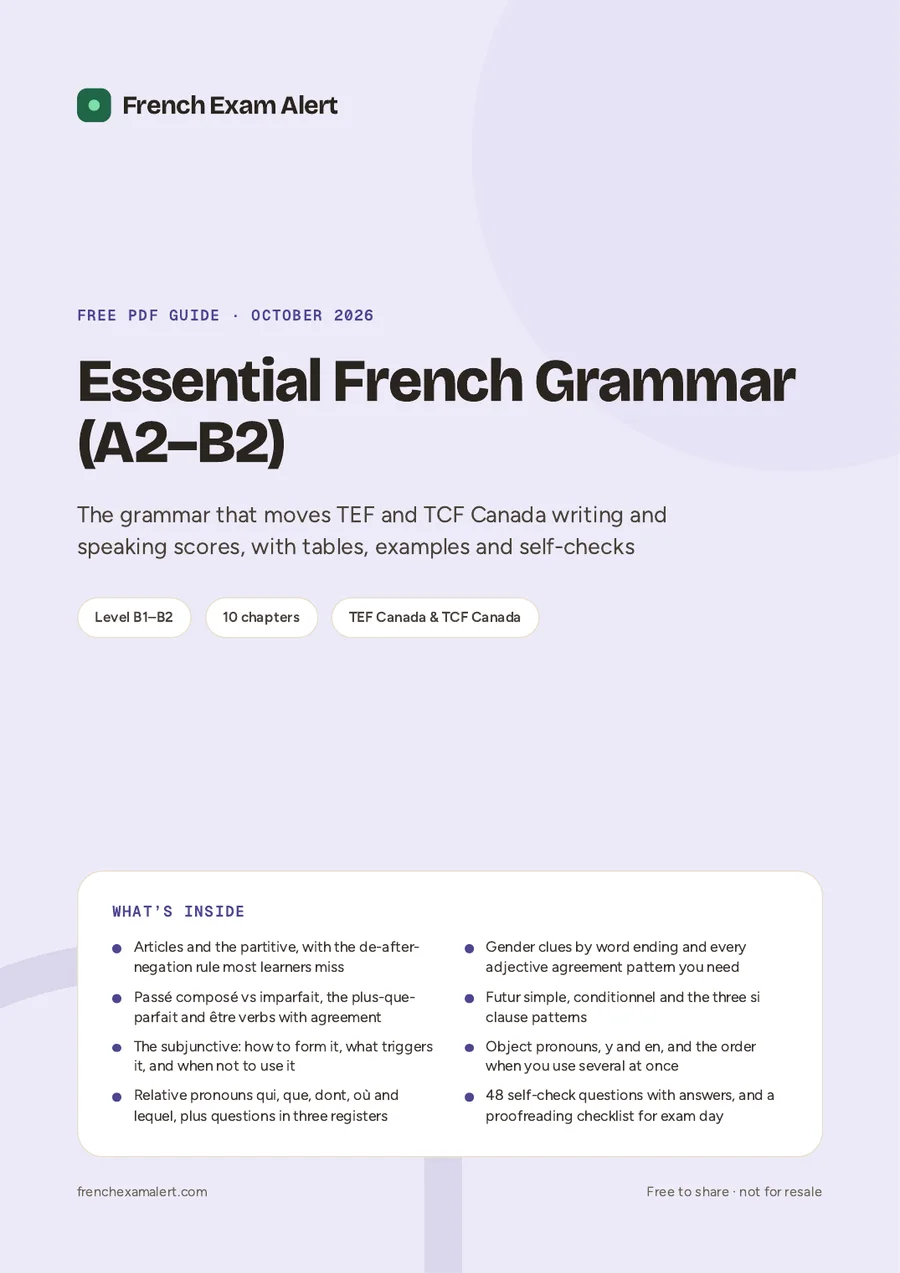
What’s inside
- Articles and the partitive, with the de-after-negation rule most learners miss
- Gender clues by word ending and every adjective agreement pattern you need
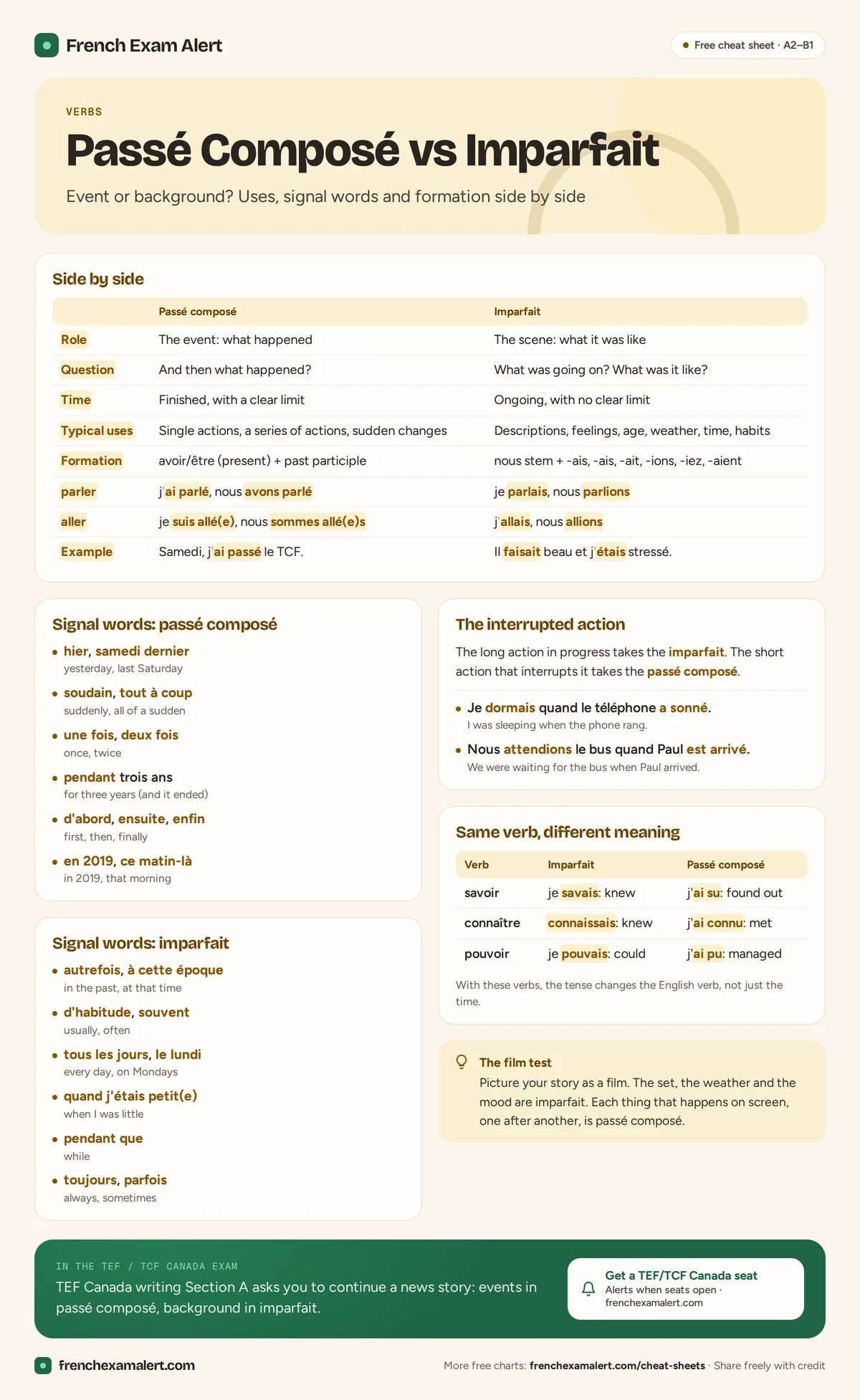
- Passé composé vs imparfait, the plus-que-parfait and être verbs with agreement
- Futur simple, conditionnel and the three si clause patterns
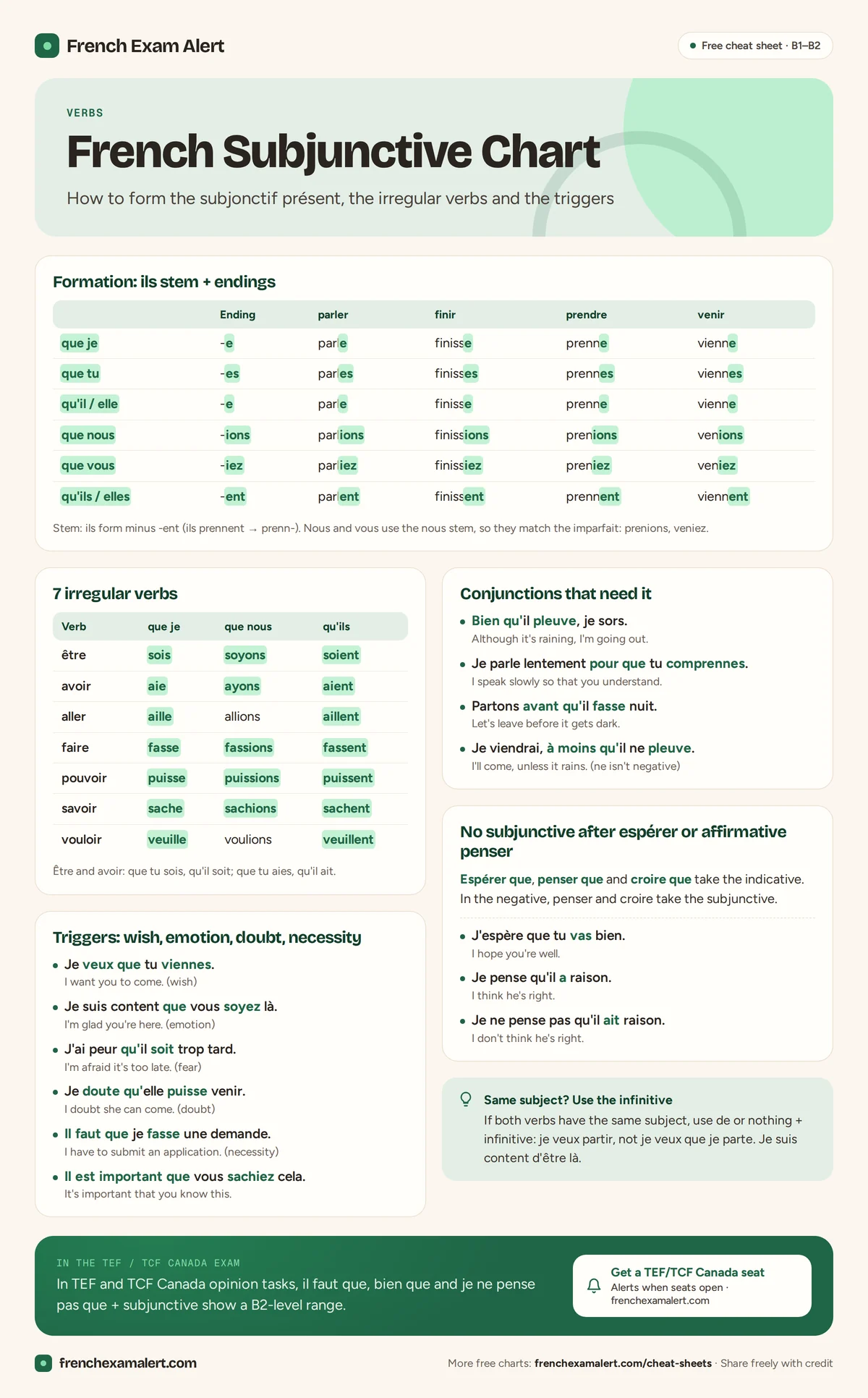
- The subjunctive: how to form it, what triggers it, and when not to use it
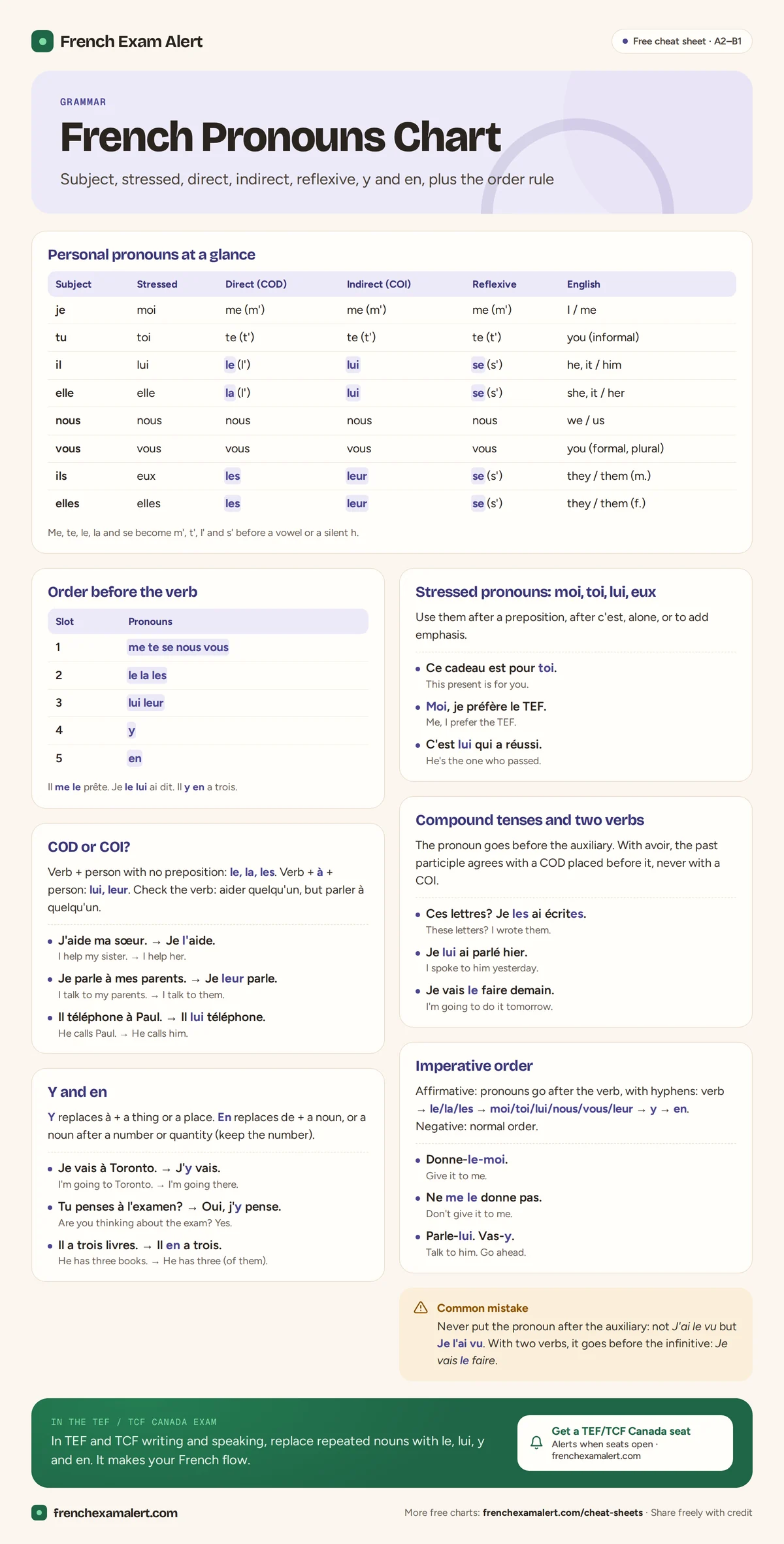
- Object pronouns, y and en, and the order when you use several at once
- Relative pronouns qui, que, dont, où and lequel, plus questions in three registers
- 48 self-check questions with answers, and a proofreading checklist for exam day
Who it’s for: Learners between A2 and B2 who are preparing for TEF Canada or TCF Canada and want their writing and speaking to be accurate.
Contents
- 01Articles, gender and agreementEvery French noun has a gender, and the article in front of it carries that information through the whole sentence.
- 02Past tenses: passé composé, imparfait, plus-que-parfaitThe passé composé tells what happened. The imparfait describes what it was like. The plus-que-parfait goes one step further back.
- 03The future, the conditional and si clausesTwo tenses built on the same stem, and three if patterns you will use in almost every argument.
- 04The subjunctiveThe subjunctive is not a tense. It is a mood that follows certain triggers, and at B1–B2 a handful of them cover almost every case.
- 05Pronouns, y and enPronouns keep your French from repeating the same noun, and their order follows a fixed pattern you can learn once.
- 06Relative pronouns: qui, que, dont, où, lequelRelative pronouns join two short sentences into one longer one, which is exactly what B2 writing looks like.
- 07Negation, questions and registerCorrect negation matters everywhere, and polite questions are the core of the speaking tasks where you ask the examiner for information.
- 08Comparisons and prepositions with placesComparing two options is the core of an argument, and saying where you live or come from is in every introduction.
- 09Connectors: putting it all togetherConnectors turn correct sentences into an organised argument, and some of them decide the mood of the verb that follows.
- 10Book your exam seatGood grammar only counts once you have a test date.
Look inside
Got your exam date yet?
TEF and TCF Canada seats at many centres sell out within minutes. Pick your cities and we alert you by email or WhatsApp the moment one opens.
Questions
For NCLC 7, focus on accurate agreement, the passé composé and imparfait, the futur and conditionnel, si clauses, the common subjunctive triggers, object pronouns and relative pronouns such as dont. This PDF covers all of them with examples and self-checks.
Yes. You can download it, print it and share it. The landing page also shows the same content as text.
It is written for learners between A2 and B2. If you are at A2, start with chapters 1 and 2. If you are at B1, spend most of your time on the subjunctive, si clauses, pronouns and relative pronouns.
Yes. Every chapter ends with a six-question self-check, and the answers are printed straight after it.
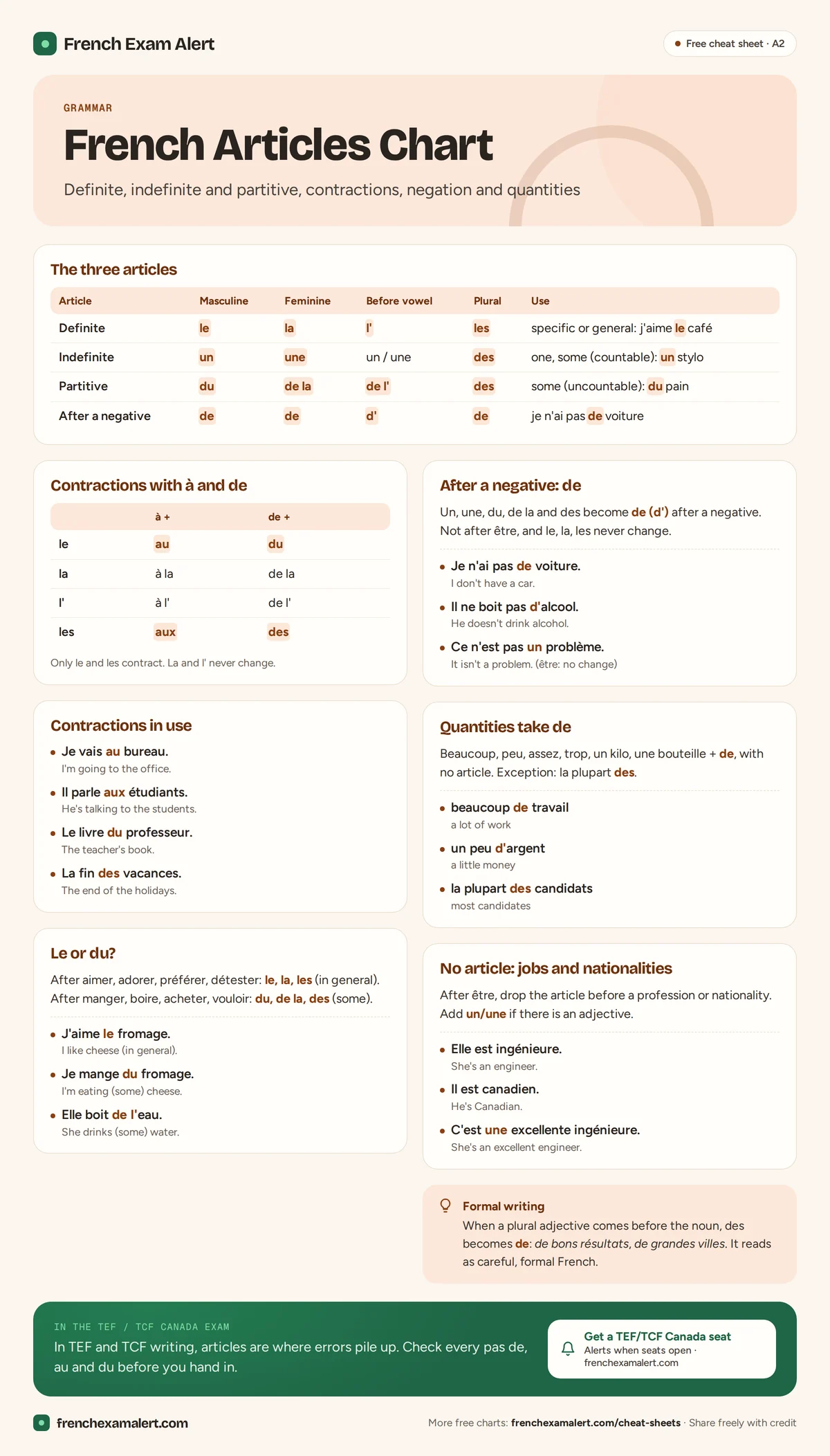
One-page cheat sheets to go with it
Related guides
TEF Canada writing and speaking: Sections A and B explained
200 words in 35 minutes, then 10 minutes to change a mind
Read the guide →TCF Canada writing: the 3 tasks, word counts and model answers
Three tasks, one clock, and a 10/20 that decides your CRS bonus
Read the guide →From NCLC 5 to NCLC 7: a calm 12-week study plan
The skill you avoid is the one that decides your French points
Read the guide →More free PDFs
All PDF guides →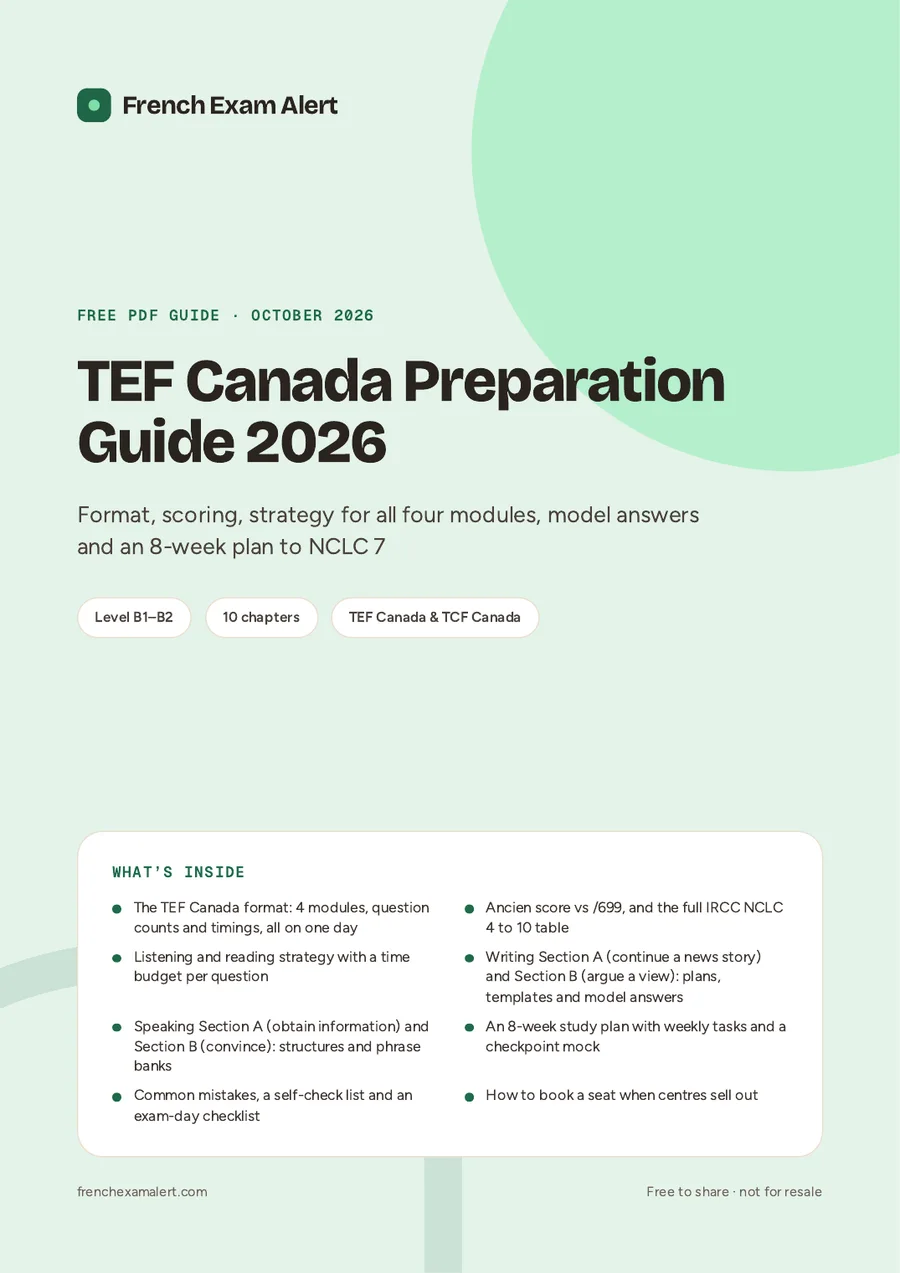 Free PDF · 26 pagesTEF Canada Preparation Guide 2026Format, scoring, strategy for all four modules, model answers and an 8-week plan to NCLC 7
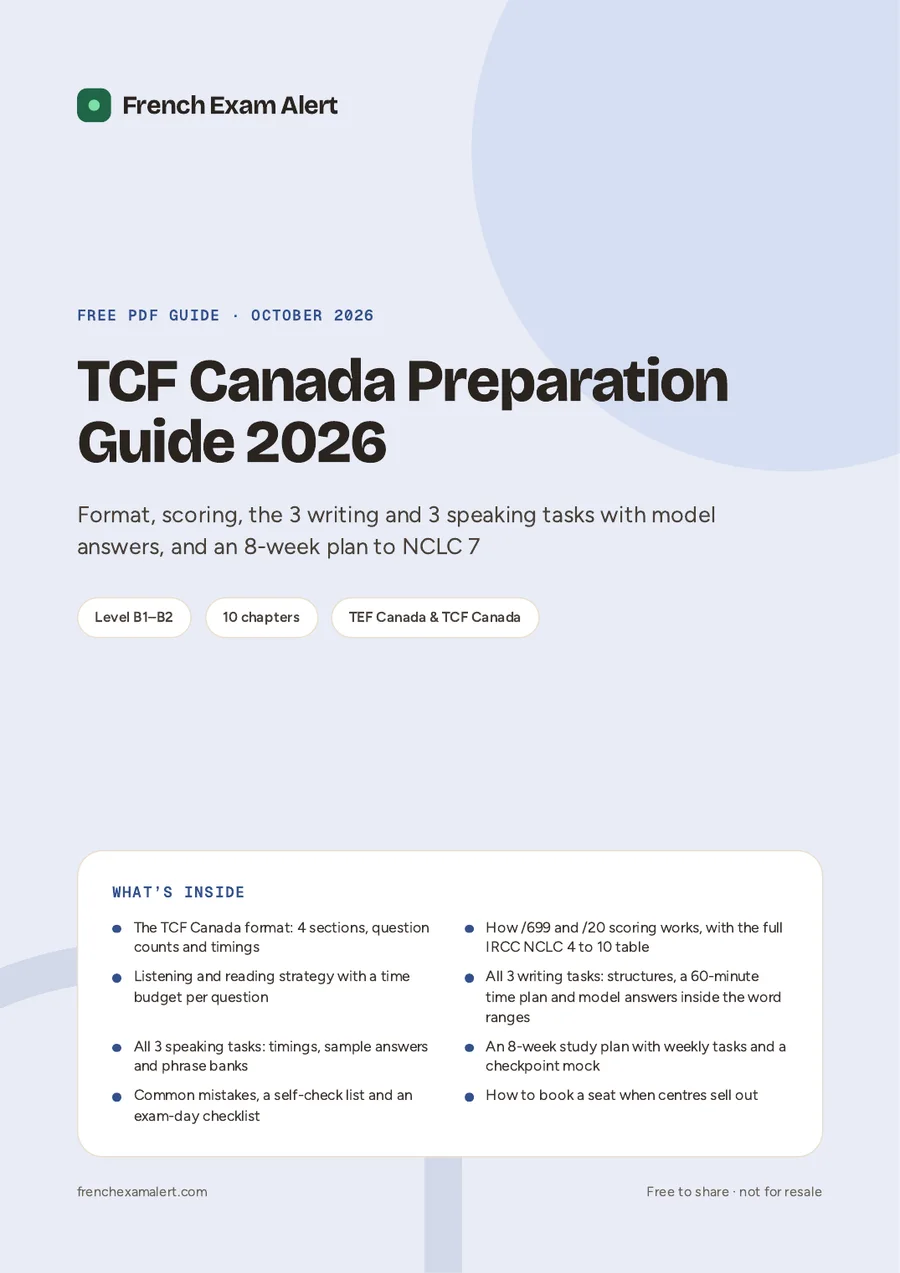 Free PDF · 24 pagesTCF Canada Preparation Guide 2026Format, scoring, the 3 writing and 3 speaking tasks with model answers, and an 8-week plan to NCLC 7
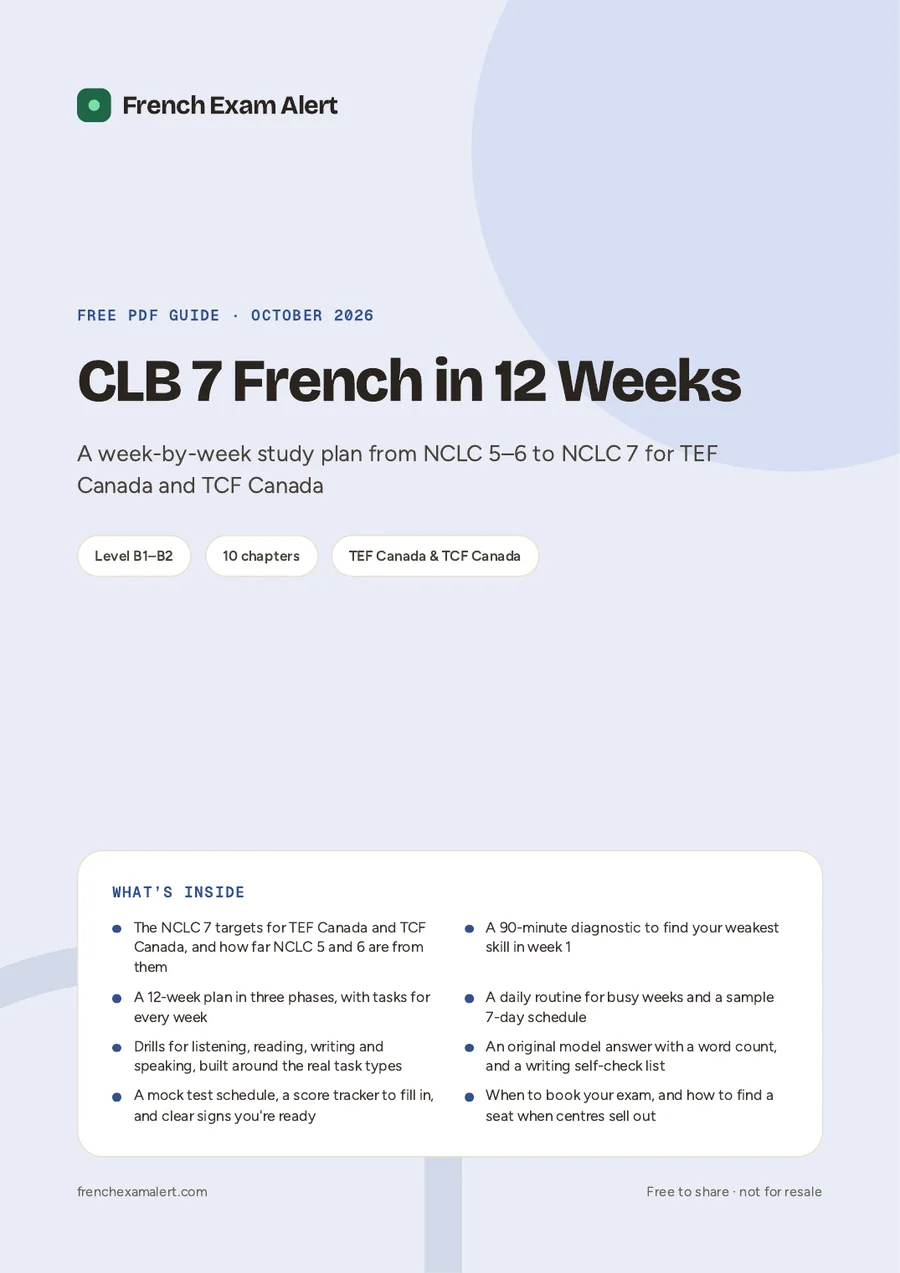 Free PDF · 26 pagesCLB 7 French in 12 WeeksA week-by-week study plan from NCLC 5–6 to NCLC 7 for TEF Canada and TCF Canada
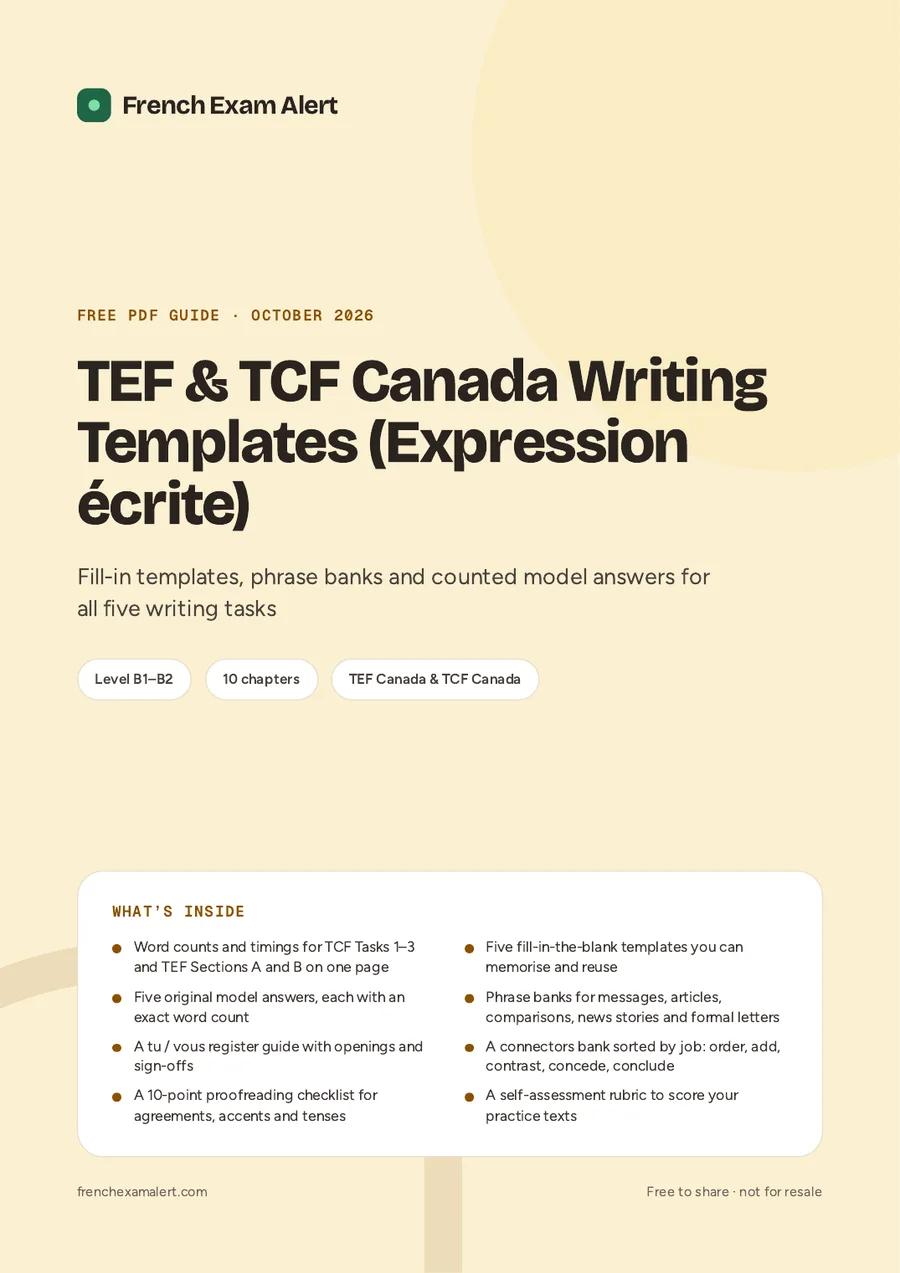 Free PDF · 28 pagesTEF & TCF Canada Writing Templates (Expression écrite)Fill-in templates, phrase banks and counted model answers for all five writing tasks