French Pronouns Chart
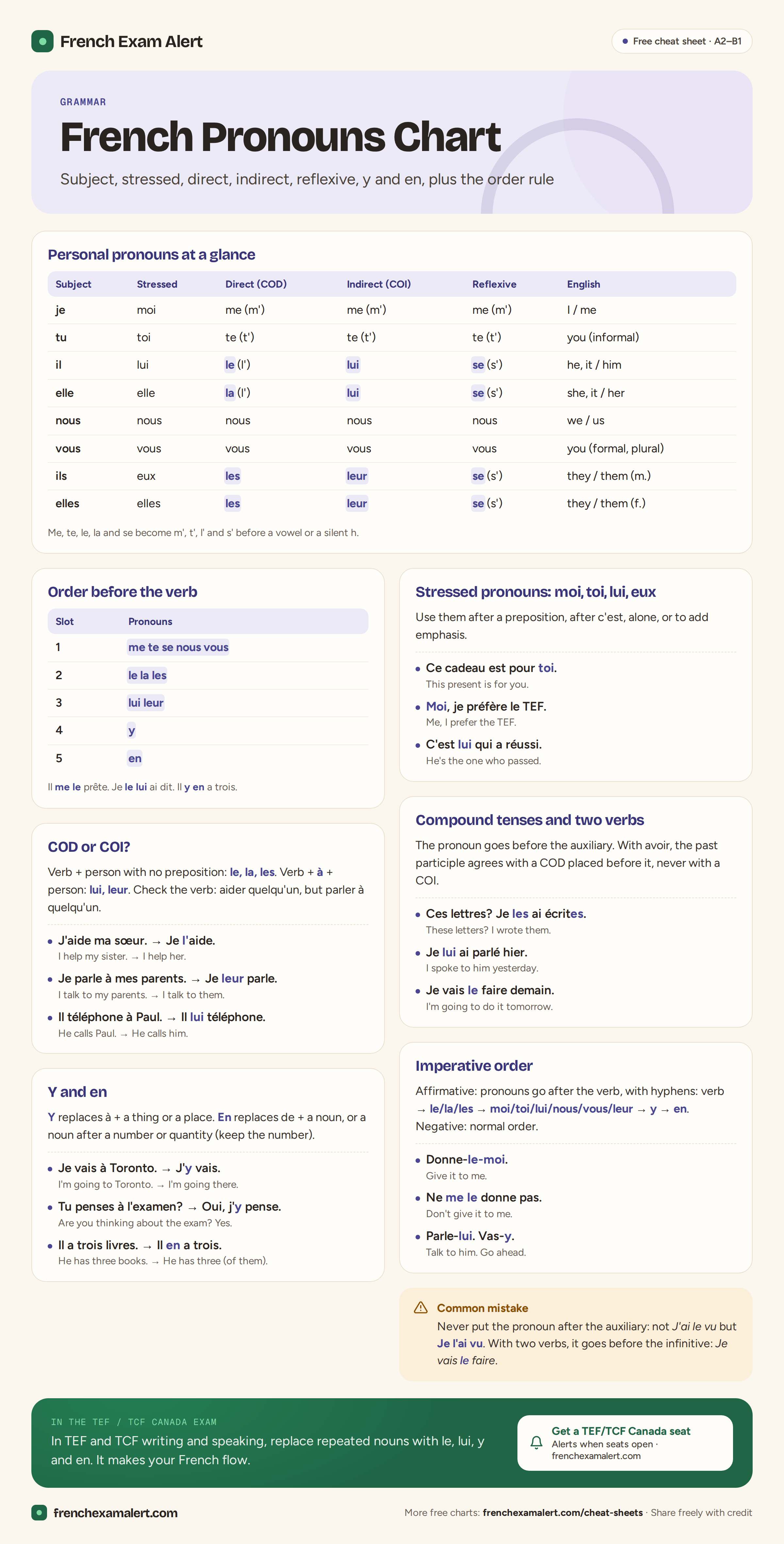
French has five sets of personal pronouns: subject (je), stressed (moi), direct object (me, le, la), indirect object (me, lui, leur) and reflexive (me, se), plus y and en. Object pronouns go before the conjugated verb, in a fixed order: me/te/se/nous/vous, then le/la/les, then lui/leur, then y, then en. In the affirmative imperative they move after the verb.
Free to print and share with credit to French Exam Alert (licence). 2400×4724px.
In the TEF / TCF Canada exam
In TEF and TCF writing and speaking, replace repeated nouns with le, lui, y and en. It makes your French flow.
French Pronouns Chart: the full chart as text
Personal pronouns at a glance
| Subject | Stressed | Direct (COD) | Indirect (COI) | Reflexive | English |
|---|---|---|---|---|---|
| je | moi | me (m') | me (m') | me (m') | I / me |
| tu | toi | te (t') | te (t') | te (t') | you (informal) |
| il | lui | le (l') | lui | se (s') | he, it / him |
| elle | elle | la (l') | lui | se (s') | she, it / her |
| nous | nous | nous | nous | nous | we / us |
| vous | vous | vous | vous | vous | you (formal, plural) |
| ils | eux | les | leur | se (s') | they / them (m.) |
| elles | elles | les | leur | se (s') | they / them (f.) |
Me, te, le, la and se become m', t', l' and s' before a vowel or a silent h.
Order before the verb
| Slot | Pronouns |
|---|---|
| 1 | me te se nous vous |
| 2 | le la les |
| 3 | lui leur |
| 4 | y |
| 5 | en |
Il me le prête. Je le lui ai dit. Il y en a trois.
COD or COI?
Verb + person with no preposition: le, la, les. Verb + à + person: lui, leur. Check the verb: aider quelqu'un, but parler à quelqu'un.
- J'aide ma sœur. → Je l'aide.I help my sister. → I help her.
- Je parle à mes parents. → Je leur parle.I talk to my parents. → I talk to them.
- Il téléphone à Paul. → Il lui téléphone.He calls Paul. → He calls him.
Y and en
Y replaces à + a thing or a place. En replaces de + a noun, or a noun after a number or quantity (keep the number).
- Je vais à Toronto. → J'y vais.I'm going to Toronto. → I'm going there.
- Tu penses à l'examen? → Oui, j'y pense.Are you thinking about the exam? Yes.
- Il a trois livres. → Il en a trois.He has three books. → He has three (of them).
Stressed pronouns: moi, toi, lui, eux
Use them after a preposition, after c'est, alone, or to add emphasis.
- Ce cadeau est pour toi.This present is for you.
- Moi, je préfère le TEF.Me, I prefer the TEF.
- C'est lui qui a réussi.He's the one who passed.
Compound tenses and two verbs
The pronoun goes before the auxiliary. With avoir, the past participle agrees with a COD placed before it, never with a COI.
- Ces lettres? Je les ai écrites.These letters? I wrote them.
- Je lui ai parlé hier.I spoke to him yesterday.
- Je vais le faire demain.I'm going to do it tomorrow.
Imperative order
Affirmative: pronouns go after the verb, with hyphens: verb → le/la/les → moi/toi/lui/nous/vous/leur → y → en. Negative: normal order.
- Donne-le-moi.Give it to me.
- Ne me le donne pas.Don't give it to me.
- Parle-lui. Vas-y.Talk to him. Go ahead.
Go deeper
Preparing for TEF or TCF Canada?
Seats at many centres sell out within minutes. Pick your cities and we alert you by email or WhatsApp the moment one opens.
Questions
Before the verb: me, te, se, nous, vous come first, then le, la, les, then lui, leur, then y, then en. For example: Il me le donne. Je le lui ai dit. Il y en a trois.
Look at the verb. If it takes a person directly (aider quelqu'un, voir quelqu'un), use le, la or les. If it takes à + person (parler à, téléphoner à, demander à), use lui or leur.
Y replaces à + a thing or a place: J'y vais (I'm going there). En replaces de + a noun or a quantity: J'en ai deux (I have two of them). For à + a person, use lui or leur, not y.