French Relative Pronouns
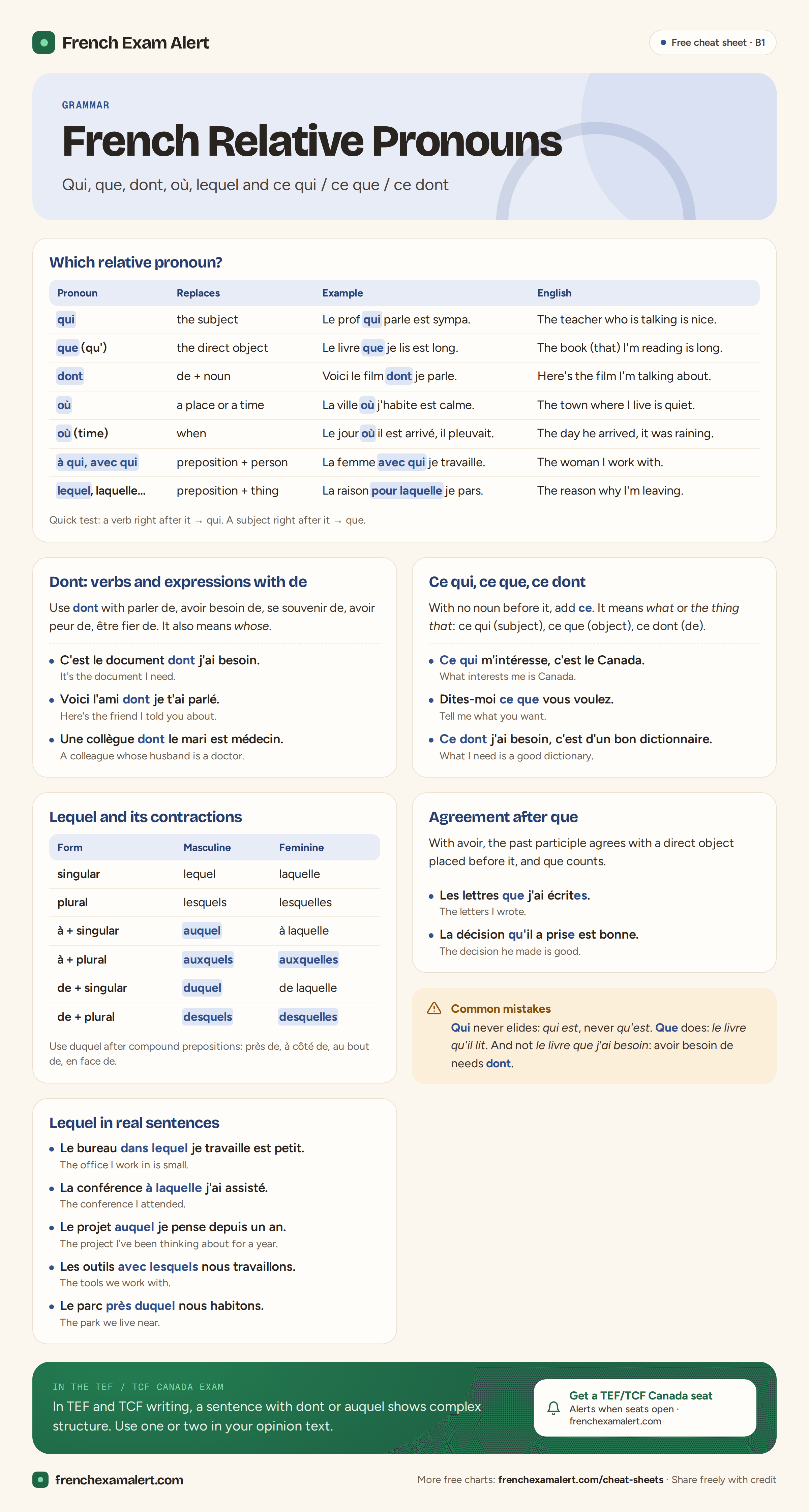
Use qui when the pronoun is the subject of the next verb, que when it is the direct object, dont to replace de + noun, and où for a place or a time. After a preposition, use qui for people and lequel (laquelle, lesquels, lesquelles) for things. With no noun in front, add ce: ce qui, ce que, ce dont.
Free to print and share with credit to French Exam Alert (licence). 2400×4488px.
In the TEF / TCF Canada exam
In TEF and TCF writing, a sentence with dont or auquel shows complex structure. Use one or two in your opinion text.
French Relative Pronouns: the full chart as text
Which relative pronoun?
| Pronoun | Replaces | Example | English |
|---|---|---|---|
| qui | the subject | Le prof qui parle est sympa. | The teacher who is talking is nice. |
| que (qu') | the direct object | Le livre que je lis est long. | The book (that) I'm reading is long. |
| dont | de + noun | Voici le film dont je parle. | Here's the film I'm talking about. |
| où | a place or a time | La ville où j'habite est calme. | The town where I live is quiet. |
| où (time) | when | Le jour où il est arrivé, il pleuvait. | The day he arrived, it was raining. |
| à qui, avec qui | preposition + person | La femme avec qui je travaille. | The woman I work with. |
| lequel, laquelle… | preposition + thing | La raison pour laquelle je pars. | The reason why I'm leaving. |
Quick test: a verb right after it → qui. A subject right after it → que.
Dont: verbs and expressions with de
Use dont with parler de, avoir besoin de, se souvenir de, avoir peur de, être fier de. It also means whose.
- C'est le document dont j'ai besoin.It's the document I need.
- Voici l'ami dont je t'ai parlé.Here's the friend I told you about.
- Une collègue dont le mari est médecin.A colleague whose husband is a doctor.
Lequel and its contractions
| Form | Masculine | Feminine |
|---|---|---|
| singular | lequel | laquelle |
| plural | lesquels | lesquelles |
| à + singular | auquel | à laquelle |
| à + plural | auxquels | auxquelles |
| de + singular | duquel | de laquelle |
| de + plural | desquels | desquelles |
Use duquel after compound prepositions: près de, à côté de, au bout de, en face de.
Lequel in real sentences
- Le bureau dans lequel je travaille est petit.The office I work in is small.
- La conférence à laquelle j'ai assisté.The conference I attended.
- Le projet auquel je pense depuis un an.The project I've been thinking about for a year.
- Les outils avec lesquels nous travaillons.The tools we work with.
- Le parc près duquel nous habitons.The park we live near.
Ce qui, ce que, ce dont
With no noun before it, add ce. It means what or the thing that: ce qui (subject), ce que (object), ce dont (de).
- Ce qui m'intéresse, c'est le Canada.What interests me is Canada.
- Dites-moi ce que vous voulez.Tell me what you want.
- Ce dont j'ai besoin, c'est d'un bon dictionnaire.What I need is a good dictionary.
Agreement after que
With avoir, the past participle agrees with a direct object placed before it, and que counts.
- Les lettres que j'ai écrites.The letters I wrote.
- La décision qu'il a prise est bonne.The decision he made is good.
Go deeper
Preparing for TEF or TCF Canada?
Seats at many centres sell out within minutes. Pick your cities and we alert you by email or WhatsApp the moment one opens.
Questions
Qui is the subject of the verb that follows: l'homme qui parle. Que is the direct object, so another subject follows it: l'homme que je connais. Que becomes qu' before a vowel; qui never changes.
Use dont to replace de + noun, typically with verbs and expressions built with de: parler de, avoir besoin de, se souvenir de. It also translates whose: une amie dont le frère vit à Montréal.
After a preposition, use qui for people (la personne avec qui je travaille) and lequel, laquelle, lesquels or lesquelles for things (la table sur laquelle j'écris). With à and de, lequel contracts to auquel and duquel.