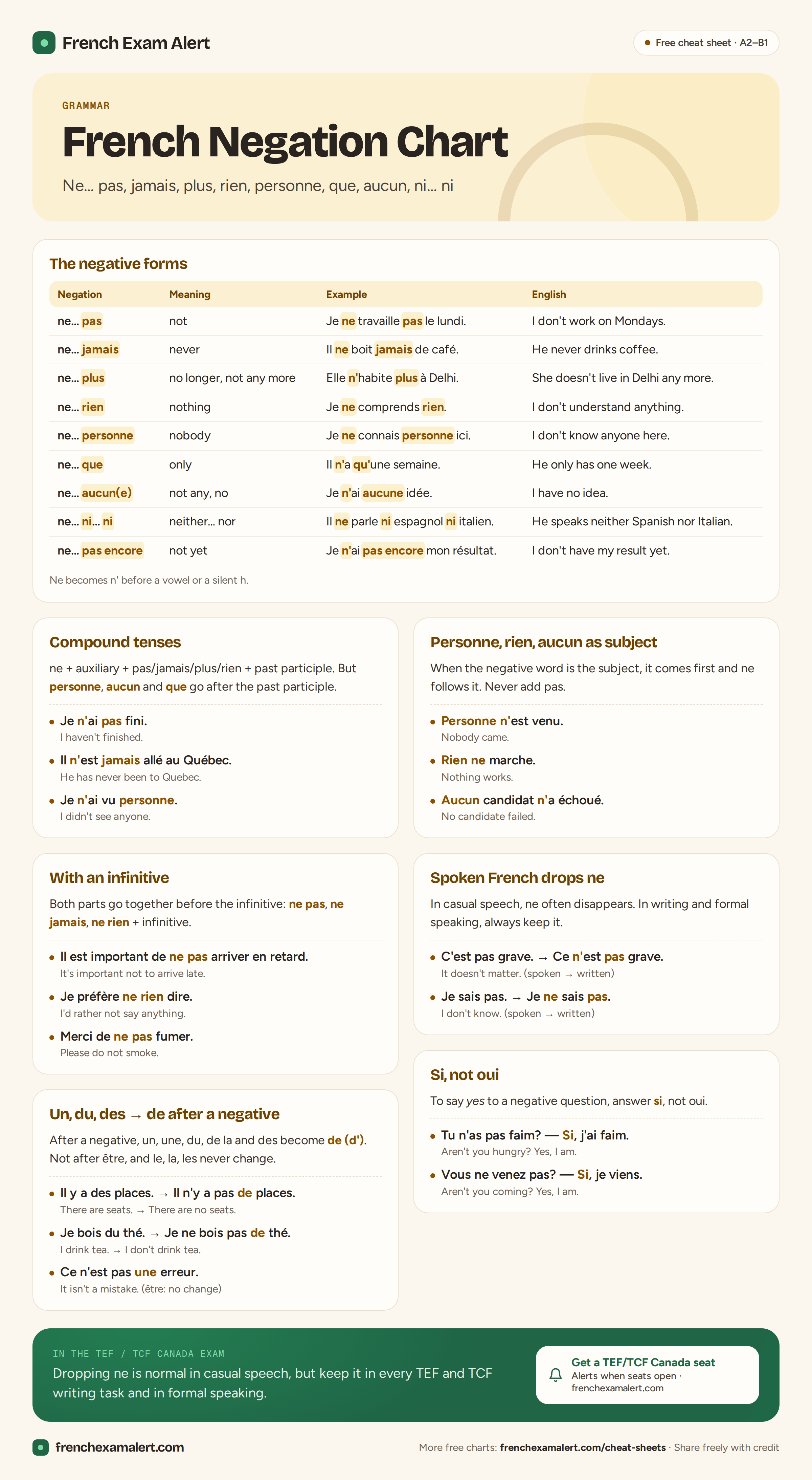
French Negation Chart
French negation has two parts: ne goes before the conjugated verb and pas (or jamais, plus, rien…) goes after it. In compound tenses the second word sits before the past participle, except personne, aucun and que, which go after it. Before an infinitive, both parts come together: ne pas faire.
Free to print and share with credit to French Exam Alert (licence). 2400×4372px.
In the TEF / TCF Canada exam
Dropping ne is normal in casual speech, but keep it in every TEF and TCF writing task and in formal speaking.
French Negation Chart: the full chart as text
The negative forms
| Negation | Meaning | Example | English |
|---|---|---|---|
| ne… pas | not | Je ne travaille pas le lundi. | I don't work on Mondays. |
| ne… jamais | never | Il ne boit jamais de café. | He never drinks coffee. |
| ne… plus | no longer, not any more | Elle n'habite plus à Delhi. | She doesn't live in Delhi any more. |
| ne… rien | nothing | Je ne comprends rien. | I don't understand anything. |
| ne… personne | nobody | Je ne connais personne ici. | I don't know anyone here. |
| ne… que | only | Il n'a qu'une semaine. | He only has one week. |
| ne… aucun(e) | not any, no | Je n'ai aucune idée. | I have no idea. |
| ne… ni… ni | neither… nor | Il ne parle ni espagnol ni italien. | He speaks neither Spanish nor Italian. |
| ne… pas encore | not yet | Je n'ai pas encore mon résultat. | I don't have my result yet. |
Ne becomes n' before a vowel or a silent h.
Compound tenses
ne + auxiliary + pas/jamais/plus/rien + past participle. But personne, aucun and que go after the past participle.
- Je n'ai pas fini.I haven't finished.
- Il n'est jamais allé au Québec.He has never been to Quebec.
- Je n'ai vu personne.I didn't see anyone.
With an infinitive
Both parts go together before the infinitive: ne pas, ne jamais, ne rien + infinitive.
- Il est important de ne pas arriver en retard.It's important not to arrive late.
- Je préfère ne rien dire.I'd rather not say anything.
- Merci de ne pas fumer.Please do not smoke.
Un, du, des → de after a negative
After a negative, un, une, du, de la and des become de (d'). Not after être, and le, la, les never change.
- Il y a des places. → Il n'y a pas de places.There are seats. → There are no seats.
- Je bois du thé. → Je ne bois pas de thé.I drink tea. → I don't drink tea.
- Ce n'est pas une erreur.It isn't a mistake. (être: no change)
Personne, rien, aucun as subject
When the negative word is the subject, it comes first and ne follows it. Never add pas.
- Personne n'est venu.Nobody came.
- Rien ne marche.Nothing works.
- Aucun candidat n'a échoué.No candidate failed.
Spoken French drops ne
In casual speech, ne often disappears. In writing and formal speaking, always keep it.
- C'est pas grave. → Ce n'est pas grave.It doesn't matter. (spoken → written)
- Je sais pas. → Je ne sais pas.I don't know. (spoken → written)
Si, not oui
To say yes to a negative question, answer si, not oui.
- Tu n'as pas faim? — Si, j'ai faim.Aren't you hungry? Yes, I am.
- Vous ne venez pas? — Si, je viens.Aren't you coming? Yes, I am.
Go deeper

Preparing for TEF or TCF Canada?
Seats at many centres sell out within minutes. Pick your cities and we alert you by email or WhatsApp the moment one opens.
Questions
Between the auxiliary and the past participle: Je n'ai pas mangé. The same goes for jamais, plus and rien. Personne, aucun and que go after the past participle: Je n'ai vu personne.
Dropping ne is normal in everyday spoken French. It is informal, so in writing, in formal letters and in exam writing tasks you should always write the full form: je ne sais pas.
Use si to contradict a negative question or statement. Tu ne viens pas? Si, je viens means 'Aren't you coming? Yes, I am.' Answering oui here would sound wrong.