French Adjectives and BAGS
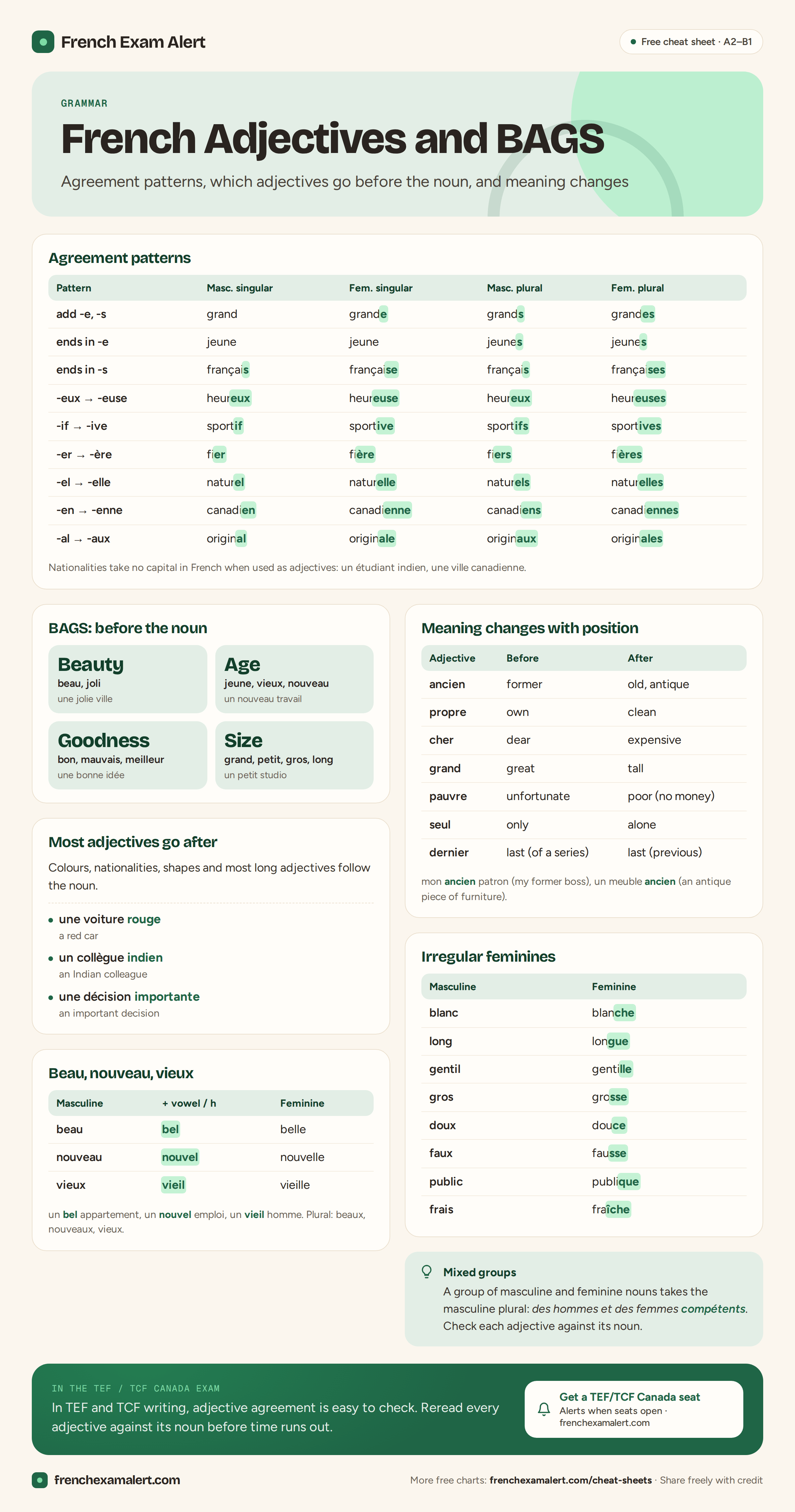
French adjectives agree with their noun: add -e for feminine and -s for plural, with set patterns such as -eux → -euse and -if → -ive. Most adjectives go after the noun. BAGS adjectives (beauty, age, goodness, size) go before it, and a few, like ancien and cher, change meaning with their position.
Free to print and share with credit to French Exam Alert (licence). 2400×4566px.
In the TEF / TCF Canada exam
In TEF and TCF writing, adjective agreement is easy to check. Reread every adjective against its noun before time runs out.
French Adjectives and BAGS: the full chart as text
Agreement patterns
| Pattern | Masc. singular | Fem. singular | Masc. plural | Fem. plural |
|---|---|---|---|---|
| add -e, -s | grand | grande | grands | grandes |
| ends in -e | jeune | jeune | jeunes | jeunes |
| ends in -s | français | française | français | françaises |
| -eux → -euse | heureux | heureuse | heureux | heureuses |
| -if → -ive | sportif | sportive | sportifs | sportives |
| -er → -ère | fier | fière | fiers | fières |
| -el → -elle | naturel | naturelle | naturels | naturelles |
| -en → -enne | canadien | canadienne | canadiens | canadiennes |
| -al → -aux | original | originale | originaux | originales |
Nationalities take no capital in French when used as adjectives: un étudiant indien, une ville canadienne.
BAGS: before the noun
- Beauty
- beau, joliune jolie ville
- Age
- jeune, vieux, nouveauun nouveau travail
- Goodness
- bon, mauvais, meilleurune bonne idée
- Size
- grand, petit, gros, longun petit studio
Most adjectives go after
Colours, nationalities, shapes and most long adjectives follow the noun.
- une voiture rougea red car
- un collègue indienan Indian colleague
- une décision importantean important decision
Beau, nouveau, vieux
| Masculine | + vowel / h | Feminine |
|---|---|---|
| beau | bel | belle |
| nouveau | nouvel | nouvelle |
| vieux | vieil | vieille |
un bel appartement, un nouvel emploi, un vieil homme. Plural: beaux, nouveaux, vieux.
Meaning changes with position
| Adjective | Before | After |
|---|---|---|
| ancien | former | old, antique |
| propre | own | clean |
| cher | dear | expensive |
| grand | great | tall |
| pauvre | unfortunate | poor (no money) |
| seul | only | alone |
| dernier | last (of a series) | last (previous) |
mon ancien patron (my former boss), un meuble ancien (an antique piece of furniture).
Irregular feminines
| Masculine | Feminine |
|---|---|
| blanc | blanche |
| long | longue |
| gentil | gentille |
| gros | grosse |
| doux | douce |
| faux | fausse |
| public | publique |
| frais | fraîche |
Go deeper
Preparing for TEF or TCF Canada?
Seats at many centres sell out within minutes. Pick your cities and we alert you by email or WhatsApp the moment one opens.
Questions
Beauty, Age, Goodness and Size. Adjectives in these groups, such as beau, jeune, nouveau, bon, mauvais, grand and petit, usually go before the noun: une belle maison, un petit appartement. Most other adjectives go after it.
Before a masculine singular noun that starts with a vowel or a silent h: un bel homme, un nouvel ami, un vieil hôtel. They make the words easier to say. The feminine forms are belle, nouvelle and vieille.
The common ones are ancien (former / old), propre (own / clean), cher (dear / expensive), grand (great / tall), pauvre (unfortunate / poor) and seul (only / alone). Before the noun the meaning is usually figurative.