With 30 days left, do a full timed mock in the first 3 days, spend the next two weeks on your weakest skill (about half your study time), do one timed full mock a week in the third and fourth weeks, and keep the last 3 days light. One month realistically moves a skill up about one NCLC level, mostly through exam technique, timing and task structure. It won't take you from A2 to B2.
Key takeaways
- Days 1–3: one full timed mock. Your scores pick your priorities.
- Give your weakest skill about half your time until day 18.
- From day 19: timed full mocks, then fix what they show.
- Last 3 days: light review, documents, sleep. No new material.
- Realistic gain: about +1 NCLC in a skill, not a jump of two CEFR levels.
On this page
You have a seat and about four weeks. This is not the time to start a textbook from page one. It's the time to find out exactly where you stand, put your hours where they move your score most, and arrive on exam day rested and used to the clock.
If you have three months or more, use the 3- or 6-month TEF Canada plan or the 12-week NCLC 5 to 7 study plan instead. This guide is for the final stretch, for both TEF Canada and TCF Canada.
- 3
- Days to diagnose with a full timed mock
- ~50%
- Of your time on your weakest skill until day 18
- +1 NCLC
- A realistic gain per skill in a month
What can you realistically gain in 30 days?
#Language level grows slowly. Estimates for moving up one CEFR level run to hundreds of hours, and NCLC 7 sits between a strong B1 and B2. Thirty days won't change your level much. They can change your score, because a lot of points are lost to things you can fix fast: running out of time, writing outside the word range, monologues in the speaking question tasks, not knowing the task types.
| Your first mock shows | Realistic in 30 days? | What to do |
|---|---|---|
| NCLC 7 or more in a skill | Yes, keep it | Maintenance only: short daily practice |
| One level short in one or two skills | Often, with focus | Half your study time on the weakest one |
| One level short in all four skills | In some, rarely in all | Put writing and speaking technique first, then reading timing |
| Two or more levels short in a skill | Unlikely | Think about moving the date, or treat this sitting as practice |
If a month feels too short, read how hard TEF Canada is at NCLC 7 to set honest targets.
What scores are you aiming for?
#| Skill | TEF NCLC 6 | TEF NCLC 7 | TCF NCLC 6 | TCF NCLC 7 |
|---|---|---|---|---|
| Listening | 217 | 249 / 360 | 398 | 458 / 699 |
| Reading | 181 | 207 / 300 | 406 | 453 / 699 |
| Writing | 271 | 310 / 450 | 7 | 10 / 20 |
| Speaking | 271 | 310 / 450 | 7 | 10 / 20 |
Each skill converts on its own, with no averaging, and the French CRS bonus needs NCLC 7 in all four. Full tables: TEF Canada score chart and TCF Canada score chart. The CLB calculator converts your mock scores in seconds.
What does the 30-day plan look like, week by week?
#The final month
- Days 1–3DiagnoseOne full timed mock of all four skills, in one sitting if you can. Mark it, convert to NCLC, and rank your skills from weakest to strongest. Start an error log: every mistake type, one line each.
- Days 4–14Attack the weakest skillAbout half your study time on your lowest skill. Learn the task structures for writing and speaking. Keep the others ticking over daily. On day 14, redo a timed section of your weakest skill and compare.
- Days 15–18Second skill, then balanceMove the focus to your second-weakest skill. Keep the first one going with shorter daily drills. Read your error log before every session.
- Days 19–27Rehearse under exam conditionsOne or two timed full mocks in this stretch, the last one no later than day 26. Between mocks, fix only what they show. Speak out loud every day on the real task timings.
- Days 28–30TaperShort, light sessions: listening you enjoy, one speaking run, your error log. Check documents, confirmation and route. Sleep. Nothing new.
Put your exam date into the planner below. It splits the days you have left into the same four phases (diagnose, build, rehearse, taper) and dates each one for you.
How many hours a day do you need?
#As many as you can sustain for 30 days without burning out. One honest hour every day beats four hours on Saturday. Pick your column and follow it on normal days.
| Block | 1 h a day | 2 h a day | 4 h a day |
|---|---|---|---|
| Weakest skill: drills and task practice | 25 min | 45 min | 1 h 30 |
| Speaking out loud, on the timer, recorded | 10 min | 20 min | 30 min |
| Writing: one task, then correct it | 10 min (alternate days with reading) | 20 min | 40 min |
| Reading: one timed set | 10 min (alternate days with writing) | 15 min | 30 min |
| Listening at natural speed | 10 min | 15 min | 30 min |
| Error log review | 5 min | 5 min | 20 min |
| Total | 1 h | 2 h | 4 h |
- Mock days replace the plan. A full mock takes about 3 hours (TEF: 40 + 60 + 60 + 15 min; TCF: 35 + 60 + 60 + 12 min). With 1 hour a day, do it on a weekend morning.
- At 1 hour a day, do two full mocks in the month (days 1–3 and around day 22). At 2 hours, three. At 4 hours, three or four.
- Add free minutes: French audio on the commute, reading the news on your phone. It doesn't replace the plan, but it keeps French in your ear.
Free official samples for your mocks (TEF sample papers from Le français des affaires, TCF listening practice from RFI) are listed in our free TEF and TCF Canada practice tests guide, with a schedule for running a full mock at home. For a shorter timed run, try our TEF mock test online or TCF mock test online.
What should you practise in each skill in the final month?
#| Skill | What moves the score fast | Where to start |
|---|---|---|
| Listening | Read the questions before the audio. Practise with one listen only. Drill numbers, dates and times. Daily audio at natural speed | TCF listening and reading tips · TEF listening and reading tips |
| Reading | A time budget per question. Skip and come back. Read the question, then scan the text for the answer | The same tips guides: they cover a time budget for each part of the test |
| Writing | One structure per task, used every time. Know your word counts. Keep 5 minutes for a checklist of your usual errors | Writing mistakes guide and the writing practice timer |
| Speaking | Task structure, varied question forms, no long silences, reasons for every opinion | Speaking mistakes guide and the speaking practice timer |
For listening every day of the month, pick from these free French podcasts and listening resources.
What should you do in the last 3 days?
#Taper, like an athlete. Your level won't change in 72 hours, but tiredness and stress can cost you points on the day. Keep French in your ear with short, easy sessions, and get the practical side done so nothing surprises you.
Exactly what to bring is in TEF and TCF Canada exam-day documents.
In the last week, review your formal openings and closings with how to write a formal letter in French.
Should you move your exam date?
#Look at your mock from around day 14. If a skill is still two or more NCLC levels short, the honest answer is that 16 more days probably won't close the gap. You have three options:
- Move the date. Rules and fees depend on the centre, and some don't allow changes at all. Check them in rescheduling, cancelling and refunds and on your centre's page.
- Sit it anyway, as data. You get a real score report and real exam experience. You'll pay the full fee again for the next attempt, and there's a minimum gap of 20 days between two sittings of the same test (see retake rules).
- Keep the date and narrow the goal. If you need NCLC 7 in all four for the French bonus but one skill won't get there, aim for your best result in the others and plan a second sitting.
Results take about 2 weeks for TEF Canada and about 2–4 weeks for TCF Canada, depending on the centre, so factor that into any Express Entry deadline. Results stay valid for 2 years for IRCC.
- Myth
The last week is when I should study the most.
FactThe last days are for rest and light review. Cramming raises stress and tiredness, which cost you more on the day than one extra study session gains.
- Myth
A full mock every day is the fastest way to improve.
FactMocks measure. Improvement happens when you fix what they show. One or two a week, with real review in between, beats daily mocks you never analyse.
- Myth
I should spend the month on grammar books.
FactIn 30 days, exam technique and task practice pay back faster. Study only the grammar your error log keeps flagging.
- Myth
My strongest skill is safe, so I can ignore it.
FactSkills drift without practice, and one bad section can drop below NCLC 7. Keep 10–15 minutes a day on it.
Questions people ask
If you're already close to NCLC 7, often yes: a month of focused practice on exam technique can close a one-level gap. If you're starting from A2, one month isn't enough for NCLC 7 in all four skills.
In one skill it's possible, especially writing or speaking. In all four skills at once it's unlikely. A 12-week plan is the realistic timeframe for that gap.
Two to four full timed mocks: one at the start to diagnose, one or two in weeks 3 and 4, with the last one about 4 days before the exam. Review each one properly.
Lightly. A short listening session and your error log are fine. Prepare your documents, check the route and get to bed early.
Neither is easier in general. TCF Canada writing and speaking are scored out of 20, so a small improvement can cross the NCLC 7 line at 10/20. Prepare for the exact tasks of the exam you've booked.
Contact your centre as early as possible. Rescheduling and refund rules vary by centre, and many give little or nothing back close to the date.
Terms in this guide
- CEFR
- Exam session
- Convocation
- NCLC 7
- Result validity
- CRS French bonus
- Le français des affaires
- Ancien score
Each one is defined in plain English in the TEF & TCF Canada glossary.
Sources
- Le français des affaires: TEF Canada presentation
- France Éducation international: TCF Canada
- IRCC: Language testing for Express Entry
Rules and fees change. Always confirm with IRCC and your test centre before you pay.
Your next step
Free downloads for this
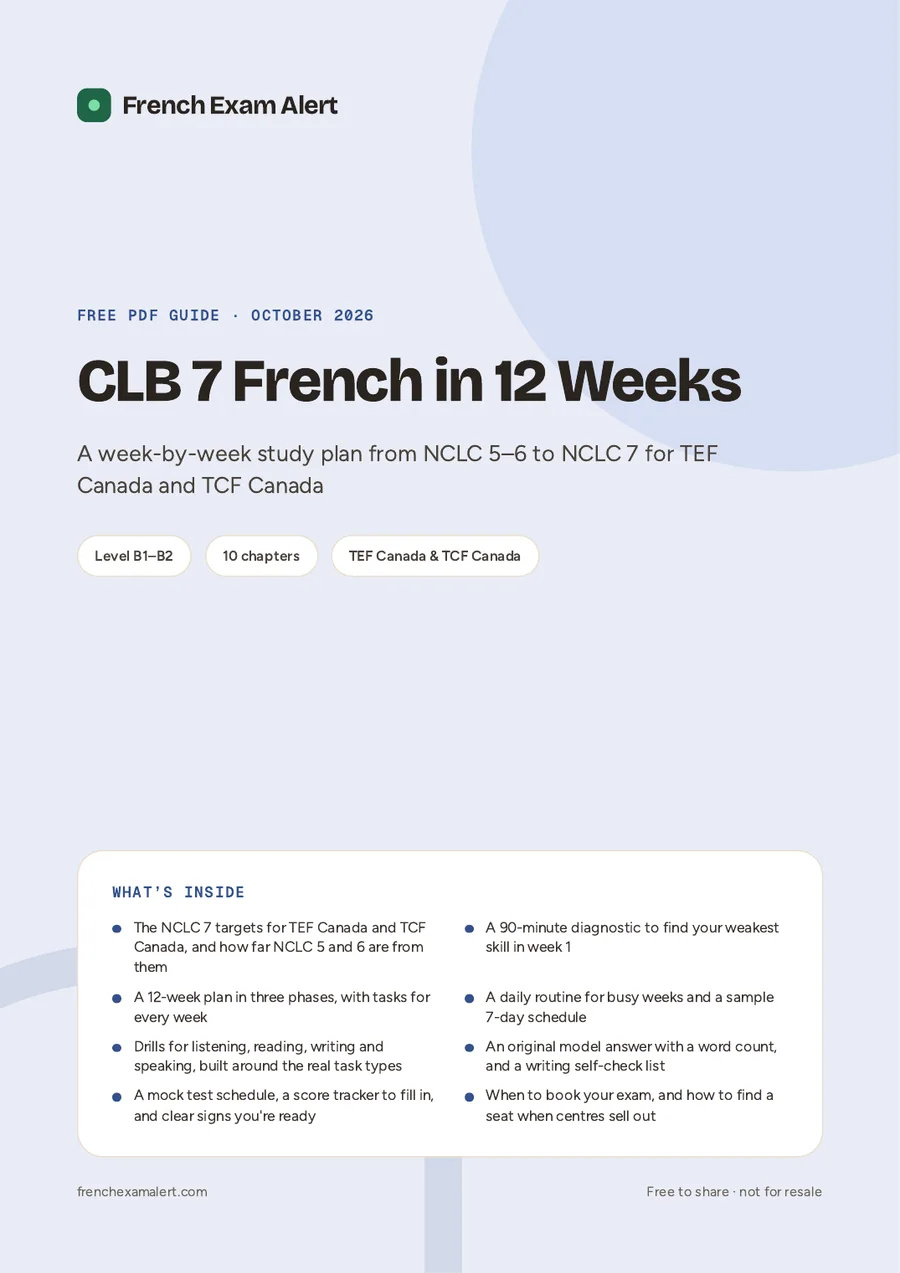 Free PDF · 26 pagesCLB 7 French in 12 WeeksA week-by-week study plan from NCLC 5–6 to NCLC 7 for TEF Canada and TCF Canada
Don’t miss the next seat.
Pick your cities. We check every booking page around the clock and alert you the moment a seat opens.