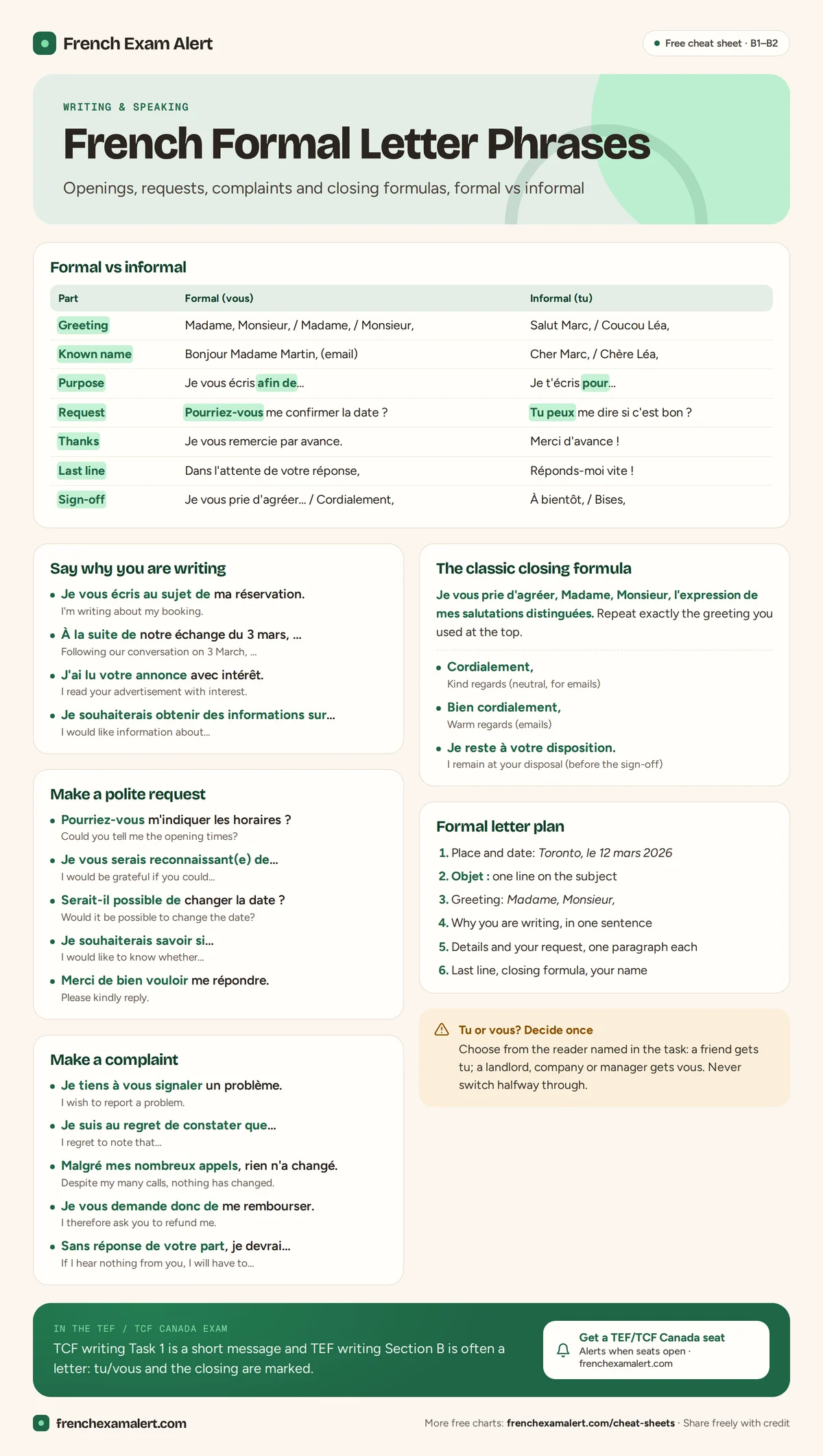
A French formal letter has eight parts in a fixed order: sender, recipient, place and date (Toronto, le 22 octobre 2026), objet (the subject line), appel (Madame, Monsieur,), the body, a formule de politesse that repeats the appel (Je vous prie d'agréer, Madame, Monsieur, mes salutations distinguées.), and your signature. Use vous from start to finish. In TEF Canada Section B you write a 200+ word letter to a newspaper; in TCF Canada a formal message often appears in Task 1 (60–120 words).
Key takeaways
- Order: sender, recipient, place and date, objet, appel, body, formule de politesse, signature.
- The closing repeats the opening exactly: Madame, Monsieur, … Madame, Monsieur.
- First sentence says why you write: Je me permets de vous écrire au sujet de…
- Formal means vous, the conditional for requests, and no spoken French.
- TEF Section B = a letter to a newspaper, 200+ words, at least 3 arguments.
On this page
- What is the structure of a formal letter in French?
- Which opening (formule d'appel) should you use?
- How do you start and end, situation by situation?
- Which formule de politesse should you use?
- Tu or vous in a formal letter?
- Example 1: a formal TCF Task 1 message (request)
- Example 2: a complaint letter that tells an experience (TCF Task 2)
- Example 3: a TEF Canada Section B letter to a newspaper
- What are the most common formal letter mistakes?
The formal letter is the one French text type that turns up in both Canadian exams. TEF Canada writing Section B asks for a letter to a newspaper (200 words minimum, 35 minutes, at least three arguments, per Le français des affaires' sample paper). TCF Canada Task 1 is often a message to a landlord, a company or a neighbour you don't know, and Task 2 can be a letter that tells an experience. Get the frame right and you collect easy points for fitting the situation before the marker reads a single argument.
This guide covers the structure, the set phrases by situation, and three full letters. For a one-page list of phrases to print, use the French formal letter phrases cheat sheet.
- 8
- Parts of a formal letter, in a fixed order
- 200+
- Words for the TEF Section B newspaper letter
- 60–120
- Words for a formal TCF Task 1 message
What is the structure of a formal letter in French?
#| # | Part | Where | Example |
|---|---|---|---|
| 1 | Expéditeur (sender) | Top left | Amina Diallo, 45 rue King, Toronto (ON) M5H 1A1 |
| 2 | Destinataire (recipient) | Right, below the sender | Service clientèle, Société Hydro-Confort, Montréal |
| 3 | Lieu et date | Right, below the recipient | Toronto, le 22 octobre 2026 |
| 4 | Objet (subject line) | Left, in bold | Objet : demande de remboursement |
| 5 | Appel (salutation) | Left, ends with a comma | Madame, Monsieur, |
| 6 | Corps (body) | Short paragraphs | Purpose → details → request or arguments → conclusion |
| 7 | Formule de politesse | After the last paragraph | Je vous prie d'agréer, Madame, Monsieur, mes salutations distinguées. |
| 8 | Signature | Bottom right | Amina Diallo |
That is the layout used in France. Québec's Office québécois de la langue française (OQLF) puts the place and date at the top right and the recipient block on the left, but the order of the core parts (date, objet, appel, body, closing, signature) is the same. Both are correct.
- The date takes le, the month in lower case, and no weekday: Ottawa, le 3 mars 2026, not Ottawa, lundi 3 Mars 2026.
- Objet is singular, with a capital O and a colon. The OQLF advises against replacing it with RE, Sujet or Concerne.
- The appel always ends with a comma, and the first word of the body still starts with a capital.
- The formule de politesse is a full sentence with a final period, and it repeats the appel word for word.
Which opening (formule d'appel) should you use?
#| You're writing to | Appel | Avoid |
|---|---|---|
| Unknown reader, a company, a newspaper | Madame, Monsieur, | Cher Monsieur, (too familiar for a stranger) · Bonjour, alone in a letter |
| A named man or woman | Monsieur, / Madame, | Monsieur Dupont, (the surname is usually left out) |
| Someone with a title | Monsieur le Directeur, / Madame la Maire, | Leaving out the title once you've used it |
| Newspaper editor | Madame, Monsieur, / Madame la Rédactrice en chef, | Chers lecteurs, (you write to the paper, not the readers) |
| A contact you know well, professionally | Chère Madame, / Cher Monsieur, | Using it with someone you've never met |
How do you start and end, situation by situation?
#Every formal letter opens by saying why you're writing in the first sentence. These are the openings and key phrases for the four situations the exams use most.
| Job | Phrase |
|---|---|
| Open | Je me vois dans l'obligation de vous écrire au sujet de… |
| State the facts | Le 4 septembre, j'ai commandé… Or, à ce jour,… |
| Show it's not the first time | Malgré plusieurs appels à votre service clientèle,… |
| Demand | Je vous demande donc de bien vouloir… dans les plus brefs délais. |
| Firm close | À défaut de réponse avant le…, je me verrai contraint(e) de… |
| Job | Phrase |
|---|---|
| Open | Je me permets de vous écrire afin d'obtenir des renseignements sur… |
| Ask | Pourriez-vous m'indiquer… ? / Je souhaiterais savoir si… |
| Softer ask | Je vous serais reconnaissant(e) de bien vouloir m'envoyer… |
| Close | Je vous remercie par avance de votre réponse. |
| Job | Phrase |
|---|---|
| Open | En réponse à votre annonce parue sur…, je souhaite vous proposer ma candidature au poste de… |
| Experience | Fort(e) de cinq ans d'expérience dans…, j'ai acquis… |
| Motivation | Votre entreprise m'intéresse particulièrement car… |
| Close | Je me tiens à votre disposition pour un entretien. |
À la suite de votre annonce is safer than Suite à votre annonce, which many style guides still criticise.
| Job | Phrase |
|---|---|
| Open | J'ai lu avec attention votre article du 12 mars affirmant que… |
| Position | Je tiens à réagir, car je ne partage pas du tout cet avis. / Je partage entièrement ce point de vue. |
| Arguments | Tout d'abord,… Ensuite,… Enfin,… |
| Concede | Certes,… Il n'en reste pas moins que… |
| Close | C'est pourquoi je souhaite que votre journal… |
Which formule de politesse should you use?
#The closing is one sentence that repeats your appel. The OQLF ranks the verbs from least to most deferential: Recevez / Agréez, then Veuillez recevoir / Veuillez agréer, then Je vous prie de recevoir / Je vous prie d'agréer.
| Situation | Formule de politesse |
|---|---|
| Default, any formal letter | Je vous prie d'agréer, Madame, Monsieur, mes salutations distinguées. |
| France, very common form | Je vous prie d'agréer, Madame, Monsieur, l'expression de mes salutations distinguées. |
| Waiting for an answer | Dans l'attente de votre réponse, je vous prie d'agréer, Madame, Monsieur, mes salutations distinguées. |
| Writing to an authority (mayor, minister) | Veuillez agréer, Madame la Maire, l'expression de ma considération respectueuse. |
| Application | Je vous prie de recevoir, Madame, Monsieur, mes salutations distinguées. |
| Formal email | Cordialement, / Bien cordialement, |
Two traps. *Avoid sentiments in professional letters: mes sentiments les meilleurs is for personal letters. And a participle opening needs a matching subject: Espérant une réponse rapide, je vous prie d'agréer… is correct; Espérant une réponse rapide, veuillez agréer…* is not, because it's you who hopes, not the reader.
Tu or vous in a formal letter?
#Always vous. A company, a landlord, a newspaper, a mayor and a neighbour you don't know all get vous, from the appel to the signature. The register also changes your grammar: requests go in the conditional (pourriez-vous, je souhaiterais, je vous serais reconnaissant) and spoken forms disappear (ne in every negative, no y a, no du coup). Mixing tu and vous is one of the 18 common writing mistakes markers spot fastest.
- Salut, je vous écris parce que y a un problème.
- Vous pouvez me rappeler ?
- J'sais pas quoi faire.
- Merci, bisous
- Madame, Monsieur, je me permets de vous écrire au sujet d'un problème.
- Pourriez-vous me contacter ?
- Je ne sais pas comment procéder.
- Je vous prie d'agréer…
Example 1: a formal TCF Task 1 message (request)
#Prompt (original): Vous voulez inscrire votre fils à un camp de jour cet été. Écrivez un message à l'organisateur pour demander des informations (dates, prix, activités). 60–120 words.
Madame, Monsieur,
Je me permets de vous écrire afin d'obtenir des renseignements sur votre camp de jour. Je souhaiterais y inscrire mon fils, âgé de neuf ans, pour deux semaines en juillet.
Pourriez-vous m'indiquer les dates exactes des sessions et le prix par semaine ? Je voudrais également savoir quelles activités sont proposées aux enfants de cet âge et si les repas sont compris. Enfin, mon fils parle surtout anglais à la maison : les animateurs parlent-ils les deux langues ?
Je vous remercie par avance de votre réponse.
Cordialement, Ravi Sharma
More Task 1 models, informal and formal, are in our bank of TCF Canada writing examples.
Example 2: a complaint letter that tells an experience (TCF Task 2)
#Prompt (original): Vous avez séjourné dans un hôtel qui ne correspondait pas à la description. Écrivez à la direction pour raconter votre séjour et demander un geste commercial. 120–150 words.
Objet : réclamation, séjour du 8 au 10 août
Madame, Monsieur,
Je me vois dans l'obligation de vous écrire au sujet de mon récent séjour dans votre hôtel.
J'avais réservé une chambre double avec vue sur le lac, présentée sur votre site comme « calme et rénovée ». Or, à mon arrivée, on m'a attribué une chambre au rez-de-chaussée, donnant sur le parking. De plus, la climatisation ne fonctionnait pas et, malgré mes deux demandes à la réception, personne n'est venu la réparer. Nous avons donc très mal dormi pendant deux nuits.
Je suis d'autant plus déçue que je recommandais votre établissement depuis des années. Je vous demande par conséquent de bien vouloir me rembourser une nuit.
Dans l'attente de votre réponse, je vous prie d'agréer, Madame, Monsieur, mes salutations distinguées.
Lucie Martin
Example 3: a TEF Canada Section B letter to a newspaper
#The real TEF instruction reads, in Le français des affaires' sample paper: Écrivez une lettre au journal pour dire ce que vous en pensez (200 mots minimum). Développez au moins 3 arguments pour défendre votre point de vue. Practice statement (original): « Les villes devraient rendre les transports en commun gratuits pour tous. »
Madame, Monsieur,
J'ai lu avec attention l'article de votre journal affirmant que les villes devraient rendre les transports en commun gratuits pour tous. Je partage entièrement ce point de vue et je souhaite expliquer pourquoi.
Tout d'abord, la gratuité aiderait les familles qui ont de petits revenus. Aujourd'hui, un abonnement mensuel coûte plus de cent dollars dans plusieurs grandes villes canadiennes, ce qui représente une somme importante pour un étudiant ou un nouvel arrivant. La gratuité leur permettrait de se rendre plus facilement au travail, à l'école ou à leurs rendez-vous.
Ensuite, des bus et des métros gratuits inciteraient de nombreux automobilistes à laisser leur voiture au garage. Moins de voitures, c'est moins d'embouteillages, moins de bruit et un air plus sain pour tous. C'est d'ailleurs ce qu'a constaté la ville de Dunkerque, en France, où la fréquentation des bus a fortement augmenté après la mise en place de la gratuité.
Enfin, la gratuité simplifierait la vie de chacun. Plus besoin d'acheter un billet ni de contrôler les passagers : les trajets seraient plus rapides et les chauffeurs pourraient se concentrer sur la conduite.
Certes, cette mesure coûterait cher aux municipalités. Il n'en reste pas moins qu'elle pourrait être financée en partie par les entreprises, qui profitent elles aussi d'un réseau efficace. Plusieurs villes européennes, comme Luxembourg, ont déjà fait ce choix.
C'est pourquoi j'espère que votre journal continuera à défendre cette idée auprès de nos élus.
Je vous prie d'agréer, Madame, Monsieur, mes salutations distinguées.
Kofi Mensah
Write your own Section B against the real 35-minute clock. The timer counts your words as you type and flags the 200-word minimum.
For more Section B statements to practise, see TEF and TCF opinion topics. You can also read TEF writing topics with sample answers. For the whole TEF writing paper, including Section A, read TEF Canada writing and speaking.
The argument holds together because of its linking words. See the full list in French connectors for TEF and TCF Canada.
What are the most common formal letter mistakes?
#| Wrong | Right | Why |
|---|---|---|
| Cher Madame, Monsieur, | Madame, Monsieur, | Cher is for people you know, and it would have to agree (Chère Madame) |
| Cher Monsieur Tremblay, (to a stranger) | Monsieur, | The classic letter appel leaves out the surname and keeps cher for people you know |
| Je vous écris pour vous dire que… | Je me permets de vous écrire au sujet de… | Correct but flat. The set phrase shows you know the genre |
| Je veux un remboursement. | Je souhaiterais obtenir un remboursement. | Vouloir in the present sounds blunt; use the conditional |
| Madame, Monsieur, … Veuillez agréer, Monsieur,… | Madame, Monsieur, … Veuillez agréer, Madame, Monsieur,… | The closing must repeat the appel exactly |
| Espérant votre réponse, veuillez agréer… | Espérant votre réponse, je vous prie d'agréer… | The participle's subject must be the subject of the main verb |
| Mardi, 3 Mars 2026 | Le 3 mars 2026 | No weekday, le before the date, month in lower case |
Quick check
1 of 4.You open with « Madame la Directrice, ». How should the closing read?
2 of 4.Which date line is correct?
3 of 4.What does TEF Canada writing Section B ask for?
4 of 4.Which request sounds most formal?
Want fill-in templates for every TEF and TCF writing task, including the Section B letter? Get the free French writing templates PDF. To make your arguments flow, add the French connectors chart and the French opinion phrases sheet. And when your practice letters hit the mark, compare upcoming sessions on TEF Canada exam dates.
Questions people ask
Use Madame, Monsieur, followed by a comma. The OQLF also accepts the person's full name followed by a comma when you know the name but not how they wish to be addressed.
It's standard and polite in a formal email or short message. In a formal paper letter, and in TEF Section B, the full sentence (Je vous prie d'agréer…) is the safer choice.
Use any plausible first and last name, or the name the instructions give you. The marker judges the French, not the identity.
No. You're writing to the newspaper, so open with Madame, Monsieur, or a title such as Madame la Rédactrice en chef. Chers lecteurs suits a blog post or an article, not a letter.
An email drops the address blocks and the date line, keeps a clear subject (objet), opens with Madame, Monsieur, or Bonjour Madame, and usually closes with Cordialement or Bien cordialement.
It's the subject line, written Objet : followed by a short phrase that starts with a capital, for example Objet : demande de remboursement. It goes on the left, just above the appel.
Terms in this guide
Each one is defined in plain English in the TEF & TCF Canada glossary.
Sources
- Le français des affaires: TEF writing sample topics and marking criteria (PDF)
- OQLF Vitrine linguistique: elements of the administrative letter
- OQLF Vitrine linguistique: formules de salutation dans la lettre
- France Éducation international: TCF Canada
Rules and fees change. Always confirm with IRCC and your test centre before you pay.
Your next step
Free downloads for this
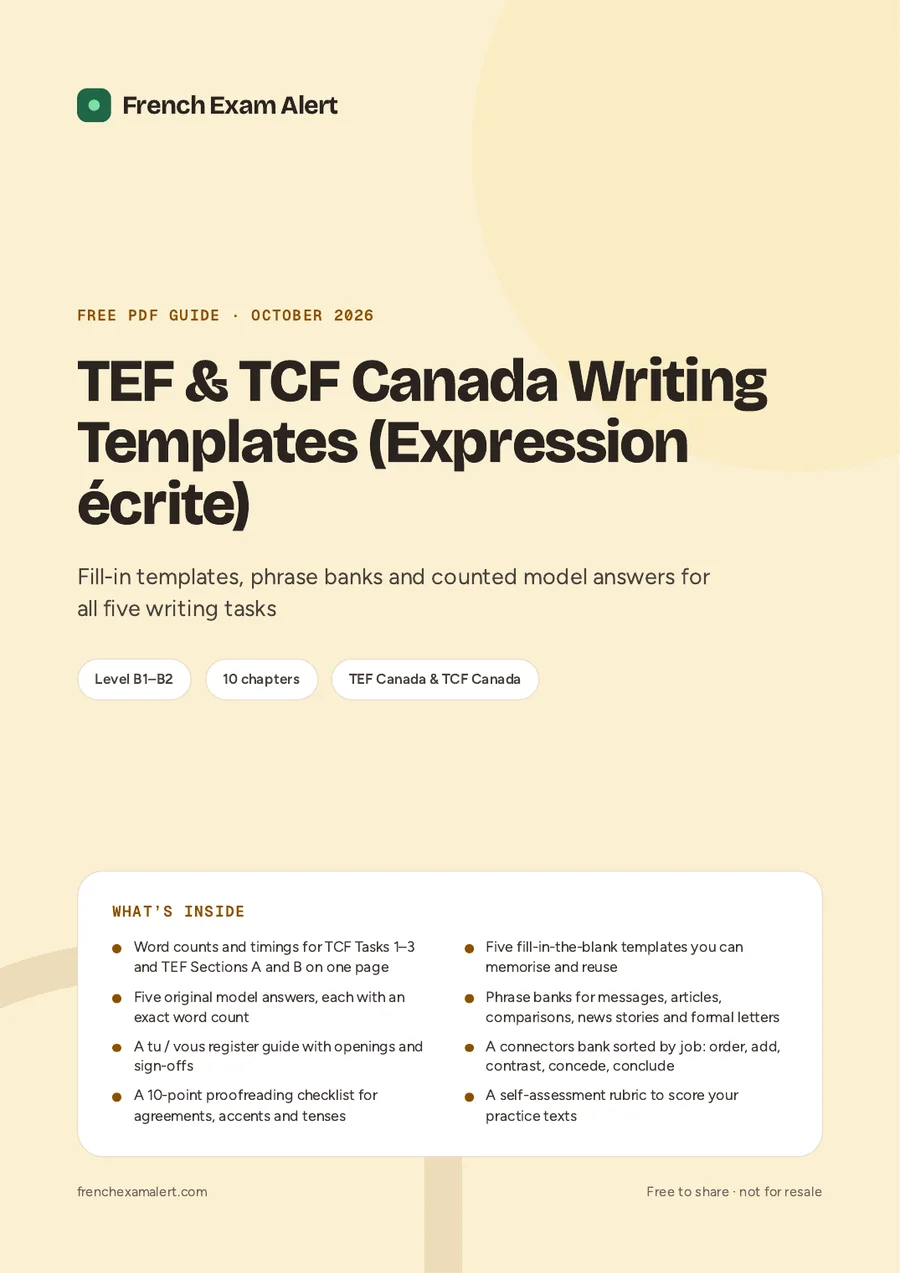 Free PDF · 28 pagesTEF & TCF Canada Writing Templates (Expression écrite)Fill-in templates, phrase banks and counted model answers for all five writing tasks
Don’t miss the next seat.
Pick your cities. We check every booking page around the clock and alert you the moment a seat opens.