The speaking mistakes that cost the most in TEF and TCF Canada are about the task, not grammar: long silences, reciting memorised scripts, answers that are too short, giving opinions without reasons, and ignoring what the examiner says. After those come tu/vous slips, anglicisms, and pronunciation that makes words hard to understand, such as nasal vowels, u versus ou and pronounced silent letters. Each one has a simple fix you can drill in a week.
Key takeaways
- A short French phrase beats a long silence every time.
- Learn structures and phrases, not whole answers.
- Answer, add a detail, add a reason: three steps, every time.
- Vous with the examiner, tu only when the role is a friend.
- Fix the sounds that change meaning first: nasals, u/ou, silent endings.
On this page
- Mistakes 1–5: what costs points in the task itself?
- Mistakes 6–8: what hurts fluency?
- Mistakes 9–10: tu or vous, and how casual can you be?
- Mistakes 11–13: which grammar and vocabulary slips are most common?
- Mistakes 14–16: which pronunciation errors hurt comprehension?
- What does an answer with these mistakes sound like?
- What should you check in the last week before the exam?
Most speaking points are lost in two places: not doing what the task asks and French that's hard to follow. The first is a strategy problem: monologues in a question task, scripts, answers that stop after one sentence. The second is a habit problem: silences, euh, anglicisms, sounds that blur into each other. Both are fixable, and the TEF marking criteria list pronunciation, vocabulary and syntax alongside how well your speech fits the situation and reacts to the examiner.
Below are 16 mistakes we see again and again, grouped by type, each with a fix or a wrong → right version. This is the speaking counterpart of our TEF and TCF writing mistakes guide. For the tasks themselves, see TCF Canada speaking tasks and TEF Canada writing and speaking.
- 16
- Common speaking mistakes, with fixes
- 12 · 15 min
- Length of the speaking test (TCF · TEF)
- 10/20 · 310
- Speaking minimum for NCLC 7 (TCF · TEF)
Mistakes 1–5: what costs points in the task itself?
#These cost the most, because good French can't make up for a task that isn't done.
| # | Mistake | Fix |
|---|---|---|
| 1 | Talking instead of asking. In TEF Section A and TCF Task 2 you're there to get information, and you spend two minutes explaining your situation. | One sentence of context, then questions. Most of your turns should end with a question mark. |
| 2 | Answering too briefly. « Oui, j'aime bien. » Then silence. Common in TCF Task 1 and in answers to the examiner's objections. | Answer, add a detail, add a reason. « Oui, j'aime beaucoup ma ville, surtout le bord de mer, parce que j'y vais courir tous les matins. » |
| 3 | Giving an opinion with no reasons. « Je pense que le télétravail est bien. » and nothing else. | Every opinion gets a reason and an example: parce que…, par exemple…, c'est pourquoi… |
| 4 | Ignoring the examiner's cues. The examiner says « ça dépend » or raises an objection, and you move to your next prepared point. | Treat every answer as material. Ask « ça dépend de quoi ? », answer the objection before you move on. |
| 5 | Reciting a memorised script. The examiner asks something slightly different, and you deliver your prepared paragraph anyway. | Memorise openings, linking phrases and closings. Build the middle live, from the question you actually got. |
Mistakes 6–8: what hurts fluency?
#| # | Mistake | Fix |
|---|---|---|
| 6 | Long silences while you search for the perfect word. | Say it another way: « comment dire… c'est un endroit où… ». Paraphrase is a skill. Silence isn't. |
| 7 | Filling every pause with euh, or with English (« um », « so », « like »). | Swap in French thinking words (see the table below). Use them, but don't use the same one every sentence. |
| 8 | Restarting the sentence after every small error. « Je suis allé… non, je suis allée… non, attends… » | Correct once if it changes meaning, then keep going. Constant restarts break fluency more than the original slip. |
| Instead of | Say | Use it to |
|---|---|---|
| euh… | Alors… / Bon… | Start an answer or a new point |
| euh, um | Voyons… / Voyons voir… | Think about a question |
| I mean | C'est-à-dire que… / Enfin, je veux dire… | Rephrase or correct yourself |
| what's the word | Comment dire… / Je cherche le mot… | Look for a word, then paraphrase |
| actually | En fait… | Add a nuance (not every sentence) |
| let's say | Disons que… | Give an approximate answer |
| good question | C'est une bonne question. Je dirais que… | Buy two seconds before an opinion |
Replace euh with real linking words: the connectors that work best when you speak.
Mistakes 9–10: tu or vous, and how casual can you be?
#| # | Wrong | Right | Why |
|---|---|---|---|
| 9 | TEF Section B, to a friend: « Vous devriez venir avec moi, je vous assure. » Then later: « Tu verras, c'est génial. » | « Tu devrais venir avec moi, je t'assure. Tu verras, c'est génial. » | Pick from the role and stay with it. TEF Section A: vous. TEF Section B: tu (a friend). TCF Tasks 1 and 3: vous. TCF Task 2: whatever the role says |
| 10 | « Ouais, genre, c'est grave cool. » | « Oui, c'est vraiment super. » | Slang and very casual forms sound wrong with an examiner, even in a friendly role-play. Natural and correct beats street |
Dropping the ne (« je sais pas ») is normal in spoken French, so don't panic if it slips out. In a formal role-play like TEF Section A, keeping it costs nothing and fits the situation better.
Mistakes 11–13: which grammar and vocabulary slips are most common?
#| Wrong | Right | English behind it |
|---|---|---|
| Je suis très excité de partir. | J'ai vraiment hâte de partir. | excited |
| Ça fait du sens. | Ça a du sens. / C'est logique. | it makes sense |
| Je suis confortable avec ça. | Je suis à l'aise avec ça. | comfortable with |
| C'est définitivement mieux. | C'est sans aucun doute mieux. / C'est vraiment mieux. | definitely |
| J'ai appliqué pour ce poste. | J'ai postulé à ce poste. | apply for |
| Je vais vous revenir là-dessus. | Je vous recontacte à ce sujet. | get back to you |
| Ça prend place samedi. | Ça a lieu samedi. | take place |
| Wrong | Right | The rule |
|---|---|---|
| Qu'est-ce que c'est le prix ? | Quel est le prix ? / C'est combien ? | Quel + être + noun for « what is the… » |
| Je voudrais savoir quand commence-t-il. | Je voudrais savoir quand il commence. | No inversion in an indirect question |
| Je voudrais savoir qu'est-ce qui est inclus. | Je voudrais savoir ce qui est inclus. | Qu'est-ce qui / que → ce qui / ce que after savoir, dire, demander |
| Où est-ce que se trouve la salle ? | Où se trouve la salle ? / Où est-ce que la salle se trouve ? | After est-ce que, keep normal order: subject, then verb |
| Il y a-t-il un parking ? | Y a-t-il un parking ? / Est-ce qu'il y a un parking ? | The inversion of il y a is y a-t-il |
| Wrong | Right | The rule |
|---|---|---|
| Je suis 32 ans. Je suis faim. | J'ai 32 ans. J'ai faim. | Age, hunger, thirst, cold and fear use avoir: avoir 32 ans, avoir faim, avoir froid, avoir peur |
| J'habite ici pour trois ans. | J'habite ici depuis trois ans. | Depuis + present for something still going on |
| Hier, je vais au marché. | Hier, je suis allé au marché. | Talk about the past in the past: passé composé for events |
| Si j'aurais plus de temps, je voyagerais. | Si j'avais plus de temps, je voyagerais. | Never the conditional right after si |
| Je pense que c'est le plus meilleur choix. | Je pense que c'est le meilleur choix. | Meilleur is already a comparative |
Questions are where many candidates slip, so drill them with the French question words chart. For opinion tasks, the French opinion phrases sheet gives you ways to state and justify a view without repeating « je pense que ».
Mistakes 14–16: which pronunciation errors hurt comprehension?
#An accent is fine. Nobody expects you to sound Parisian or Québécois. What costs points is a sound that changes the word, so the examiner has to guess. These three are the usual suspects.
| Sound | Mix-up | Pairs to practise | Tip |
|---|---|---|---|
| [ɑ̃] an / en | with [ɔ̃] | vent / vont · cent / son · lent / long | Mouth open, lips relaxed |
| [ɔ̃] on | with [ɑ̃] | bon / banc · ton / temps | Lips rounded, as for « o » |
| [ɛ̃] in / ain / un | with [ɑ̃] | vin / vent · plein / plan · teint / temps | Lips spread, like a smile |
| Nasal + n or m | Saying the n | bon [bɔ̃] / bonne [bɔn] · un [œ̃] / une [yn] | No n sound after a nasal vowel, unless another vowel follows (bonne, une) |
| Pair | Meaning | How to make the sound |
|---|---|---|
| tu / tout | you / all | For u: say « i », keep your tongue there, then round your lips |
| rue / roue | street / wheel | For ou: tongue back, lips rounded, as in English « food » |
| dessus / dessous | on top / underneath | Getting this wrong can reverse the meaning |
| vu / vous | seen / you | Record both and listen: they should sound clearly different |
| début / debout | beginning / standing | If the examiner can't tell, the sentence breaks |
| Wrong | Right | The rule |
|---|---|---|
| ils parl-ENT | ils parl(ent) [il paʁl] | The -ent of a verb in ils / elles is silent |
| beaucou-P, temp-S, tro-P | beaucoup, temps, trop | Most final consonants are silent. C, R, F, L are often pronounced (think « careful ») |
| H-ôtel, H-eure | (h)ôtel, (h)eure | The h is never pronounced |
| les / amis (with a pause) | les‿amis [lezami] | Liaison after les, des, nous, vous, ils, elles before a vowel |
| six euros, with no link [si øʁo] | six‿euros [sizøʁo] | Numbers before a vowel link: deux‿ans, trois‿heures |
What does an answer with these mistakes sound like?
#Here's a short answer to a TCF Task 3 question, « Selon vous, le télétravail est-il une bonne chose ? », first with several of the mistakes above, then fixed. Try to spot them before you read the note.
Euh… oui. Euh, je pense que c'est bien. Ouais. Parce que, euh, c'est définitivement plus confortable. Je travaille à la maison pour deux ans et, euh, je suis très excité de ne pas prendre le métro. Tu vois, c'est logique. Voilà.
Alors, personnellement, je pense que le télétravail est plutôt une bonne chose, à condition d'être bien organisé. D'abord, on gagne beaucoup de temps. Par exemple, je travaille à la maison depuis deux ans, et je ne perds plus une heure par jour dans le métro. J'utilise ce temps pour faire du sport ou pour étudier le français. Ensuite, je suis plus concentré, parce qu'il y a moins de bruit qu'au bureau. Bien sûr, certains diront qu'on se sent isolé, et c'est vrai. C'est pourquoi je pense que deux ou trois jours par semaine au bureau, c'est l'équilibre idéal.
- Myth
My accent will lower my score.
FactThe criterion is pronunciation that's clear and natural, not a native accent. What costs points is a sound that changes the word or makes you hard to follow.
- Myth
Memorising perfect answers is the safest strategy.
FactExaminers react to what you say and push you off-script on purpose. A recited answer that doesn't fit the question hurts. Memorise building blocks, not speeches.
- Myth
Every grammar mistake costs me the level.
FactSpeaking is judged on the whole performance: doing the task, interacting, range and accuracy. A steady flow with small slips usually beats careful French full of silences.
- Myth
If I don't understand the examiner, I should guess and keep talking.
FactAsking « Pardon, vous pouvez répéter ? » or « Qu'est-ce que vous voulez dire par… ? » is part of real conversation. Answering the wrong question is worse.
Spot the mistake
1 of 4.In TEF Section A, you want to know what's included. Which question is correct?
2 of 4.In TEF Section B, the examiner plays your friend. What do you say?
3 of 4.You need a second to think. What's the best filler?
4 of 4.How is « ils parlent » pronounced?
What should you check in the last week before the exam?
#Run a timed practice of your exam's speaking test every other day in the final week. The timer below runs every TEF and TCF Canada task with its real timing, and the full version is the speaking practice timer. After each run, go down this list.
Want topics to drill? Use the TEF Section A model questions, the TCF Task 2 role-play examples and the opinion topics for TEF Section B and TCF Task 3. For a random prompt by task, use the exam speaking topic generator. For ready phrases, the free French speaking phrases PDF fits on a few pages.
Speaking needs 10/20 on TCF Canada or 310/450 on TEF Canada for NCLC 7. Convert a practice score with the TCF Canada score converter or the TEF Canada score converter.
Questions people ask
Not doing the task the way it's set: monologues in the question tasks, very short answers, or opinions without reasons. Grammar matters, but these cost more.
Everyone makes some. Speaking is judged on the whole performance, so a clear, fluent answer with small slips is usually better than slow, careful French with long pauses.
No accent is penalised as such. Examiners assess whether your pronunciation is clear and easy to follow. Work on the sounds that change meaning, like nasal vowels and u versus ou.
Yes, Québec French is French. Avoid expressions that are criticised as anglicisms, like ça fait du sens, and very informal slang, and you'll be fine.
Ask: « Pardon, vous pouvez répéter, s'il vous plaît ? » or « Vous voulez dire que… ? ». It's normal conversation and much better than answering a question you weren't asked.
Record yourself and count them. Replace them one at a time with alors, bon, voyons or disons, and practise pausing silently for a second instead. It takes about a week of daily recording to notice the change.
Terms in this guide
Each one is defined in plain English in the TEF & TCF Canada glossary.
Sources
- Le français des affaires: TEF speaking sample topics and marking criteria (PDF)
- Le français des affaires: TEF speaking examiner handbook, 2024 (PDF)
- France Éducation international: TCF Canada
Rules and fees change. Always confirm with IRCC and your test centre before you pay.
Your next step
Free downloads for this
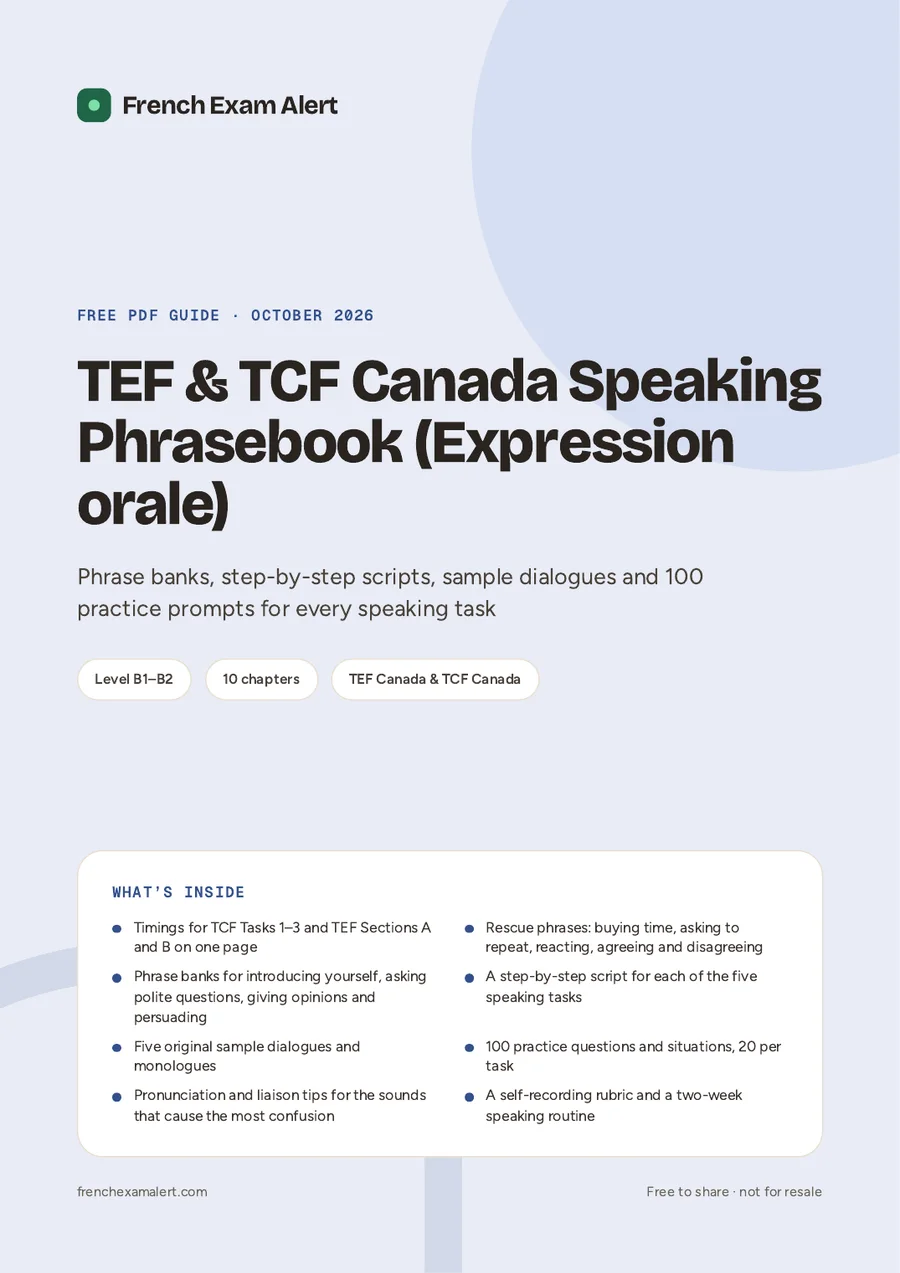 Free PDF · 29 pagesTEF & TCF Canada Speaking Phrasebook (Expression orale)Phrase banks, step-by-step scripts, sample dialogues and 100 practice prompts for every speaking task
Don’t miss the next seat.
Pick your cities. We check every booking page around the clock and alert you the moment a seat opens.