In TEF Canada speaking Section A (5 minutes), you read a short everyday ad, then phone the advertiser, played by the examiner, and ask about ten questions to get the details. The marks go to relevant, varied questions, follow-ups when the answer is vague, and a polite, formal conversation in vous. Prepare a question-word bank and a checklist of topics (price, dates, place, conditions, booking) so you never run out.
Key takeaways
- 5 minutes, a phone call about an ad, around ten questions, in vous.
- The examiner gives partial answers on purpose. Your follow-up is what scores.
- Mix est-ce que, inversion and indirect questions (J'aimerais savoir si…).
- Run through price, dates, place, conditions and booking if you blank.
- NCLC 7 needs 310/450 in speaking, Sections A and B marked together.
On this page
- What happens in TEF Canada speaking Section A?
- How is Section A marked?
- Which question forms should you use?
- What question words do you need?
- 5 sample Section A ads with model questions
- What does a full Section A call sound like?
- What do you say to open and close the call?
- What do you do when you blank in Section A?
- How should you practise Section A?
TEF Canada speaking Section A lasts 5 minutes. You get an ad from daily life (a job, a service, a leisure activity, a flat) and you call to find out more. The official instruction is three lines: you've read the ad, you're interested, you phone for more information, « Posez une dizaine de questions », and the examiner plays the person you're calling.
This guide gives you what that instruction leaves out: how the examiner is trained to react, which question forms to use, a word bank, five practice ads with 12 model questions each, a full sample call, and a plan for the moment your mind goes blank. For Section B, the 10-minute persuasion task, see TEF Canada writing and speaking and the Section B practice topics. You can also work through our persuasion topics for Section B.
- 5 min
- Length of Section A
- ~10
- Questions the instruction asks for
- 310 / 450
- TEF speaking score for NCLC 7
What happens in TEF Canada speaking Section A?
#| Element | What it is |
|---|---|
| Length | 5 minutes, then Section B (10 minutes). About 15 minutes in total |
| Document | A short ad or notice from daily life: job offer, service, leisure, housing |
| Situation | A formal role-play. You phone the advertiser to get information |
| Your job | Ask about ten precise questions, and ask for details when an answer is vague |
| The examiner | Plays the employer, landlord, seller or organiser, and answers in short |
| Register | Formal: vous, polite openings and closings |
| Format | Face to face with an examiner, and recorded. The recording is marked by Le français des affaires |
The examiner hands you the ad, checks that you understand the task and who you're talking to, starts the recording and opens the call with « Allô ? ». The official materials don't list a separate timed preparation phase for TEF Canada, so read the ad fast and have your first two questions ready before the examiner speaks. The TEF Canada exam format chart puts all four modules on one page.
How is Section A marked?
#Le français des affaires publishes the handbook its examiners use. For Section A, the communication goal « obtenir des informations » is split into three criteria:
- Pertinence du questionnement: are your questions relevant to the ad and precise?
- Prise d'initiative et gestion de l'imprévu: do you lead the call, and do you react when something unexpected comes up?
- Qualité des échanges: does it sound like a real, polite phone call?
On top of that, your French itself is marked: vocabulary, sentence structure (tenses and moods) and pronunciation. The handbook also tells examiners how to behave, and that's the most useful thing you can know before the test:
So a vague answer is not a problem. It's an invitation. « Cela dépend » is your cue to ask « Ça dépend de quoi ? » and pick up points for follow-up and initiative.
Which question forms should you use?
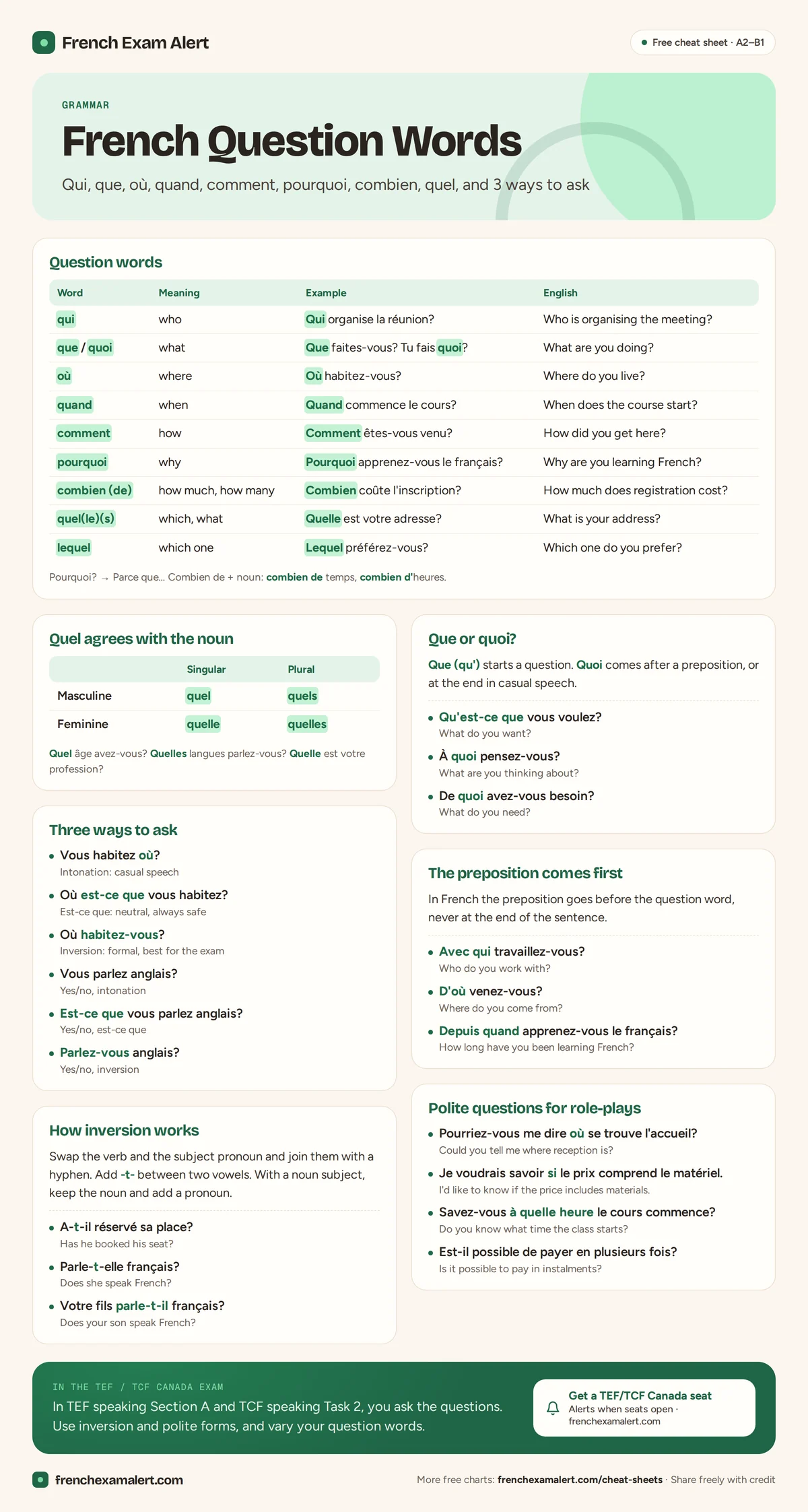
#Ten questions that all start with « Est-ce que… » show a narrow range. Mix the forms below. Inversion and indirect questions sound more formal, which fits a call to a business.
| Form | Example | When to use it |
|---|---|---|
| Intonation only | Le parking est gratuit ? | Quick follow-ups. Fine in speech, but don't use it for every question |
| Est-ce que | Est-ce que le parking est gratuit ? | Your safe default. Works with any question word: Où est-ce que… ? |
| Inversion | Le parking est-il gratuit ? / Proposez-vous des cours le soir ? | Formal and precise. Add -t- between vowels: Y a-t-il… ? A-t-elle… ? |
| Indirect question | J'aimerais savoir si le parking est gratuit. | Polite openers. No inversion and no est-ce que after savoir si / savoir où |
| Polite conditional | Pourriez-vous me dire si le parking est gratuit ? | Asking for a favour or a detail. Very natural on the phone |
What question words do you need?
#| French | Meaning | Section A example |
|---|---|---|
| Combien… ? | How much / how many | Combien coûte l'inscription ? |
| Combien de temps… ? | How long | Combien de temps dure la formation ? |
| Quand… ? / À quelle heure… ? | When / at what time | À quelle heure commence le premier cours ? |
| À partir de quand… ? / Jusqu'à quand… ? | From / until when | Jusqu'à quand l'offre est-elle valable ? |
| Depuis quand… ? | Since when | Depuis quand l'appartement est-il libre ? |
| Où… ? / D'où… ? | Where / from where | D'où part le bus ? |
| Comment… ? | How | Comment se passe l'inscription ? |
| Pourquoi… ? | Why | Pourquoi vendez-vous la voiture ? |
| Qui… ? / Avec qui… ? | Who / with whom | Qui donne les cours ? |
| Quel / Quelle / Quels / Quelles… ? | Which / what | Quels sont vos horaires ? Quelle est la durée du bail ? |
| Lequel / Laquelle… ? | Which one | Vous avez deux formules : laquelle est la plus adaptée aux débutants ? |
| Qu'est-ce qui… ? / Que… ? | What (subject / object) | Qu'est-ce qui est compris dans le prix ? Que faut-il apporter ? |
| De quoi… ? | Of / on what | Ça dépend de quoi ? |
| Y a-t-il… ? / Est-il possible de… ? | Is there / is it possible to | Est-il possible de payer en plusieurs fois ? |
Print the French question words chart and keep it next to you while you practise. After a week it should be in your head, not on paper.
5 sample Section A ads with model questions
#Each ad below is original, in the style of the official samples. Read the ad, try your own ten questions out loud first, then compare. The model questions mix forms on purpose, and each set covers the same core topics: availability, price, time, place, conditions, next step.
Ad 1: a new gym
FORME+ : nouvelle salle de sport en centre-ville Musculation, cardio, cours collectifs. Ouvert 7 jours sur 7. Offre de lancement : le premier mois offert ! Renseignements : 514 555 0172
- Bonjour, j'appelle au sujet de votre annonce pour la nouvelle salle de sport. Je pourrais avoir quelques renseignements ?
- Où se trouve exactement la salle ? Est-ce qu'il y a un parking à proximité ?
- Quels sont vos horaires d'ouverture en semaine et le week-end ?
- Quels types de cours collectifs proposez-vous ?
- Faut-il réserver sa place pour les cours, ou peut-on venir quand on veut ?
- Combien coûte l'abonnement après le premier mois offert ?
- Est-ce que je dois m'engager pour un an, ou est-ce qu'il existe un abonnement au mois ?
- Avez-vous des tarifs réduits pour les étudiants ou pour les couples ?
- Y a-t-il des coachs pour aider les débutants à utiliser les machines ?
- Les vestiaires sont-ils équipés de douches et de casiers ?
- J'aimerais savoir ce que je dois apporter pour m'inscrire.
- Est-il possible de faire une séance d'essai avant de me décider ?
Ad 2: a flat to rent
À louer : 4 ½ lumineux, 70 m², proche métro Libre le 1er décembre. 1 250 $ par mois. Contactez M. Gagnon : 438 555 0119
- Bonjour monsieur, je vous appelle à propos de l'appartement à louer. Est-il toujours disponible ?
- À quel étage se trouve l'appartement ? Y a-t-il un ascenseur ?
- L'annonce dit « 4 ½ » : il y a donc deux chambres fermées ?
- Est-ce que le chauffage et l'électricité sont compris dans le loyer ?
- L'appartement est-il meublé, ou est-ce qu'il est vide ?
- La cuisine est-elle équipée ? Il y a un réfrigérateur et une cuisinière ?
- À combien de minutes à pied se trouve la station de métro ?
- Les animaux sont-ils acceptés ? J'ai un petit chat très calme.
- Quelle est la durée du bail ?
- Pourriez-vous me dire quels documents je dois fournir pour mon dossier ?
- Y a-t-il une buanderie dans l'immeuble, ou des branchements pour une laveuse ?
- Quand est-ce que je pourrais visiter l'appartement ?
Ad 3: an intensive French course
École Horizon : cours intensifs de français, tous niveaux Petits groupes. Session d'hiver : début le 12 janvier. Attestation remise en fin de session. Inscriptions : info@ecole-horizon.ca
- Bonjour madame, j'ai vu votre annonce pour les cours intensifs et j'aimerais en savoir un peu plus.
- Comment déterminez-vous le niveau des élèves ? Y a-t-il un test avant l'inscription ?
- Combien d'élèves y a-t-il par groupe, au maximum ?
- Combien d'heures de cours y a-t-il par semaine ?
- Est-ce que les cours ont lieu le matin, l'après-midi ou le soir ?
- Combien de temps dure la session d'hiver ?
- Quel est le prix total ? Les manuels sont-ils inclus ?
- Est-il possible de payer en plusieurs fois ?
- Proposez-vous aussi une préparation au TEF Canada ?
- Qui sont les professeurs ? Ils ont tous une formation en français langue étrangère ?
- Si je manque quelques cours pour mon travail, est-ce que je peux les rattraper ?
- Jusqu'à quand peut-on s'inscrire pour la session de janvier ?
Ad 4: a weekend trip
Escapade à Québec : 3 jours en autocar au départ de Montréal Hôtel 3 étoiles, visites guidées. À partir de 349 $ par personne. Agence Évasion : 1 800 555 0144
- Bonjour, je vous téléphone au sujet de votre week-end à Québec. Pourriez-vous me donner quelques précisions ?
- Quelles sont les prochaines dates de départ ?
- D'où part l'autocar, et à quelle heure ?
- Que comprend exactement le prix de 349 $ ?
- Les repas sont-ils inclus, ou seulement le petit-déjeuner ?
- L'annonce dit « à partir de 349 $ ». Ça dépend de quoi ?
- Combien de personnes y a-t-il dans le groupe, en général ?
- Quelles visites sont prévues au programme ?
- Est-ce qu'il reste du temps libre pour se promener seul ?
- Est-il possible d'avoir une chambre individuelle ? Ça coûte combien de plus ?
- Que se passe-t-il si je dois annuler ? Est-ce que je suis remboursé ?
- Comment est-ce que je peux réserver ? Faut-il verser un acompte ?
Ad 5: a second-hand car
À vendre : berline 2019, 85 000 km, très bon état Entretien régulier, pneus d'hiver inclus. 15 500 $, prix à discuter. Appelez Sophie : 819 555 0163
- Bonjour madame, je vous appelle pour la voiture que vous vendez. Elle est toujours disponible ?
- Pourquoi vendez-vous cette voiture ?
- Depuis quand l'avez-vous ? Vous êtes la première propriétaire ?
- A-t-elle déjà eu un accident ?
- Est-ce que vous avez le carnet d'entretien et les factures des réparations ?
- Elle consomme combien d'essence, à peu près ?
- Les pneus d'hiver sont dans quel état ? Ils ont combien d'années ?
- La garantie du constructeur est-elle encore valable ?
- J'aimerais savoir s'il y a des réparations à prévoir prochainement.
- Le prix est à discuter : quel serait votre dernier prix ?
- Est-ce que je pourrais l'essayer et la faire vérifier par un mécanicien ?
- Où et quand est-ce qu'on pourrait se rencontrer ?
What does a full Section A call sound like?
#Here is the flat from Ad 2 as a real exchange. Watch what the candidate does with each partial answer: she never moves on until she has the detail.
Examinateur : Allô ? Candidate : Bonjour monsieur, je vous appelle au sujet de l'annonce pour le 4 ½ près du métro. Est-il toujours disponible ? Examinateur : Oui, tout à fait. Candidate : Très bien. Est-ce que le loyer de 1 250 $ comprend les charges ? Examinateur : Ça dépend des charges. Candidate : D'accord. Qu'est-ce qui est compris, alors ? Le chauffage, par exemple ? Examinateur : Le chauffage, oui, mais pas l'électricité. Candidate : Et l'électricité coûte combien par mois, à peu près ? Examinateur : Il faut compter une soixantaine de dollars. Candidate : Bon, c'est raisonnable. L'annonce dit « proche métro » : c'est à combien de minutes à pied ? Examinateur : Cinq minutes. Par contre, il y a des travaux dans la rue en ce moment. Candidate : Ah bon ? Ils vont durer combien de temps ? Est-ce que c'est bruyant pendant la journée ? Examinateur : Jusqu'en janvier, et seulement en semaine. Candidate : Je vois. Moi, je travaille de jour, donc ça ira. Les animaux sont-ils acceptés ? J'ai un petit chat. Examinateur : Il faudra en parler avec le propriétaire. Candidate : Vous n'êtes pas le propriétaire ? Vous pourriez lui poser la question pour moi ? Examinateur : Oui, bien sûr. Candidate : Merci. Pourriez-vous aussi me dire quels documents je dois fournir pour le dossier ? Examinateur : Une pièce d'identité et une preuve de revenus. Candidate : Parfait. Une dernière chose : quand est-ce que je pourrais visiter ? Examinateur : Excusez-moi, j'ai un autre appel. Je peux vous rappeler plus tard ? Candidate : Bien sûr. Je vous laisse mon numéro : 438 555 0187. Merci beaucoup, bonne journée !
What do you say to open and close the call?
#| Moment | Phrase |
|---|---|
| Opening | Bonjour madame / monsieur, je vous appelle au sujet de votre annonce pour… |
| Opening | J'ai vu votre annonce sur Internet et j'aimerais avoir quelques renseignements. |
| Reacting | Ah, d'accord. / Je vois. / C'est intéressant. / Ah bon ? Pourquoi ? |
| Asking for detail | C'est-à-dire ? / Ça dépend de quoi ? / Vous pourriez préciser ? |
| Checking | Si j'ai bien compris, le prix comprend… c'est bien ça ? |
| Not understood | Excusez-moi, je n'ai pas bien entendu. Vous pouvez répéter, s'il vous plaît ? |
| Closing | Merci beaucoup pour ces informations. Je vais réfléchir et je vous rappelle. |
| Closing | Parfait, je passerai jeudi alors. Bonne journée, au revoir ! |
For more ready-made phrases across all speaking tasks, the free French speaking phrases PDF has them on a few printable pages.
What do you do when you blank in Section A?
#Everyone freezes for a second at some point. The fix is to have a route through the topics that doesn't depend on memory of the ad. French teachers use QQOQCCP: qui, quoi, où, quand, comment, combien, pourquoi. Run through it and you'll always find the next question.
- 1React to the last answerThe easiest next question is hidden in what the examiner just said. « Vous avez dit plusieurs formules : lesquelles ? »
- 2Check what you've heard« Si j'ai bien compris, le cours a lieu le soir, c'est bien ça ? » buys you time and counts as clarifying.
- 3Go round QQOQCCPQui (who teaches, who to contact), quoi (what's included), où, quand, comment (booking, payment), combien, pourquoi.
- 4Ask about conditionsEngagement, cancellation, refund, deposit, documents, age limits. Every ad has conditions.
- 5Ask about the next step« Comment est-ce que je peux m'inscrire ? », « Quand est-ce qu'on peut se voir ? » These also make a natural close.
- Myth
If I ask exactly ten questions, I've done the task.
FactThe count is a guide. The criteria are relevance, initiative and the quality of the exchange. Ten questions read from a list, with no reaction to the answers, score lower than eight good ones with follow-ups.
- Myth
The examiner's vague answers mean they're not cooperating.
FactPartial answers are in the examiner handbook on purpose. They test whether you ask for clarification. Treat every « ça dépend » as a gift.
- Myth
Casual French is fine because it's a phone call.
FactThe handbook describes Section A as a formal conversation. Use vous, bonjour madame / monsieur, and polite forms. Save tu for Section B, where the examiner plays a friend.
How should you practise Section A?
#Take any real ad (a gym flyer, a rental listing, a course page), give yourself 30 seconds to read it, then talk for 5 minutes against the clock. Record it. Count your questions, and mark which ones were follow-ups. The timer below runs Section A and B with practice ads. The full version is the speaking practice timer.
No partner? The guide to practising French speaking alone shows how to play the examiner with answer cards. The official sample ads are linked in our free TEF and TCF practice tests guide. For a random Section A prompt, use the TEF speaking topic generator. Taking TCF Canada instead? Its equivalent is Task 2, with 2 minutes of preparation: see the TCF Canada speaking Task 2 examples.
When you get a practice score, check it against the TEF Canada score chart: speaking needs 310/450 on the ancien score for NCLC 7 and 349 for NCLC 8.
Asking where something is? Get à, en and au right with the French prepositions for places chart.
Questions people ask
The official materials don't describe a separate timed preparation phase. The examiner gives you the ad and checks you understand the task before the 5 minutes start, so read quickly and have your first questions ready.
Yes. You read the ad and refer to it during the call, and the examiner collects it at the end. Use it to pick questions, not to read sentences aloud.
Answer it briefly and naturally, then go back to asking. Examiners are trained not to reverse the roles, so it will be rare and short.
Vous. Section A is a formal call to a business or a stranger. Tu is for Section B, where the examiner plays your friend.
Everyday ads: job offers, services, leisure activities, housing and things for sale. The official samples include a carer job, a hiking holiday, extras for a musical and second-hand furniture.
Terms in this guide
Each one is defined in plain English in the TEF & TCF Canada glossary.
Sources
- Le français des affaires: TEF speaking sample topics and marking criteria (PDF)
- Le français des affaires: TEF speaking examiner handbook, 2024 (PDF)
- Le français des affaires: TEF Canada presentation
Rules and fees change. Always confirm with IRCC and your test centre before you pay.
Your next step
Free downloads for this
 Free PDF · 29 pagesTEF & TCF Canada Speaking Phrasebook (Expression orale)Phrase banks, step-by-step scripts, sample dialogues and 100 practice prompts for every speaking task
Don’t miss the next seat.
Pick your cities. We check every booking page around the clock and alert you the moment a seat opens.